
How Sheep Manure Turns into Nutrient Rich Fertilizer
16 July 2026
Sheep dunged nutrient-rich organic fertilizer for plants, made with the help of maggots. Built on community empowerment and a zero-waste principle.



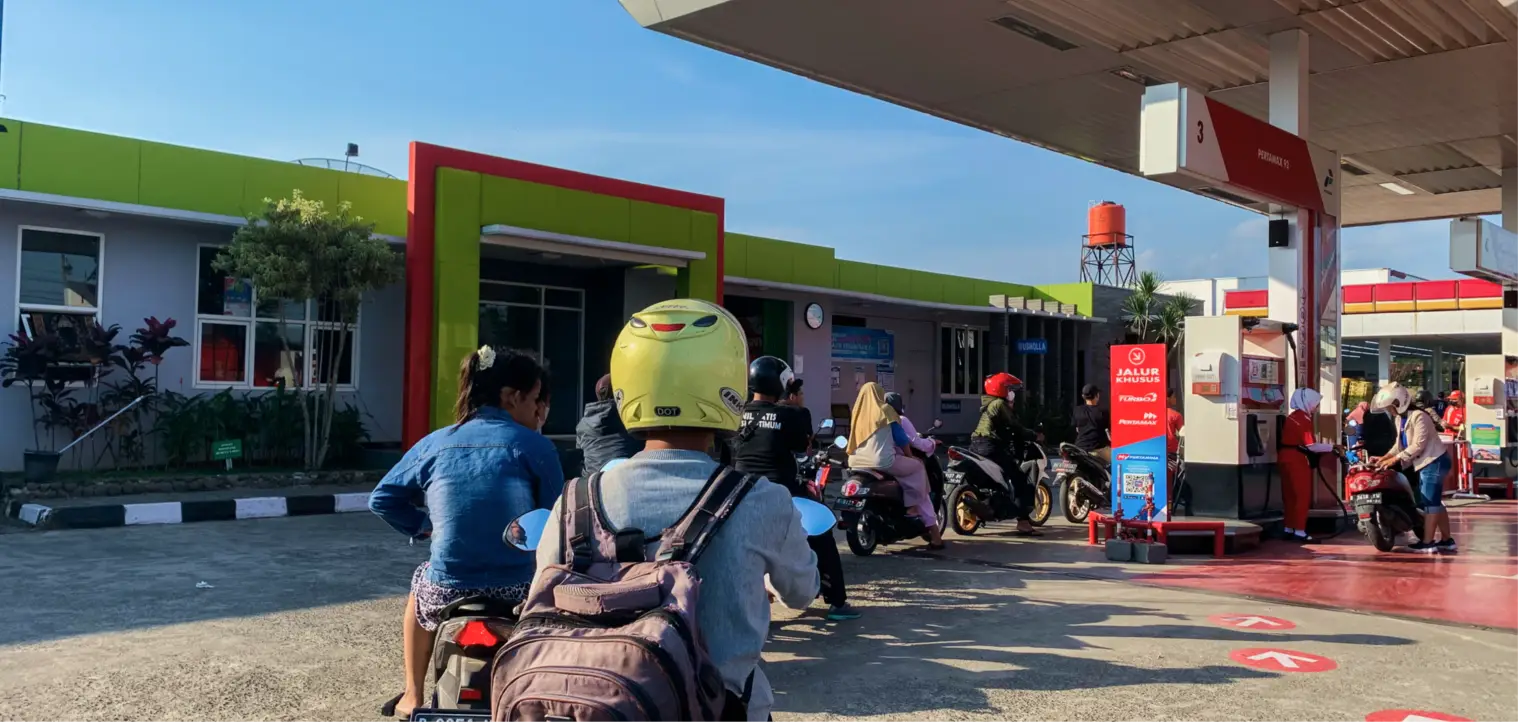
The closure of the Strait of Hormuz due to the US-Iran-Israel war has driven global oil prices upward. Brent crude oil even reached USD 116 in early March.
Fuel prices have already risen in several countries in 2026. Prices increased by 67.81 percent in Cambodia, followed by Vietnam at 49.73 percent, Laos at 32.94 percent, Australia at 16.55 percent, and Singapore at 15.69 percent.
Akbar Pratama Kartika, S.E., M.SE., a Development Economics lecturer at Universitas Muhammadiyah Surakarta (UMS), explained that the Strait of Hormuz is one of the most crucial trade routes for global oil and gas distribution. Its closure creates a domino effect on the global economy.
"About 20 percent of crude oil trade passes through the Strait of Hormuz," said Akbar on Tuesday (31/3/2026).
Akbar stated that the closure of the Strait of Hormuz could trigger widespread impacts on the global economy, affecting sectors ranging from manufacturing and goods distribution to agriculture.
Rising fuel prices create a chain reaction, increasing production and distribution costs, as fuel is essential for both industrial machinery and logistics.
The impact will be felt by the public in both primary and secondary needs. As a result, prices of goods will continue to rise, forcing people to spend more to sustain their daily lives.
"Imagine, factory production costs will also rise. The impact is that product prices will also increase. At the end of the day, consumers will bear the burden," he explained.
In addition to fuel prices, the agricultural sector is also at risk. The Strait of Hormuz plays a key role in the global fertilizer supply chain, with around 33 percent of the world's fertilizer transported through this route.
According to Akbar, this situation will affect economies that rely heavily on agriculture. "If the flow of these products is disrupted and cannot be distributed properly, it will lead to supply shortages in the market, which in turn drives prices up," he added.
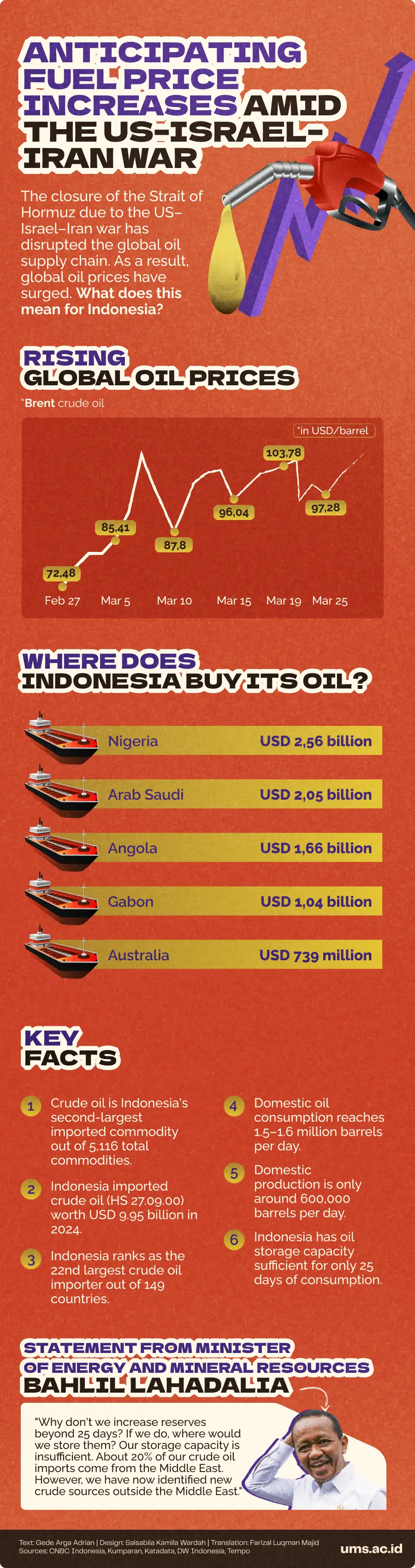
Fuel prices in Indonesia are predicted to rise in April 2026 in line with increasing global oil prices. Plans for a domestic fuel price adjustment have been circulating over the past week.
Prof. Dr. Anton Agus Setyawan, S.E., M.Si., a lecturer in the Master of Managementt program at UMS, stated that the fuel subsidy assumption in Indonesia's 2026 State Budget (APBN) is set at USD 70 per barrel. This is lower than current global oil prices, which range between USD 90 and USD 103.
Rising global oil prices, he said, could risk widening Indonesia's 2026 state budget (APBN) deficit. Adjustments are necessary to ensure the deficit remains under control.
"The government will have to cover the fuel price shortfall," he explained.
Despite the need for adjustments, Anton emphasized that the government must uphold fairness. One way is by ensuring that subsidized fuel prices remain affordable for low-income communities.
Subsidized fuel prices should not rise significantly and must continue to receive government support. "The calculations must be very precise," he added.
Fuel price adjustments are a crucial short-term step to maintain fiscal stability. At the same time, Anton encouraged the government to accelerate energy diversification efforts.
"Indonesia has actually taken concrete steps in energy diversification. For example, our subsidized diesel now implements the B40 biodiesel program, which consists of 60 percent fossil diesel and 40 percent palm oil," Anton explained.
This diversification reduces dependence on oil imports. From an energy security perspective, he believed Indonesia has made significant progress.
Beyond biodiesel, energy transition efforts can also involve geothermal energy, solar panels, and bioethanol or other biofuels.
According to Anton, energy diversification is a vital medium- to long-term solution to address fuel price volatility driven by global geopolitical conditions.
"If we are now successful with B40, then our target for 2026 is to move toward B50. This means 50 percent of our fuel will come from domestic palm oil and 50 percent from fossil sources," he concluded.
Writer: Gede Arga Adrian
Translator: Farizal Luqman Majid
Editor: Al Habiib Josy Asheva
Sheep dunged nutrient-rich organic fertilizer for plants, made with the help of maggots. Built on community empowerment and a zero-waste principle.
Nothing’s more special than reading curated news just for you.
Subscribe to the UMS Newsletter for free today.