
How Sheep Manure Turns into Nutrient Rich Fertilizer
16 July 2026
Sheep dunged nutrient-rich organic fertilizer for plants, made with the help of maggots. Built on community empowerment and a zero-waste principle.




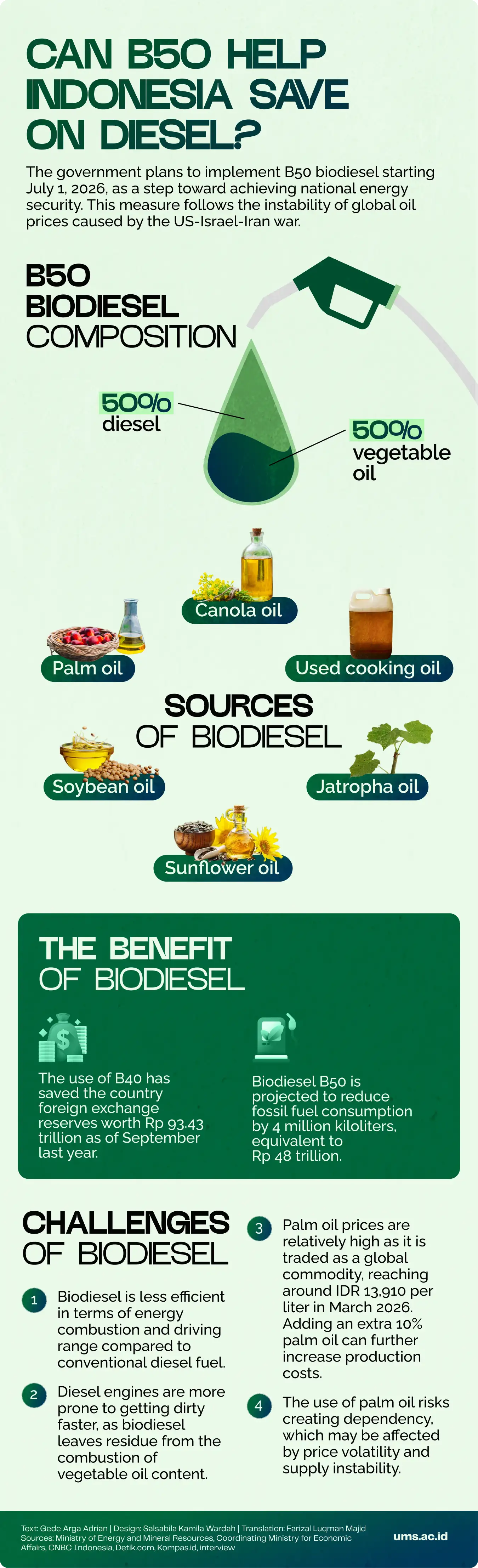
The government plans to implement B50 biodiesel starting July 1, 2026. The government argued that this measure serves as a buffer to mitigate the volatility of global oil prices caused by the US-Israel-Iran war.
Testing of B50 biodiesel continues to be conducted by the Ministry of Energy and Mineral Resources (ESDM) on various vehicles, including mining heavy equipment.
Director General of New, Renewable Energy, and Energy Conservation at the Ministry of ESDM, Eniya Listiani Dewi, said the implementation of B50 is an important step in promoting national energy independence.
"By utilizing domestic resources, we are not only strengthening energy security but also adding value to the national economy," Eniya said, as quoted by (16/4/2026).
A similar view was expressed by the Coordinating Ministry for Economic Affairs, which claims that B50 biodiesel can save 4 million kiloliters of fossil fuel consumption, equivalent to Rp48 trillion.
Biodiesel is a renewable fuel for diesel engines derived from vegetable oils, such as palm oil or jatropha oil. The implementation of biodiesel in Indonesia began in 2006. The legal basis for its implementation is stipulated in Law Number 30 of 2007 on Energy.
Biodiesel implementation started with B5, consisting of 5 percent palm oil. The palm oil composition has continued to increase over time, progressing from B10, B20, B30, to B40.
B40 biodiesel consists of 60 percent diesel and 40 percent palm oil. Indonesia implemented B40 biodiesel on January 1, 2025. The government claims that B40 implementation successfully saved Rp93.43 trillion in foreign exchange as of September last year.
The government had originally planned to implement B50 biodiesel by 2027 at the latest. However, due to unstable global oil prices caused by the US-Israel-Iran war, the government decided to accelerate B50 biodiesel implementation to July 1, 2026.
Rois Fatoni, S.T., M.Sc., Ph.D., Deputy for Research, Innovation, and Intellectual Property Center at Universitas Muhammadiyah Surakarta, said the government's move to implement B50 biodiesel is a strategy to reduce dependence on global oil.
The approach involves finding additional vegetable-based fuels that can reduce fuel imports. "These vegetable oils can be obtained from palm oil grown in Indonesia," said Rois when met at his office o Thursday.
However, the UMS Chemical Engineering lecturer noted that the use of biodiesel in diesel engines presents several challenges.
Biodiesel has a significantly lower calorific value compared to pure diesel. As a result, biodiesel consumption tends to be higher than diesel to cover the same distance.
"For the same one liter, biodiesel produces less energy because it contains oxygen compounds. Meanwhile, pure diesel consists only of carbon and hydrogen elements," he explained.
The use of biodiesel can cause diesel engine fuel filters to become dirty more quickly, requiring more frequent replacement. Rois said this is due to the more complex organic compounds in vegetable oil compared to petroleum compounds. "All biodiesel is like that," he added.
On the other hand, using palm oil in higher compositions tends to be less economical. This is because the price of palm oil commodities is higher than diesel.
The market index price of Fatty Acid Methyl Ester (FAME) based on crude palm oil reaches Rp13,910 per liter, higher than conventional diesel, which ranges from Rp11,000 to Rp12,100 per liter. "This is because palm oil is already an international commodity," he added.
Rois also noted that the use of palm oil in the B50 biodiesel composition risks creating dependency. This poses a risk if there are price fluctuations and disruptions to domestic palm oil supply, as occurred in 2022.
Rois encouraged the government and academics in Indonesia to explore alternative vegetable oil sources that can replace palm oil in biodiesel composition. "The role of universities is to explore," he stressed.
One example is oil from the jatropha plant. This type of oil has been used in the automotive world, including as aircraft lubricant during the Japanese occupation from 1942 to 1945.
From an economic perspective, Rois noted that jatropha oil is not yet classified as an international commodity. This means jatropha oil prices have the potential to be cheaper as they are not yet influenced by global commodity prices.
However, the use of jatropha oil still requires further support from various parties. This is because jatropha agricultural land is not yet as extensive as palm oil plantations. As a result, the transition from palm oil to jatropha oil may take even longer.
Writer: Gede Arga Adrian
Translator: Farizal Luqman Majid
Editor: Al Habiib Josy Asheva
Sheep dunged nutrient-rich organic fertilizer for plants, made with the help of maggots. Built on community empowerment and a zero-waste principle.
Nothing’s more special than reading curated news just for you.
Subscribe to the UMS Newsletter for free today.