
The Sin of Football Betting
26 June 2026
Amid the FIFA World Cup 2026 euphoria, football betting is also spreading through digital platforms and conventional means.

The label “one of the dirtiest countries in the world” has recently been attached to Indonesia after a 2025 report by Ultimate Kilimanjaro ranked it among the top 10 dirtiest nations, with a pollution score of 58.75, even worse than Mongolia and Haiti. The assessment was based on four key indicators: air quality, water quality, waste management, and sanitation.
Indonesia’s waste management problem has never been fully resolved. According to Tempo, between 2020 and 2024, the amount of waste successfully processed never reached half of the total waste produced.
In fact, the National Medium-Term Development Plan (RPJMN) targets all waste in Indonesia to be fully managed by 2029, whether through reduction, sorting, or recycling efforts.
However, according to Dr. Efri Roziaty, S.Si., M.Si., an environmental activist from the Center for Environmental Studies of Universitas Muhammadiyah Surakarta (UMS), the reality tells a different story.
“Indonesia is still struggling to manage its waste. If you want to see the face of the nation’s waste crisis firsthand, a visit to the Piyungan Landfill in Yogyakarta is more than enough,” Efri said.
There, she continued, mountains of garbage have piled up year after year. Various processing efforts have been attempted, but none have proven effective. The daily volume of incoming waste is simply too large for the available system to handle.
“The situation in Piyungan isn’t an isolated case. In many major cities such as Jakarta, Surabaya, and other urban centers, landfills are already nearing their maximum capacity,” added the UMS Biology Education lecturer.
At the same time, waste sorting and transport systems for organic, inorganic, and hazardous materials remain weak at the source level. As a result, everything ends up mixed together into one massive waste stream that is nearly impossible to manage.
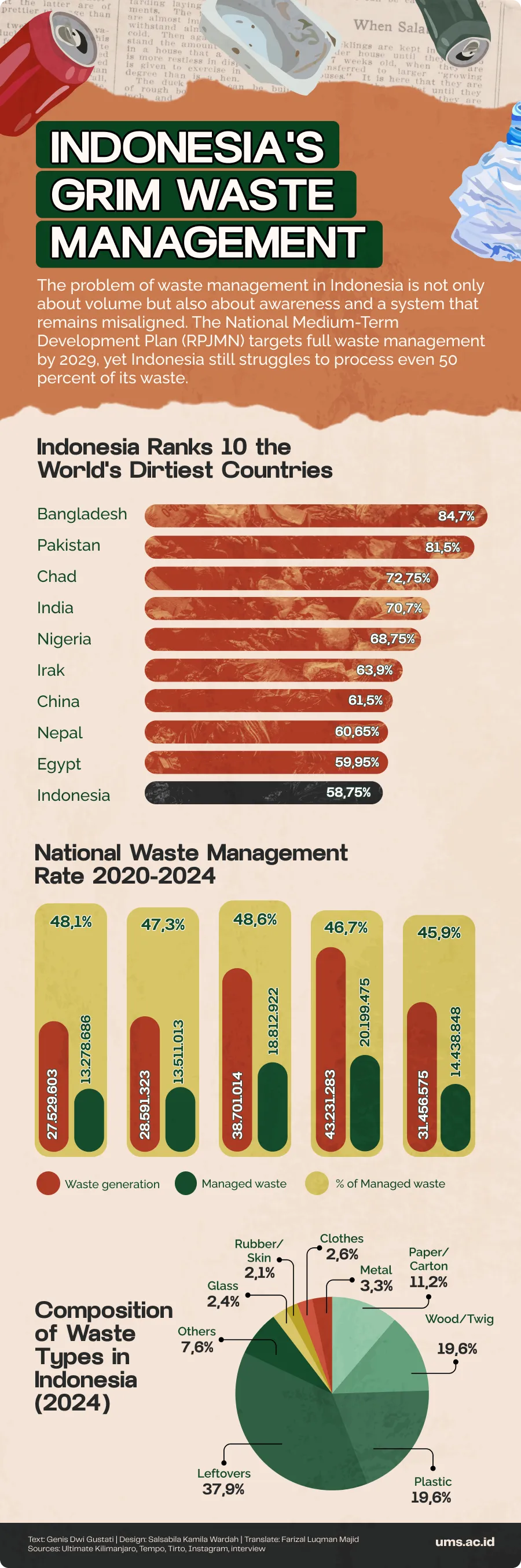
A 2023 report by the Ministry of Environment and Forestry (KLHK) revealed that plastic waste accounts for more than 18 percent or around 10 million tons of Indonesia’s total waste. The figure continues to rise in line with the increasingly consumptive lifestyle of urban communities.
Household waste remains the largest contributor, making up about 40 percent of total waste, followed by industrial waste, which significantly contributes to water and soil pollution.
According to Efri, the root of the problem lies in the imbalance between consumption levels and waste management capacity. “The number of people producing waste far exceeds the number of people capable of managing it,” she explained.
Efri believed that the Zero Waste policy and the 3R (Reduce, Reuse, Recycle) concept are already well-formulated, yet remain ineffective due to low public awareness. Hence, behavioral change is key.
“Zero Waste has long been introduced, but it hasn’t worked effectively because there’s a lack of on-the-ground mechanisms,” she said.
Meanwhile, other existing policies do not offer strong enough incentives or penalties to drive behavioral change. Without systemic encouragement, recycling campaigns and plastic reduction efforts will continue to struggle against deeply rooted consumptive habits.
From a policy standpoint, Indonesia already has Law No. 18 of 2008 on Waste Management, along with derivative programs such as Jakstranas and Jakstrada However, according to Efri, their implementation remains patchy and inconsistent.
At the Faculty of Teacher Training and Education (FKIP) UMS, Efri and her Biology Education students are conducting experiments on household-scale organic waste management. They process leftover vegetables, fruits, and other organic materials into liquid fertilizer, compost, and eco-enzyme.
“Recycling waste, that’s what we’re doing,” she explained. “We test the fertilizers produced from waste on chili plants, and the results have proven to be useful. We routinely monitor their growth from planting to harvesting, noting the increase in height and yield after fertilization.”
Efri believed that this kind of approach can be the entry point for change. “If every household can manage its own waste, the pressure on landfills will decrease. Even boarding house residents can start small,” she said optimistically.
Communities like Pandawara Group, known for their regular content cleaning up garbage-clogged rivers, show that change can come from anyone, but sadly not many are like them.
“The plastic waste, or any kind of waste, they collect today often comes back tomorrow. Even in areas that were just cleaned, new piles reappear within days,” she said regretfully.
Such conditions indicate that a system of collective awareness has yet to form among Indonesians. Many still believe that waste management is the government’s responsibility, not their own.
Efri shared a nearby example: “Even in housing complexes, some people refuse to pay the cleanliness fee and instead dump their trash carelessly on someone else’s empty land.”
She also emphasized that waste management is not only about behavior, but also about policy direction and law enforcement. “Public awareness hasn’t reached a massive scale yet. Therefore, stronger policy enforcement and stricter regulations are necessary,” Efri advised.
The government, she argued, must have the courage to implement a reward-and-punishment system for communities, institutions, and even universities that contribute to environmental management. Campuses, for instance, can foster environmental awareness through creative initiatives led by lecturers and students.
Efri also highlighted the tug-of-war between government priorities and environmental concerns. “The government wants to focus on building infrastructure, while environmental advocates want the opposite,” she said with a soft chuckle.
Without consistent law enforcement, such patterns will continue to repeat. Efri said that people generally comply only when firm sanctions are imposed, making stricter regulations necessary to create a real deterrent effect.
“Industrial and household waste remain our collective homework. At the very least, we must stop contributing to pollution ourselves. That’s the minimum,” Efri concluded firmly.
Writer: Genis Dwi Gustati
Translator: Farizal Luqman Majid
Editor: Al Habiib Josy Asheva
Amid the FIFA World Cup 2026 euphoria, football betting is also spreading through digital platforms and conventional means.
Nothing’s more special than reading curated news just for you.
Subscribe to the UMS Newsletter for free today.