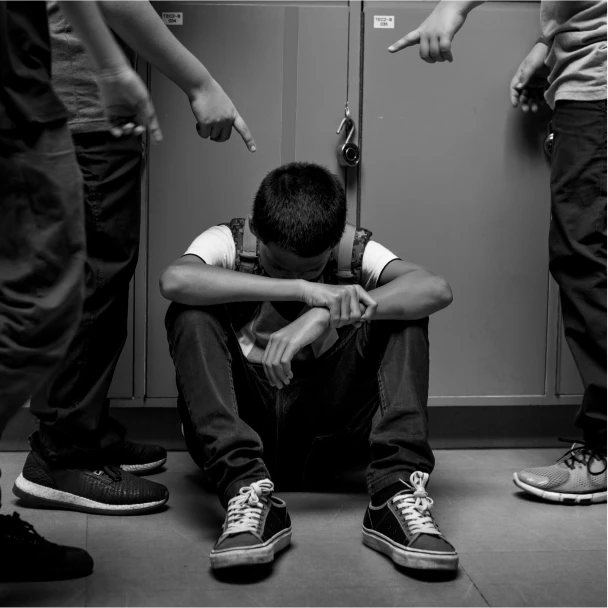
Beware of Brain Rot Symptoms
31 December 2024
Brain rot, or cognitive decay, is increasingly affecting Generation Z and Millennials due to technology addiction. What are the solutions?


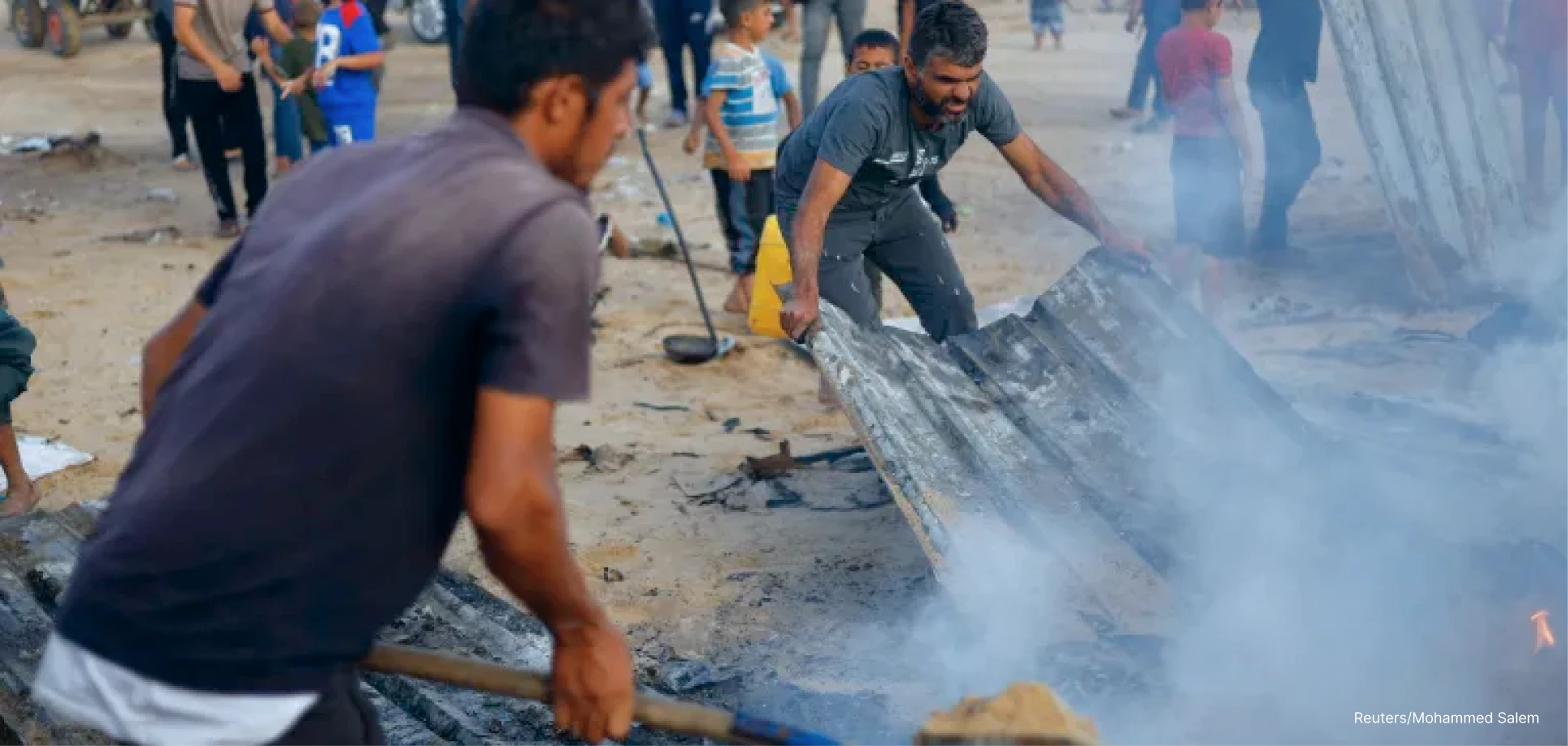
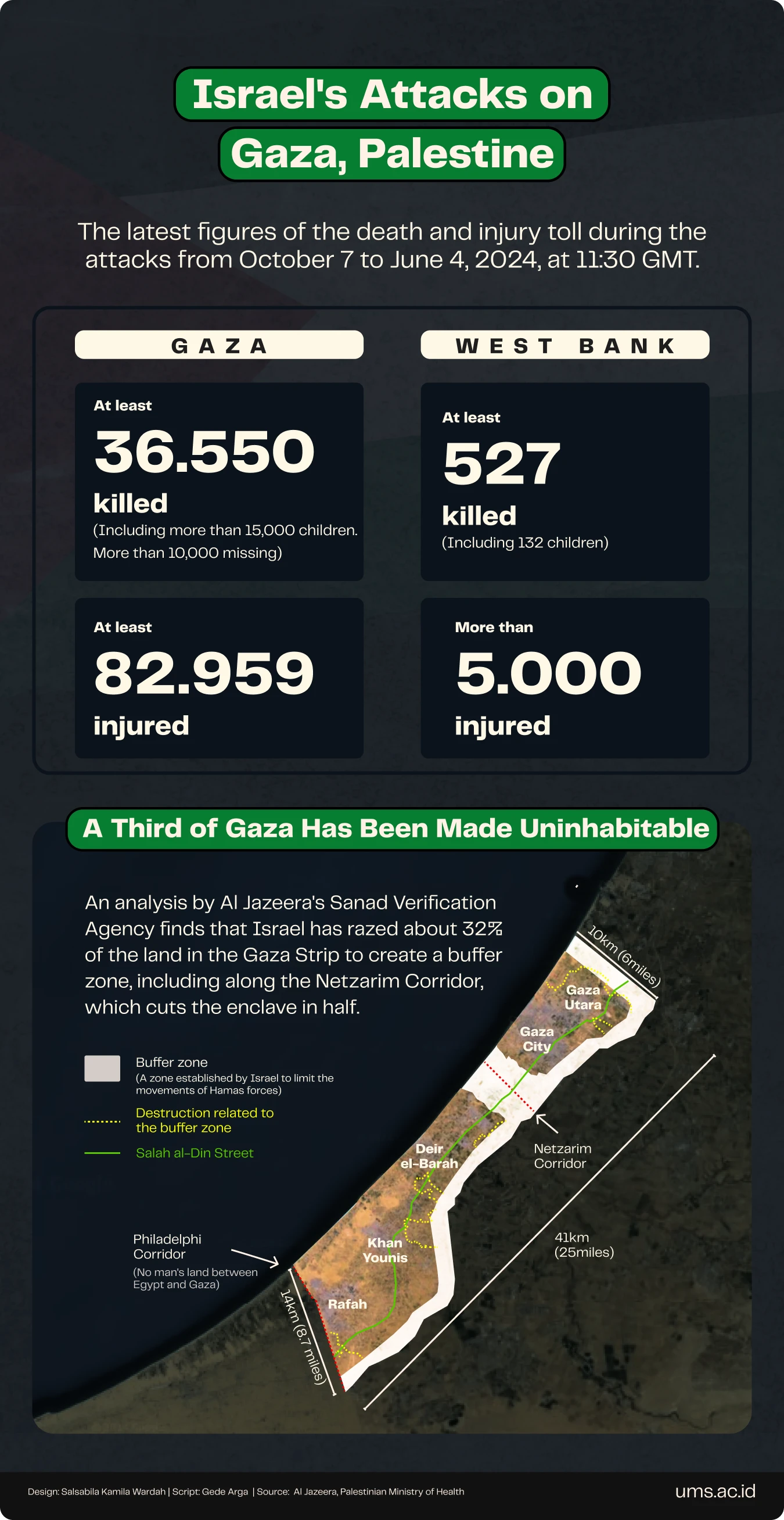
Israel launched another airstrike on the refugee camp in Rafah on Sunday night (26/05/2024). According to Dr. Muhammad al-Mughayer of the Palestinian Civil Defense (PCD), the attack burned down refugees’ tents and killed 45 people, as reported by Al Jazeera.
“The fire was huge and spread throughout the refugee camp,” al-Mughayer said. He added that most of the deceased had suffered severe burns.
The Palestinian Health Minister reported on Monday (27/05/2024) that of the 45 dead, 23 were women and children. Additionally, 249 victims were injured, with the possibility of more casualties as some survivors suffered critical burns.
The attack took place in the Tal As-Sultan area, where thousands of refugees had set up tents following an Israeli ground attack two weeks earlier.
One of the victims recounted his experience, saying he was walking around the refugee area when the explosion occurred, causing him to lose consciousness immediately. Speaking from the Kuwaiti Hospital in Rafah, he told Al Jazeera that his siblings and children were also injured in the night airstrike. “I saw [injured] legs... [but] I don’t know how badly,” he said.
In the corner of the hospital, a man shouted while raising his hands, “They (the victims) are burning! They are all burning!”
Majed al-Attar, a resident of Beit Lahiya in the northern Gaza Strip, said he lost five members of his family in the attack.
“We were sitting in a tent, and suddenly the camp was bombarded,” said Majed al-Attar. “I lost five family members; all were completely burned. Among those killed was a pregnant woman. They [the Israelis] said this area was safe until we were attacked.”
Mahmoud al-Attar, a resident of eastern Rafah who was expelled from his home, shared his feelings. He admitted that life was hellish during the Israeli-Palestinian war.
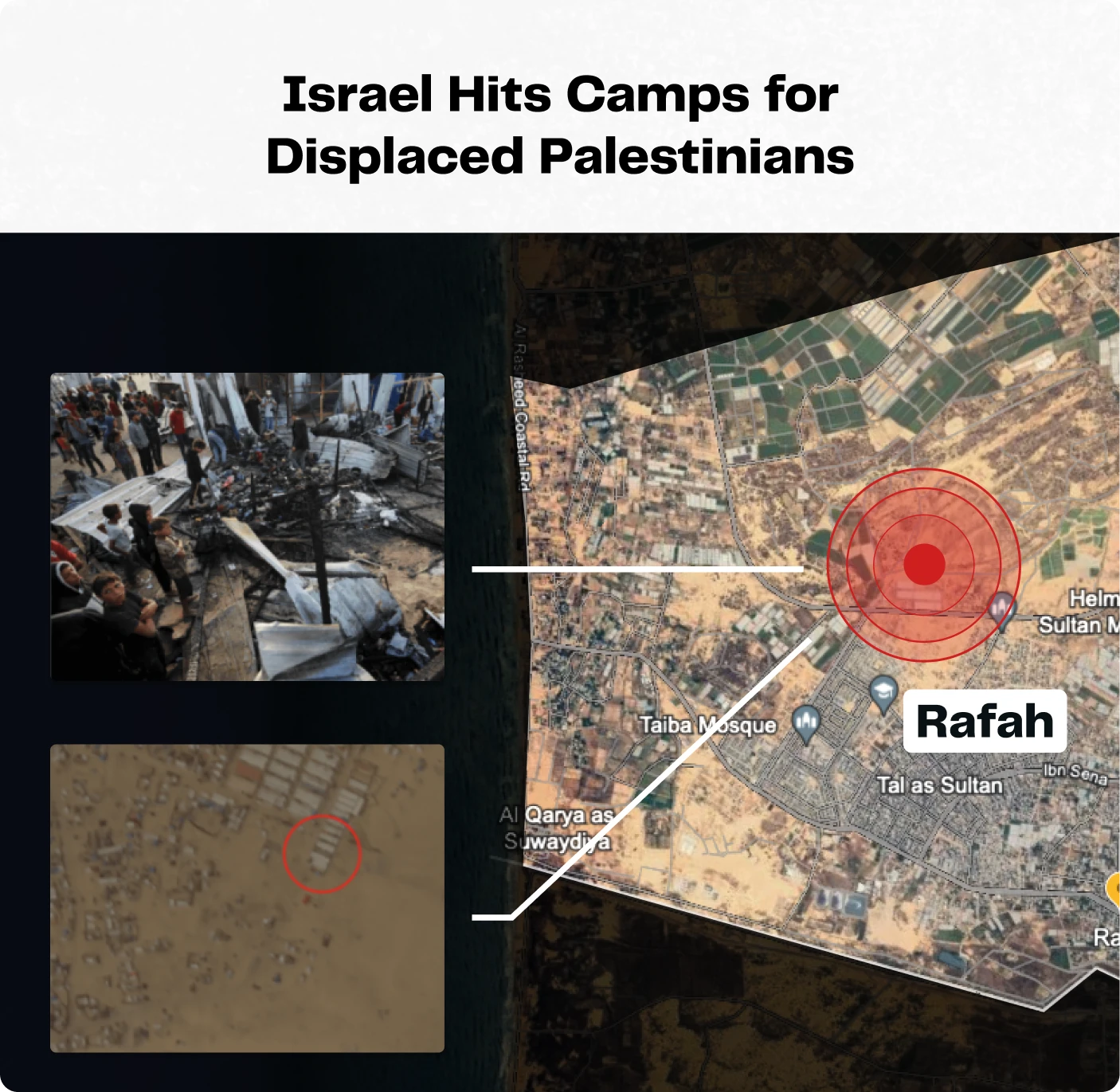
The location of the Israeli attack on Rafah, Palestine, Monday (27/5/2024) and satellite images before the attack on Rafah. Anadolu Agency/Ashraf Amra, Planet Labs PBC
Mahmoud al-Attar, a resident of eastern Rafah who was expelled from his home, shared his feelings. He admitted that life was hellish during the Israeli-Palestinian war.
“They said this area [Rafah refugee camp] was safe. We left the eastern part of Rafah for the western part of the city, thinking it would be safer. But now, there is no safe place in Gaza. Massacres are everywhere,” said Mahmoud.
Mahmoud said the atmosphere became even more tense a day after the International Court of Justice (ICJ) issued a ruling prohibiting Israel from conducting military operations in Rafah.
“We hope the world community will stand with us to stop this war. We lost a brother, and every day we lose another Palestinian,” he said.
Not even a week after the International Court of Justice (ICJ) ordered Israel to stop its attacks on the Gaza Strip, Israel launched another attack on the Rafah refugee camp, disobeying the ruling.
At the ICJ hearing on Friday, (24/05/2024), South African plaintiffs brought forward genocide charges against Israel. The Court mentioned several points prohibiting Israel from continuing attacks in Palestine, including:
Fahmi Fairuzzaman, S.H., M.H., L.L.M., an international law expert at Universitas Muhammadiyah Surakarta (UMS), commented on the verdict, calling it a significant blow to Israel. “They (Israel) have again been ordered to stop the attacks but are still evading with various excuses,” he said.
Fahmi noted that Israel continues to ignore international pressure to halt attacks in Palestine. “They (Israel) also feel they have strong backing from the United States. However, recently, the United States has reconsidered their support,” he added.
The verdict issued by the ICJ was the initial decision of a series of trials between South Africa and Israel. Given Israel’s track record during its invasion of Palestine, Fahmi doubts that Israel will comply with the ICJ’s final decision.
“Given Israel's track record, they may turn a blind eye toward the ICJ’s decision,” said Fahmi Fairuzzaman, a Master of Laws from Youngsan University. “This may continue as long as there is someone ‘protecting’ or ‘guarding’ Israel’s actions,” he added.
Fahmi said that if Israel ignores the ICJ ruling, South Africa, as the plaintiff, can ask the UN Security Council to implement it.
However, addressing this situation is complex. The UN Security Council has five permanent members: the United States, Russia, China, France, and Britain. Each has the right to veto any resolution issued by the UN.
“In reality, the United States has never taken concrete steps against Israel,” said a lecturer at the Faculty of Law, Universitas Muhammadiyah Surakarta (UMS). “As in the past, when the Security Council passes a resolution with the majority of members agreeing, the United States comes out with its veto, and then it’s over.”
Israel’s ongoing violations of international rules make pressure from the global community crucial. Pressure can start at the individual level, such as boycotting products that support Israeli actions. However, Fahmi emphasized the importance of discerning which products to boycott. “Not just any boycott,” he said.
People can also use social media to continue voice the genocide committed by Israel. Pressure through social media, according to Fahmi, can increase global awareness of the suffering of Palestinians due to Israeli actions.
“The more massive the movement of the local community, the more pressure it can exert on the local government. At the very least, it can lead to a withdrawal of support for Israel, even if it’s not yet complete,” he explained.
Protests have also emerged within the United States. A wave of student demonstrations is sweeping the country. Fahmi believed that the support of students and various groups in the United States could help raise global awareness about the situation in Palestine.
“It is not impossible that the local population can influence their government,” Fahmi added. “For example, in the United States, citizens have begun to voice their support for a free Palestine.”
At the state level, Fahmi emphasized the importance of continuing legal efforts. “Encouraging the ICJ to issue a firm decision is crucial to ending the suffering of the Palestinians,” he said.
“Don’t let South Africa walk alone when it needs support in the form of statements or experts,” he continued.
Most recently, the President of Chile, Gabriel Boric, announced that his country, alongside South Africa, will sue Israel at the International Court of Justice (ICJ). Boric criticized the dire humanitarian situation in a speech before the Chilean National Congress on Saturday (1/6/2024).
“Chile will join and support the case filed by South Africa against Israel at the International Court of Justice in The Hague,” Boric said, according to Al Arabiya.
Read More: UMS Rector Calls for 8 Demands in Defense of Palestine
The international community condemned the Israeli airstrikes on the Rafah refugee camp. Canadian Foreign Minister Mélanie Joly called for an immediate ceasefire on her X account.
“Canada does not support Israel’s military operation in Rafah. This level of human suffering must end,” Melanie tweeted on Tuesday (05/28/2024).
Prime Minister and Foreign Minister of Qatar, Sheikh Mohammed bin Abdulrahman bin Jassim Al Thani, announced that his government held an emergency meeting with Arab League foreign ministers to discuss the latest conditions in the Middle East.
“Qatar condemns the Israeli army’s aggression against refugee camps in Rafah and throughout the Gaza Strip, as well as its continued violation of international law,” he stated.
Spanish Foreign Minister José Manuel Albares said he would encourage the 26 other EU countries to officially support the ICJ and take steps to ensure Israel respects the ICJ’s decisions.
“If Israel continues to act against the Court’s ruling, we will take appropriate measures to enforce its decision,” he told reporters in Brussels.
In addition to condemning Israel’s actions, several countries began recognizing the Palestinian state. Ireland, Norway, and Spain recognized Palestine as a state, according to Al Jazeera, Tuesday (28/05/2024).
Spanish Prime Minister Pedro Sánchez emphasized that the two-state solution is the best path for Palestine and Israel to coexist in harmony.
The support from European countries to Palestine is a significant blow to Israel. It raises hopes that other countries might recognize Palestinian independence and freedom.
Condemnations also came from students across various European universities. In Amsterdam, hundreds of students demonstrated in front of the University of Amsterdam. ANP reported that 50 students protested at Utrecht University on Wednesday (8/5/2024). I
In Leipzig, Germany, around 50 to 60 students unfurled a banner reading “University occupation against genocide.”
The persistent protests fuel hopes for peace. Fahmi believed that such protests could pressure local governments to take concrete steps to address the genocide in Palestine.
“Israel is losing support, though it remains strong due to backing from the United States. However, European countries’ support could influence other previously silent countries to support Palestine,” Fahmi concluded.
Writer: Gede Arga Adrian
Editor: Al Habiib Josy Asheva
Translator: Farizal Luqman Majid
Designer: Salsabila Kamila Wardah
Brain rot, or cognitive decay, is increasingly affecting Generation Z and Millennials due to technology addiction. What are the solutions?
Nothing’s more special than reading curated news just for you.
Subscribe to the UMS Newsletter for free today.