
How Sheep Manure Turns into Nutrient Rich Fertilizer
16 July 2026
Sheep dunged nutrient-rich organic fertilizer for plants, made with the help of maggots. Built on community empowerment and a zero-waste principle.



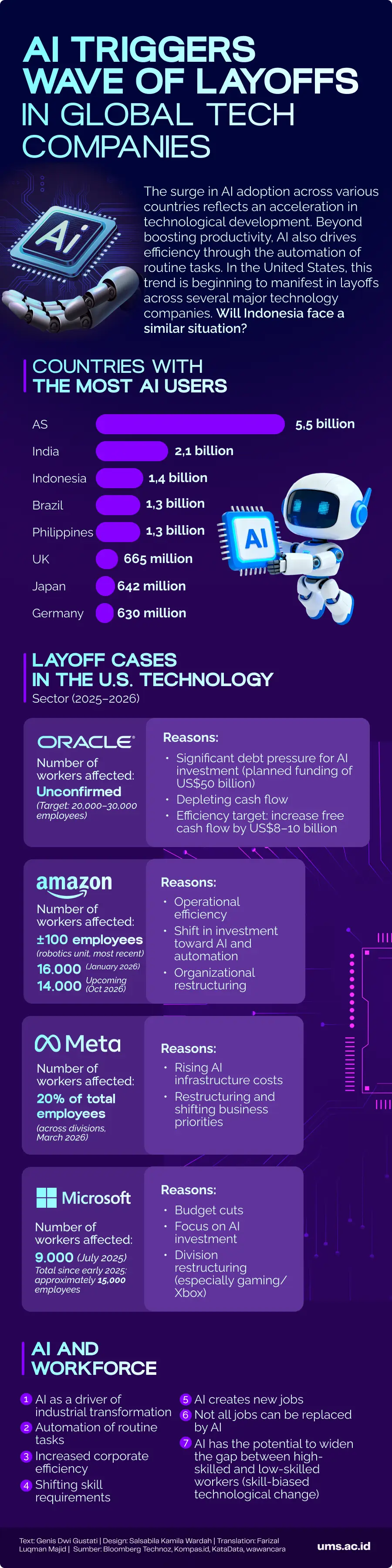
The wave of layoffs in the global technology sector is beginning to raise new concerns. Major companies are reducing their workforce as investment in artificial intelligence (AI) increases.
Bloomberg Technoz reported that tech giant Oracle Corporation carried out massive layoffs affecting around 30,000 employees globally. This move is said to be part of organizational restructuring, as well as an effort to redirect billions of dollars in budget toward AI development.
Mass layoffs at several technology companies in the United States have reportedly occurred as firms increase efficiency through AI. Previously, Amazon cut around 16,000 employees, while Meta Platforms reduced approximately 20 percent of its total workforce in recent months.
Widi Widayat, S.Kom., M.Eng., an Informatics Engineering lecturer at Universitas Muhammadiyah Surakarta (UMS), described this trend as part of an industrial transformation driven by technological advancement. According to him, AI-based automation enables companies to increase productivity while reducing operational costs.
"The wave of layoffs in global technology companies should be seen as part of an industrial transformation phase driven by technological progress, especially artificial intelligence," he said in an interview on Tuesday (14/4/2026).
Artificial intelligence is considered capable of automating various routine tasks such as data analysis, software testing, and digital customer service. This has reduced the need for workers in certain roles, although global economic factors and corporate efficiency efforts also play a role in layoffs.
"AI tools are now increasingly used in everyday work activities. Their use is no longer limited to software development, but has also expanded into administration, marketing, and digital content production," Widi added.
The adoption of AI tools continues to grow due to easier access and the improving capabilities of generative technologies. For example, AI for creating PowerPoint presentations is already being used by workers to automatically generate slides. Generative technology can also assist in writing reports, analyzing data, and producing visual materials in a short time, ultimately boosting productivity while reshaping job structures.
The role of artificial intelligence in improving company efficiency is significant. A single AI system can accelerate workflows and reduce human error, even replacing some tasks that were previously handled by multiple employees.
However, Widi emphasized that AI has not fully replaced humans. Many jobs still require creativity, critical thinking, and collaboration skills, areas where technology cannot yet perform optimally.
“Therefore, the human role remains essential in controlling, supervising, and strategically utilizing technology,” he explained.
Mass layoffs due to AI adoption could potentially occur in Indonesia, although the impact is expected to be slower than in developed countries. The still-developing level of technology adoption means that automation will likely take place more gradually.
In addition, Indonesia’s diverse industrial structure is also a key factor influencing the pace of this transformation. “Even if it happens, the impact will tend to be more gradual and not as aggressive as what is occurring in global companies,” Widi said.
Several sectors are considered more at risk, including customer service, banking, telecommunications, and the creative industry. Jobs that are routine and repetitive in nature are more easily replaced by AI-based automated systems.
However, technological advancement is also opening up new job opportunities. Demand for workers with skills in data science, machine learning, and AI development is actually increasing.
“This shows that digital transformation is not only about eliminating jobs, right? It can also create new professions that didn’t exist before,” he concluded.
In addition, the gap between high-skilled and low-skilled workers has the potential to widen due to the development of AI. Widi believed that workers with strong digital skills will find it easier to adapt, while those with limited skills risk being left behind.
However, this gap can be minimized through improved digital literacy and reskilling programs. "Once again, AI is not the main cause of inequality, but rather a technology that demands adaptation," Widi explained.
For Indonesian citizens, how to respond to technological developments is an important question amid this trend. Widi emphasized the importance of preparing human resources to face digital transformation through skill development and AI literacy.
He urged the public not to view AI as a threat, but as an opportunity. Workers who are able to utilize AI tools will gain a competitive advantage in the job market. The ability to operate various AI platforms is increasingly valued by companies.
"AI does not replace humans, but humans who fail to adapt to AI risk being left behind. Adaptation is the key to staying relevant," he stressed.
Therefore, rather than worrying about layoffs, the Indonesian workforce needs to improve digital skills, understand technological developments, and leverage artificial intelligence to enhance productivity.
Writer: Genis Dwi Gustati
Translator: Farizal Luqman Majid
Editor: Al Habiib Josy Asheva
Sheep dunged nutrient-rich organic fertilizer for plants, made with the help of maggots. Built on community empowerment and a zero-waste principle.
Nothing’s more special than reading curated news just for you.
Subscribe to the UMS Newsletter for free today.