
The Sin of Football Betting
26 June 2026
Amid the FIFA World Cup 2026 euphoria, football betting is also spreading through digital platforms and conventional means.

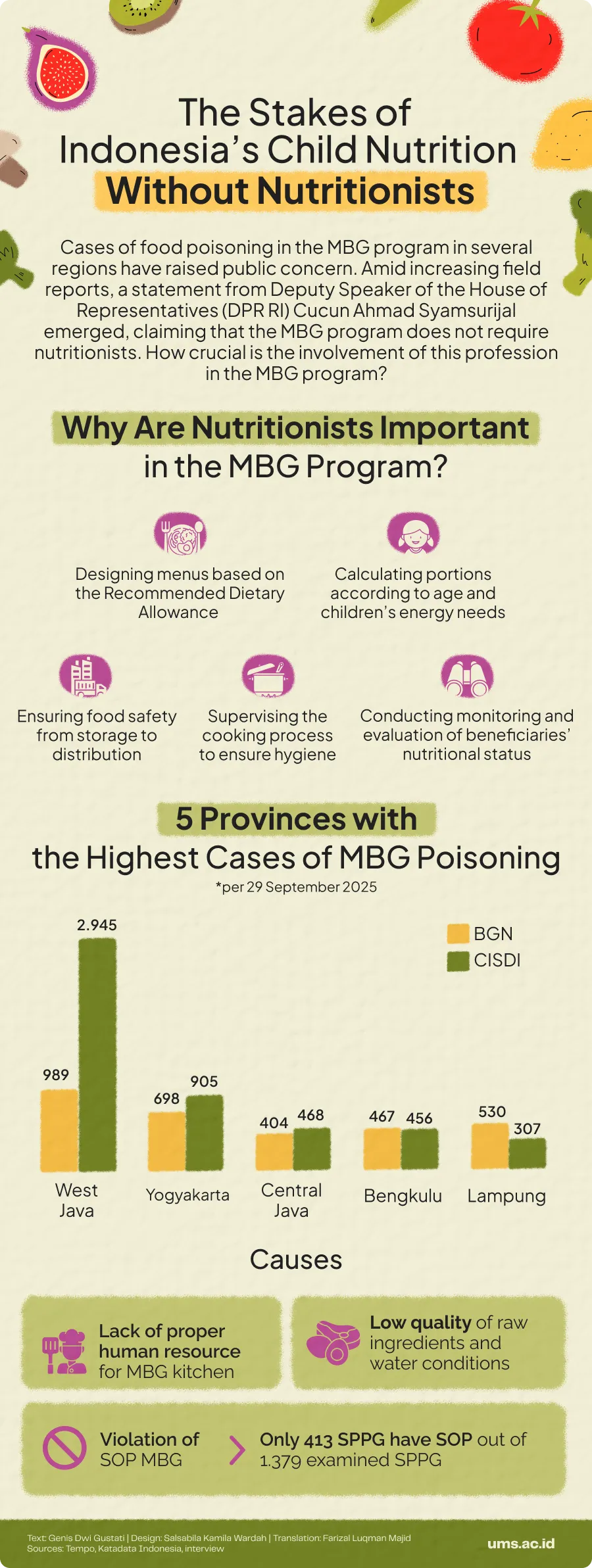
The competence of nutritionists came into focus after the statement of the Deputy Speaker of the DPR RI, Cucun Ahmad Syamsurijal, who said that the Free Nutritious Meals (MBG) program did not require nutritionists. His remarks in the consolidation forum of the MBG Nutrition Fulfillment Service Unit (SPPG) in Bandung Regency sparked criticism from various groups who were concerned about the nutritional service standards of the MBG program.
After drawing public protests, Cucun apologized and clarified that his comments were meant to highlight the shortage of nutritionists in the field, not to belittle the profession. The clarification was delivered after Cucun held a meeting with the National Nutrition Agency (BGN) and the Indonesian Nutritionists Association (Persagi) at the Parliament Complex, Senayan, Jakarta, Monday (17/11/2025).
Although Cucun has delivered an apology, the blunder he left behind is still being widely discussed by the public. Can the MBG program truly run without the presence of nutritionists?
According to the Head of the Dietitian Professional Program at UMS, Dr. Dwi Sarbini, S.ST., M.Kes., without experts, MBG menu planning is prone to being nutritionally inadequate, using inappropriate food ingredients. Moreover, it causes budget inefficiencies due to inaccurate portions and nutrient calculations. “Without experts, a large program can still run, but its accuracy and effectiveness will decline,” Dwi explained in an online interview, Friday (21/11/2025).
Several MBG food poisoning incidents that have occurred in various regions have further worsened public trust. Although the causes vary, many experts believe that weak supervision and the lack of nutrition personnel can be contributing risk factors. It is at this point that the debate triggered by Cucun’s statement becomes relevant.
Read more: Food Poisoning in MBG Carries Pain Beyond the Data
“Nutrition science is not something that can simply be learned through short training. It involves mathematical calculations, mapping of nutritional needs, and the ability to analyze differences in energy requirements across regions and age groups,” explained Dwi, who is also part of the MBG drafting team of the Muhammadiyah Central Board (PP Muhammadiyah).
Malnutrition can be triggered by mismanagement in meal programs, especially when menus are prepared without scientific calculation by nutritionists. The menu may appear varied, but is actually nutritionally poor.
Initial findings from the MBG team of PP Muhammadiyah reinforce what the government has also acknowledged: the varying prices of food ingredients, differences in the availability of protein sources across regions, as well as the differing capacities of field kitchens in processing meals. These conditions make the presence of nutritionists even more crucial.
“Without accurate nutritional calculations, a menu may look simple but fails to meet the minimum nutritional requirements,” she said.
According to Dwi, the competence of a nutritionist can only be obtained through professional education grounded in ethics and legal responsibility. Such competence cannot be acquired through short training, and therefore their role cannot be substituted by personnel without a nutrition science background.
Nutritionists are responsible for ensuring that MBG menus meet the Recommended Dietary Allowances (RDA), calculating portion needs, selecting safe and affordable food ingredients, and supervising storage and food processing to ensure hygiene. If the role of nutritionists were truly removed or replaced by nonprofessional workers, the resulting risks would be severe.
“MBG menus could easily become nutritionally unbalanced, contaminated, mismatched with children’s energy needs, lead to potential food poisoning cases, and ultimately weaken the program’s long-term effectiveness,” Dwi warned.
Dwi also highlighted her involvement as an expert in the MBG program under Muhammadiyah. “Our team developed technical guidelines, menu standards based on local food sources, nutritional requirement calculation models, as well as implementation and monitoring frameworks,” she added.
The MBG program of PP Muhammadiyah involves academics, nutrition practitioners, and food experts. According to Dwi, such a data-driven and collaborative approach represents an ideal model of how the state should run MBG.
In the MBG program, the state must enforce strict standards to ensure nutritional quality remains intact. Dwi emphasized that menu development must be based on the RDA and the needs of the target groups, while food safety must be maintained from storage and processing to distribution.
She also highlighted the importance of local food diversity to ensure the program remains relevant and efficient in every region, as well as the need for regular monitoring and evaluation by qualified experts. In addition, kitchen and distribution mechanisms must be hygienic, standardized, and well documented
“These standards are the foundation to ensure that MBG does not merely become a mass-feeding project, but truly functions as an effective nutritional intervention,” Dwi reminded.
Beyond implementing nutritional service standards, Dwi suggested that the government must reinforce supporting systems to ensure program quality stands firm in both concept and execution. “First, it is essential to establish a clear and proportional recruitment mechanism for nutrition professionals,” she said.
Second, there must be a requirement for a minimum number of nutritionists in each region so that program implementation becomes more measurable. Third, a tiered supervision system involving community health centers (Puskesmas), local health offices, and educational institutions must be provided. Fourth, cross-sector collaboration is needed to strengthen implementation quality.
Additionally, according to Dwi, Indonesia indeed has regulations concerning nutrition professionals, including competency standards and guidelines for institutional food services. Unfortunately, the implementation remains far from ideal.
“Balanced nutrition in a program on the scale of MBG can only be achieved if there are strengthened placement and supervision mechanisms for professional nutritionists,” she explained. Coordination between BGN, Persagi, the Ministry of Health, and local governments also needs to be reinforced.
In many news reports, several MBG kitchens are often suspected of operating without sufficient supervision from nutrition professionals. Heightening the risk of technical errors and declining service quality. Without professional oversight, the government’s noble goal of improving the nation’s nutritional status is unlikely to truly succeed.
Writer: Genis Dwi Gustati
Translator: Farizal Luqman Majid
Editor: Al Habiib Josy Asheva
Amid the FIFA World Cup 2026 euphoria, football betting is also spreading through digital platforms and conventional means.
Nothing’s more special than reading curated news just for you.
Subscribe to the UMS Newsletter for free today.