
How Sheep Manure Turns into Nutrient Rich Fertilizer
16 July 2026
Sheep dunged nutrient-rich organic fertilizer for plants, made with the help of maggots. Built on community empowerment and a zero-waste principle.



Hundreds of truck drivers held demonstrations in several regions across Java Island throughout June 2025. They demanded the cancellation of the Draft Law on Over Dimension Over Loading (ODOL Bill).
In Soreang, Bandung Regency, hundreds of truck drivers parked their vehicles along the arterial road near the Soroja Toll Gate on Thursday (19/6/2025) afternoon. The protest began at midday and caused traffic congestion toward the Bandung Regency government center.
According to Detik.com, trucks bearing protest slogans were seen lined up along the road, while hundreds of drivers voiced their concerns over the ODOL Bill. The protest coordinator, Cecep Beetle, stated that the ODOL Bill would harm drivers and other field workers.
“This action is taken by all truck drivers from South Bandung. If this bill is passed, it could spark conflict. We are asking for solutions. Because it’s the vehicle owners who benefit from this bill, not us on the ground,” he asserted.
A similar protest was held in Cirebon, West Java. Hundreds of truck drivers blocked the entrance to the Palimanan Toll Gate. The protest coordinator, Ahmad Wahid, said the ODOL regulation could significantly cut driver income. “We’re not corruptors, we’re just trying to earn a living. Should we be criminalized over our cargo?” he lamented.
Another truck driver, Sugiantoro, admitted that his income had declined due to the load restrictions under the ODOL regulation. “I usually carry 10 tons, but if it’s limited to 4 tons, it won’t cover the costs. If the government wants to be firm, pass the asset forfeiture law first. Don’t oppress the small people,” he said.
Rejection of the ODOL Bill spread to Central Java. Hundreds of drivers, united under the Independent Drivers Alliance (API), demonstrated in front of the Central Java Transportation Agency (Dishub Jateng) office in Semarang on Tuesday (June 23, 2025). They carried banners and posters that read “Reject the ODOL Bill,” “Too Many Rules in This Country,” and “Drivers Are Not Criminals.”
The National Chairman of API, Suroso, stated that the ODOL Bill would burden logistics transport drivers. The regulation was deemed unfair, as drivers often return home with only IDR 500,000 after three days on the road. Their conditions worsen due to the lack of holiday allowances and legal protection.
"If this is not responded to immediately, we will go on a national strike. We won't protest on the streets, but we will stay home. Because with this law, we are already under pressure and feeling burdened," said Suroso.
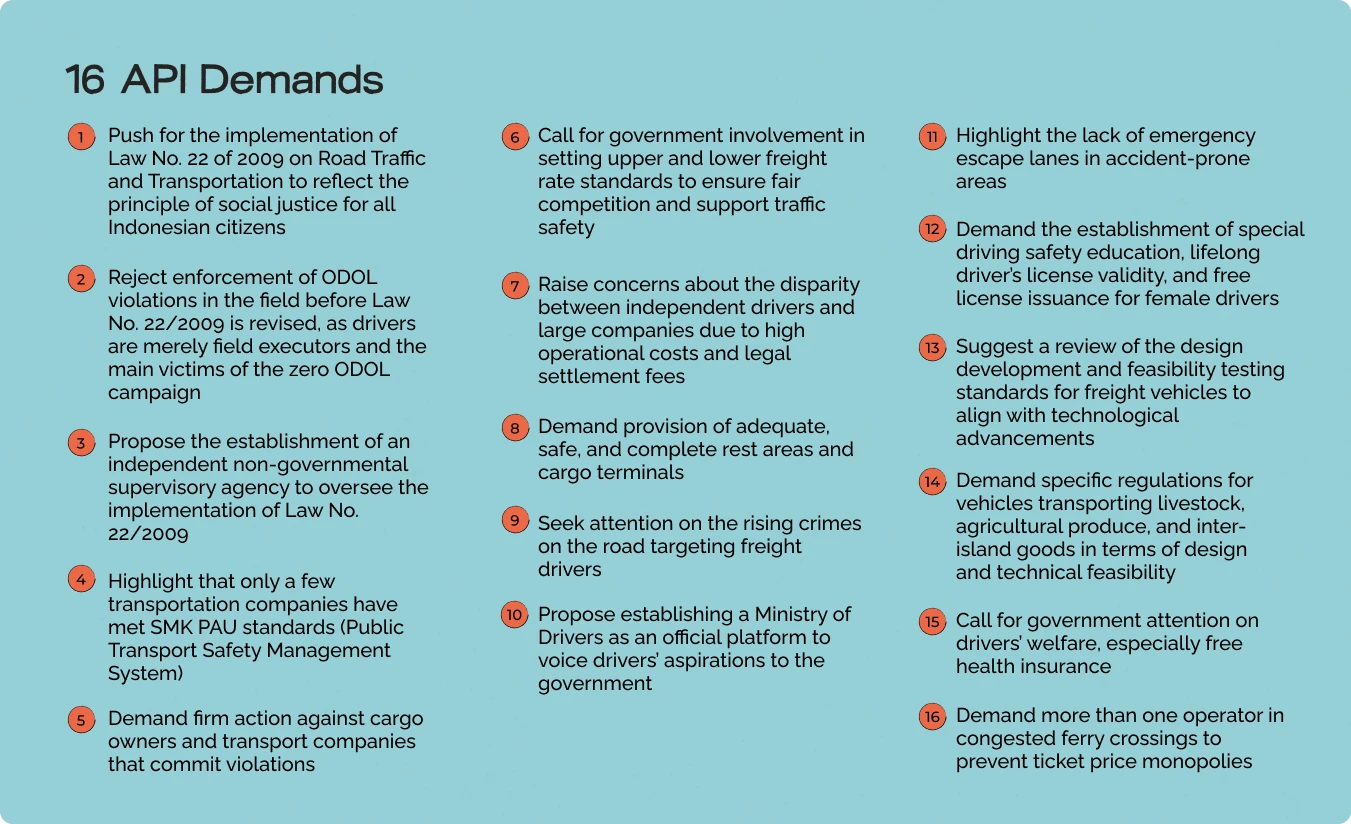
API submitted 16 demands to the government as a form of protest against the planned enactment of the ODOL Bill. One of their demands is to reject the enforcement of ODOL violations in the field before Law No. 22 of 2009 is revised, considering that drivers are merely field implementers and have become the main victims of the zero ODOL policy.
ODOL stands for Over Dimension Over Loading. ODOL refers to freight transport vehicles that exceed the physical dimensions and weight limits set by regulations.
Efforts to eliminate ODOL have been initiated since 2016, with an original target of achieving zero ODOL by 2019. However, the plan was delayed due to resistance from the industry. In 2023, the discourse resurfaced.
The government has resumed the socialization of the zero ODOL policy throughout June 2025, followed by a warning phase from 1-13 July The law enforcement phase will be carried out from 14-27, in conjunction with Operation Patuh 2025. The target is to achieve zero ODOL by 2026.
Zero ODOL is backed by several legal foundations, namely Law No. 22 of 2009 on Road Traffic and Transportation (UU LLAJ), Government Regulation No. 55 of 2012 on Vehicles, and the Minister of Transportation Regulation No. 18 of 2021 on Supervision of Freight Transport Loads on Roads.
Most recently, the government plans to issue a presidential regulation in August 2025. This regulation will strengthen criminal penalties and fines for ODOL violations.
Overload is a traffic violation subject to a traffic ticket. Meanwhile, over dimension is considered a criminal offense. Article 307 of Law No. 22 of 2009 on LLAJ stipulates that drivers of ODOL trucks can face up to two months of imprisonment or a fine of Rp500,000. Meanwhile, Article 277 of the same law mentions a one-month imprisonment and a fine of Rp24 million for truck assemblers involved in ODOL modifications.
Chair of the Center for Logistics and Industry Studies at Universitas Muhammadiyah Surakarta (UMS), Raden Danang Aryo Putro Satriyono, S.T., M.T., said it is inappropriate to place the blame solely on drivers in ODOL regulations.
“Drivers are the most vulnerable. They are only one part of the logistics system, which is largely controlled by the cargo owners and fleet operators,” said Danang on Tuesday (1/7/2025).
In addition to drivers, ODOL trucks also involve cargo owners or shippers who determine the volume and delivery targets, fleet owners who often provide incentives based on load quantity, and regulators who lack supervision and fail to protect drivers.
Danang emphasized the need for firm solutions involving all stakeholders in the national logistics distribution system. These solutions should engage regulators, academics, companies, freight forwarders, and field workers.
Supply chain optimization should be prioritized to plan logistic loads more efficiently. The application of weight-in-motion technology on toll roads is also crucial to detect and stop overloaded trucks.
Financial incentive and disincentive are also important. Practically, it can be special tariff subsidies for dimension-compliant logistics vehicles, or penalties based on risk and infrastructure damage caused by ODOL.
At the same time, the government must develop intermodal connectivity between sea, rail, and truck transport through dry ports. The logistics burden on road transport must be redistributed to other modes.
“What’s most important is collaboration between the Ministry of Transportation, state-owned logistics enterprises, and freight transport associations to draft a realistic roadmap for zero ODOL,” he emphasized.
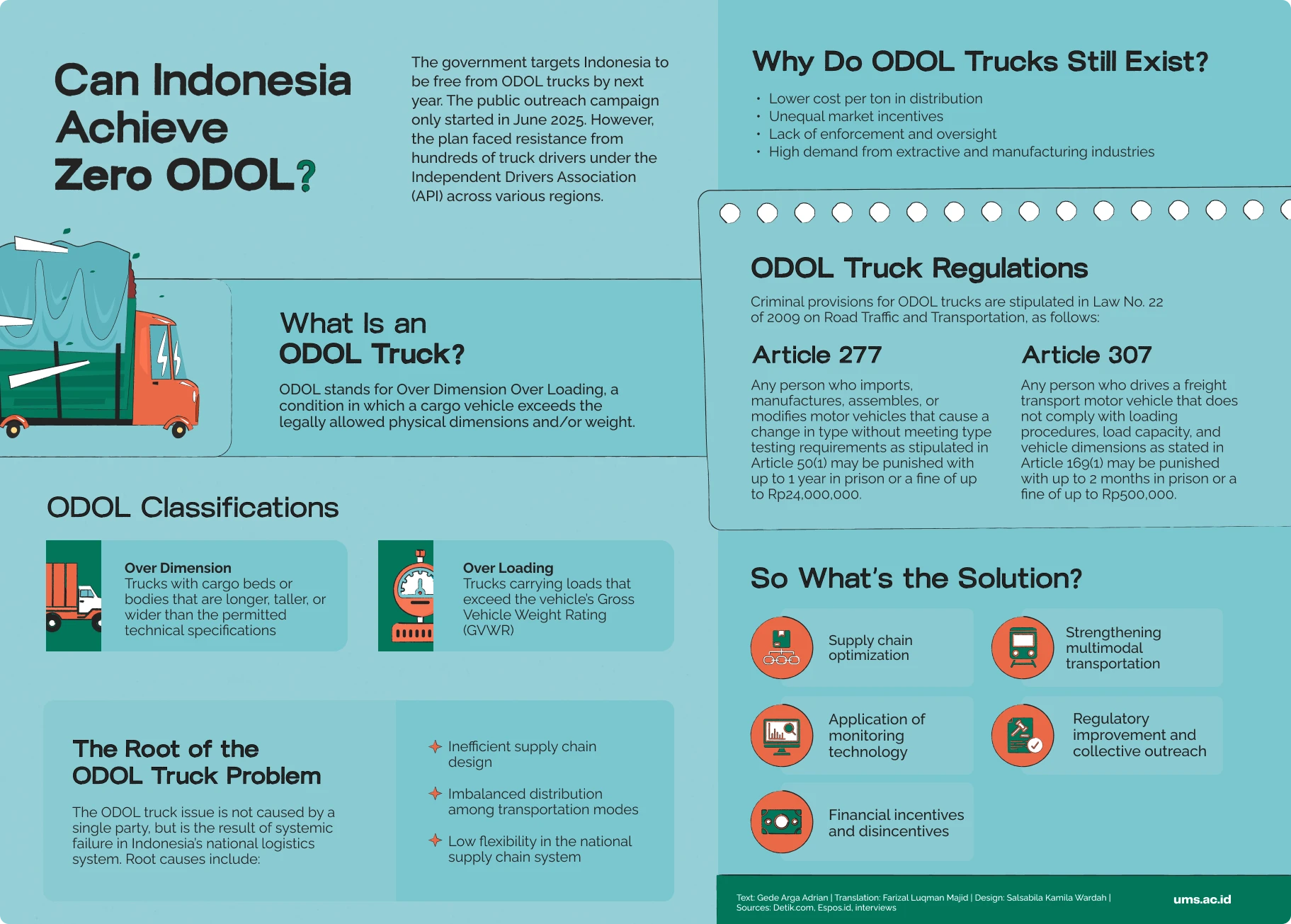
Danang stated that the ODOL truck phenomenon is a systemic consequence of Indonesia’s ineffective and inefficient logistics system. “The ODOL truck problem is not the fault of a single party, but the result of a cumulative failure in the national logistics system,” said the UMS Industrial Engineering lecturer.
Indonesia's current supply chain design is ineffective, as many companies do not apply logistics planning based on optimization such as route planning, load optimization, and multimodal transport usage.
National distribution is also still highly reliant on road transport. According to data from the National Development Planning Agency in 2023, 90 percent of freight transport still uses highways, while rail and sea transportation have yet to be optimally integrated.
“Actually, we can optimize the use of railways as a logistics mode by building dedicated freight train lines. Indonesia also has many waterways, so we should be developing proper river and sea logistics infrastructure as well,” Danang explained.
ODOL trucks are a short-term solution that rely on oversized trucks. Danang said the government should instead build an integrated hub-and-spoke system, a more centralized logistics model that can serve smaller retail points.
He added that ODOL trucks remain in demand because their distribution costs are much lower than standard trucks. ODOL trucks allow logistics companies to focus more on short-term cost efficiency.
“An ODOL truck can carry 1.5 to 2 times the normal capacity in a single trip. This lowers the cost per trip and cost per ton, especially for low-value but heavy goods such as sand, coal, and agricultural products,” he continued.
Despite being cheaper, ODOL trucks significantly damage road infrastructure due to overloading beyond the road's weight limit.
From a business perspective, Danang noted that the cost of road damage, accident risks, and fines are still considered cheaper than the operational. “For example, it’s still more affordable than hiring two trucks that fully comply with regulations,” he added.
Law enforcement against ODOL trucks has so far been weak. Monitoring of ODOL vehicles on national roads, in industrial zones, and at ports is deemed ineffective. Some weighbridge facilities are either inactive or manipulated by rogue actors.
“It's essential to ensure there is no manipulation among the sender, transporter, and recipient,” he concluded.
Writer: Gede Arga Adrian
Editor: Genis Dwi Gustati
Translator: Farizal Luqman Majid
Sheep dunged nutrient-rich organic fertilizer for plants, made with the help of maggots. Built on community empowerment and a zero-waste principle.
Nothing’s more special than reading curated news just for you.
Subscribe to the UMS Newsletter for free today.