
Far From Home, Closer to the Dream
6 July 2026
Sili built a good life as a government engineer in Fiji. To answer his father's promise, he had to leave all of it behind


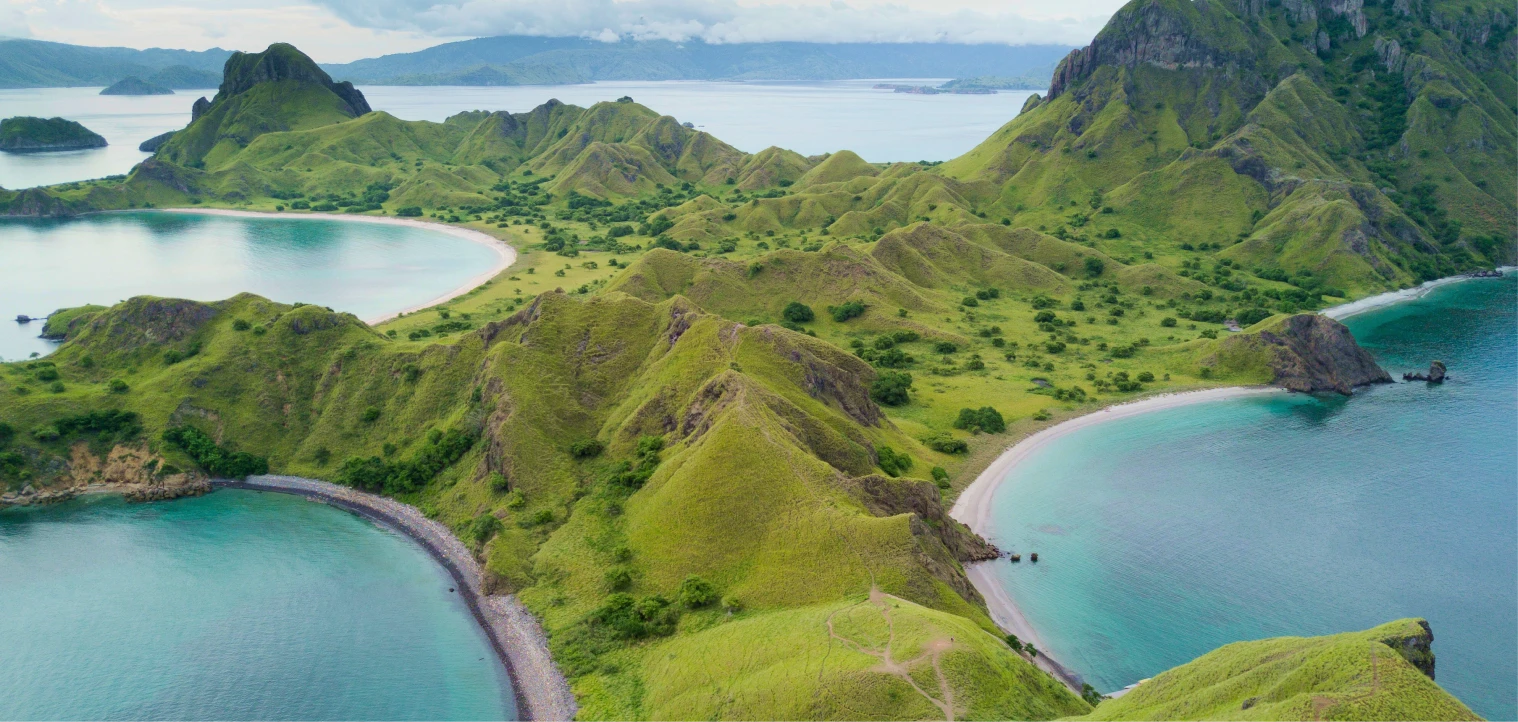
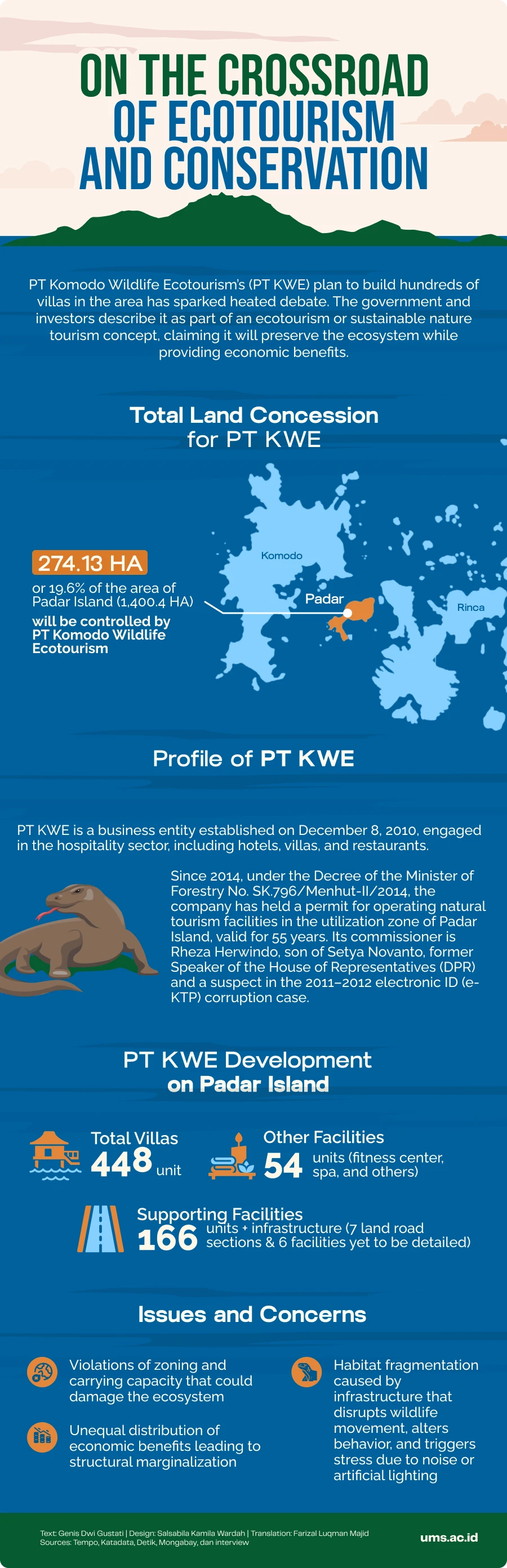
Padar Island, one of the gems in the Labuan Bajo archipelago in East Nusa Tenggara, has become the center of public attention. The plan by PT Komodo Wildlife Ecotourism (PT KWE) to construct hundreds of villas on the island has ignited heated discussions.
The government and investors present the project as part of an ecotourism initiative, sustainable nature-based tourism, expected to generate economic benefits while preserving the ecosystem. However, many parties, including local communities and environmental activists, fear that the project will instead damage the ecosystem, marginalize residents, and veer toward green capitalism.
Padar Island, along with Komodo Island and Rinca Island, has been part of Komodo National Park since 1980 and was recognized by UNESCO as a World Heritage Site in 1991. This status grants it international legal protection, with an obligation to safeguard the Outstanding Universal Value (OUV) area, which includes its unique biodiversity and geological landscape.
Aziz Akbar Mukasyaf, S.Hut., M.Sc., Ph.D., a lecturer at the Faculty of Geography, Universitas Muhammadiyah Surakarta (UMS), explained that Padar Island's position in Indonesia’s biogeographical map makes it both unique and fragile. The island lies within the Wallacea region, a transitional zone between Asia and Australia, renowned for its high levels of endemic flora and fauna.
“The climate here is semi-arid, drier than western Indonesia, so its landscape is dominated by savanna. The surrounding seas are rich in coral reefs, seagrass beds, and turtle habitats. The most iconic, of course, is the Komodo dragon, an endemic species found only in this region,” said Aziz, who often researches environmental geography and forestry, on Friday (15/8/2025).
In principle, ecotourism is nature-based tourism aimed at minimizing negative environmental impacts. The concept is expected to provide economic benefits for local communities while raising environmental awareness.
Aziz likened the concept of ecotourism to a double-edged sword. “If managed in line with environmental carrying capacity and zoning regulations, ecotourism can be an effective conservation tool. But if not, it can easily slip into green capitalism, where the ‘eco’ label is just a decoy to exploit resources,” he said.According to Aziz, signs that ecotourism is shifting into green capitalism can be recognized from several indicators. The first is the violation of zoning and carrying capacity, for example, development that encroaches into wilderness zones or even core zones.
The second indicator is habitat fragmentation caused by infrastructure that disrupts the roaming space of wildlife, alters the behavior of Komodo dragons, and triggers stress due to noise or artificial light. The third is unequal distribution of economic benefits, where major investors reap most of the profits while local residents are left with only marginal roles.
“If these signs appear, the essence of ecotourism is lost. What remains is merely infrastructure expansion and profit extraction within a conservation area,” Aziz emphasized.
PT KWE has held a business license for nature-based tourism facilities since 2014. The site in use is located in Padar Island’s utilization zone, which under regulations does permit limited tourism activities. The government has stated that construction will only occupy a small portion of the concession area, using knockdown structures, elevated buildings, and strict waste management systems, according to a BBC report on Friday (15/8/2025)
Aziz questioned the effectiveness of such mitigation measures. “Technical mitigation steps like elevated structures and waste treatment systems are indeed part of the Environmental Impact Analysis (AMDAL). But their effectiveness depends on disciplined implementation and continuous monitoring. In reality, for many projects in Indonesia, monitoring is only carried out at the beginning,” he criticized.
For Aziz, the biggest challenge lies in the island’s limited carrying capacity. Small islands like Padar have restricted natural resources, water, open space, and wildlife corridors.
“Without a strict carrying capacity analysis, villa construction risks permanently altering the character of the ecosystem,” he explained.
Aziz clearly outlined the looming ecological impacts. Habitat fragmentation from development could cut off the roaming paths of Komodo dragons, forcing them to adapt to a fragmented environment. This condition could heighten the risk of human-wildlife conflict, as has often happened in other conservation areas.
In addition, increased tourism activity on the beaches could damage coral reefs and disrupt turtle habitats. “Once coral is damaged, it can take decades to recover. Yet it’s a crucial part of the marine ecosystem chain around Padar Island,” he said.
For local communities, the risks of development are not only ecological but also tied to access to resources and economic opportunities. According to Aziz, projects dominated by major investors often create economic dependence rather than independence.
“Profits may flow out of the region. Locals might only get low-level jobs, while strategic positions are held by outsiders. Even future zoning revisions could be used to restrict or evict residents. This is a form of structural marginalization,” Aziz explained.
Similar cases have occurred in other conservation sites, where communities lost access to seas or land due to zoning policy changes. In Aceh, for instance, forests maintained by the Gayo Lues Indigenous Community through agroforestry were sealed off by a task force. Without dialogue and participation, the task force acted on the claim that the area was part of Gunung Leuser National Park (TNGL), even though the indigenous community had long served as guardians of the ecosystem, according to a Mongabay report on Friday (15/8/2025).
Aziz pointed to Rinca Island, also part of Komodo National Park, as an example. The tourism project in Loh Buaya was once required to revise its AMDAL to align with recommendations from UNESCO and the IUCN. “That’s proof that international pressure can correct plans that risk the OUV,” he said.
He stressed that the tourism model for Padar Island should make conservation top priority, not merely strike a balance between ecology and economy. “If the area intersects with endemic species and critical habitats, conservation must be the absolute priority,” he asserted.
The controversy in Padar Island, Labuan Bajo, illustrates the classic dilemma between conservation and investment. On one hand, tourism is indeed the economic driver of East Nusa Tenggara. On the other, the region’s natural wealth and UNESCO World Heritage status demand high standards of protection.
Aziz concluded with a warning: “Ecotourism is both an opportunity and a test. If we fail to uphold its principles, Padar Island could become an example of how the concept turns into green capitalism. But if we succeed, it could become a true model of sustainable nature-based tourism management.”
Writer: Genis Dwi Gustati
Translator: Farizal Luqman Majid
Editor: Al Habiib Josy Asheva
Sili built a good life as a government engineer in Fiji. To answer his father's promise, he had to leave all of it behind
Nothing’s more special than reading curated news just for you.
Subscribe to the UMS Newsletter for free today.