
How Sheep Manure Turns into Nutrient Rich Fertilizer
16 July 2026
Sheep dunged nutrient-rich organic fertilizer for plants, made with the help of maggots. Built on community empowerment and a zero-waste principle.



In the depths of the Sumpur Kudus Forest, West Sumatra, tears fell from Septian “Deki” Andriki, a Rafflesia researcher from Bengkulu. Deki was overwhelmed, as before him emerged a budding Rafflesia hasseltii preparing to bloom.
The moment was clearly captured in a video shared by Chris Thorogood, a researcher from Oxford University, UK, on his X account. “Allahu Akbar,” Deki exclaimed in awe in the video posted by Chris.
According to BBC Indonesia, Deki has spent 13 years searching for Rafflesia hasseltii. He ventured back into the Sumatran wilderness in mid-November. Alongside Chris, he was joined by Joko Ridho Witono, a researcher from the Biosystematics and Evolution Research Center at Indonesia’s National Research and Innovation Agency (BRIN).
Their journey through the forest began in the late afternoon toward evening, guided by Iswandi from the Sumpur Kudus Village Forest Management Agency. Based on the information Deki received, the site where Rafflesia hasseltii was found lies along a Sumatran tiger forest corridor.
Upon reaching the spot where the flower grew, they found it still in bud form and believed it would not bloom that day. But as dusk settled, a miracle happened. The rare blossom finally opened and revealed its beauty. Deki could not hold back his tears.

Plant taxonomist Siti Kartika Sari, S.Pd., M.Pd., from Universitas Muhammadiyah Surakarta (UMS), explained that Rafflesia hasseltii is one of the species belonging to the genus Rafflesia. “There are a total of 42 species,” said Tika in a virtual interview on Thursday (27/11/2025).
Rafflesia is a genus of giant flowering plants that is endemic to and found only in the tropical rainforests of Southeast Asia. These plants are distributed across several countries, including Indonesia, Malaysia, the Philippines, Thailand, and Brunei Darussalam.
The Rafflesia arnoldii flower is one of the most well-known Rafflesia species. The flower was named after Dr. Joseph Arnold, an English explorer who traveled through Bengkulu in 1818. Meanwhile, the name Rafflesia was given in honor of Sir Thomas Stamford Raffles, who funded Arnold’s expedition.
In 1993, the Indonesian government designated Rafflesia arnoldii as the national flower of Indonesia, titled Puspa Langka. According to Tika, Rafflesia is classified as rare because it is extremely difficult to cultivate.
All Rafflesia species can only grow on a single host plant, Tetrastigma sp. “Rafflesia is a plant that attaches itself to its host, but it is not a parasite. It does not kill the host,” Tika explained.
Rafflesia is also a very sensitive plant. External factors such as nutrients, forest conditions, wild animals, and humidity levels are crucial to the survival of this giant bloom.
The flower only blooms for a very short period, five to seven days, even though it takes years for the bloom to fully develop. “Some take five years just to emerge,” she added.
This is why Deki’s experience, waiting 13 years to find Rafflesia hasseltii, is not surprising. As there are a lot of factors affecting the blooming of Rafflesia.

Rafflesia has a diameter ranging from as small as 9 centimeters to more than 100 centimeters. The flower can weigh up to 10-11 kilograms. It has five giant petals with irregular white or yellowish spots.
Rafflesia has separate male and female flowers. Its pollination relies on insects. To attract them, the flower emits a strong, foul odor that lures insects to land and assist the pollination process.
Tika explained that Rafflesia does not have leaves and obtains nutrients through tissues embedded in its host plant. “Without Tetrastigma, Rafflesia cannot grow,” said the Biology Education lecturer from UMS.
The Rafflesia hasseltii found by Deki and Chris Thorogood has distinctive features. The flower is about 70 centimeters in diameter, with large white spots and a maroon-purplish color.
In his interview with BBC Indonesia, Chris said this species is far rarer than other kinds of Rafflesia. “I have seen 11 species of Rafflesia across Southeast Asia, and Rafflesia hasseltii is the most beautiful,” he said.
Rafflesia hasseltii is just one of ten Rafflesia species found on the island of Sumatra. The other nine species include Rafflesia arnoldii, Rafflesia atjehensis, Rafflesia rochussenii, Rafflesia micropylora, Rafflesia gadutensis, Rafflesia tuan-mudae, Rafflesia patma, Rafflesia bengkuluensis, and Rafflesia lawangensis.
It takes around five years for a Rafflesia flower to complete its life cycle. There are seven stages in the Rafflesia cycle: pollination, fruit and seed formation, seed dispersal, seed inoculation into the host, the budding or knop phase, the mature bud phase, and the blooming phase.
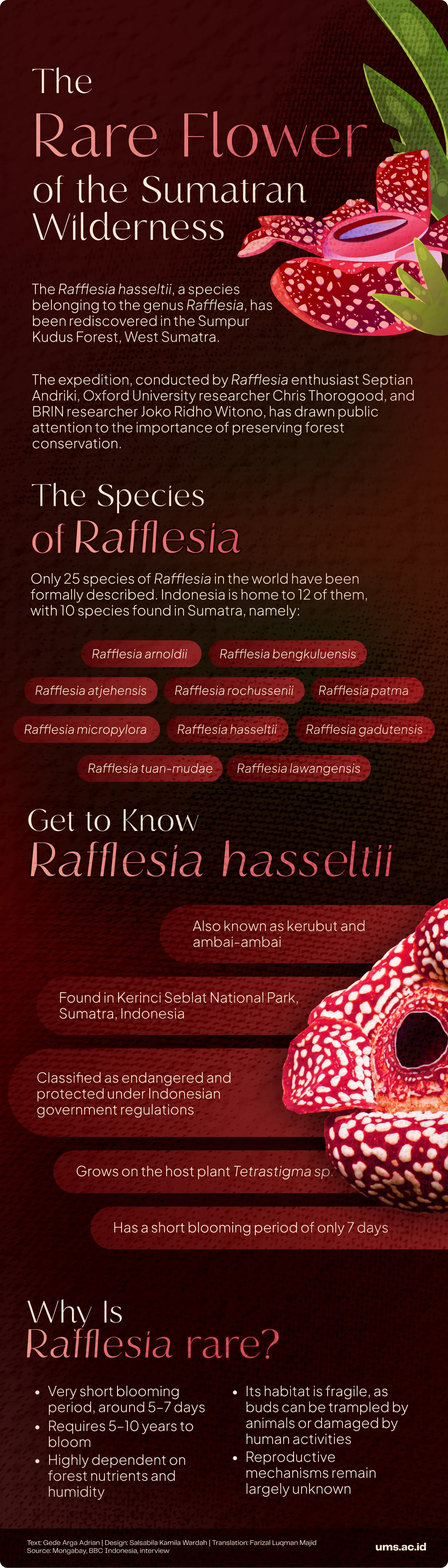
The viral discovery of Rafflesia hasseltii in the forests of West Sumatra has once again raised concerns about the urgency of forest conservation, especially as ongoing land conversion threatens the growth of this rare kerubut flower.
Mongabay records show that West Sumatra lost 139,590 hectares of forest between 2011 and 2021, an alarming trend that signals the worsening condition of its forest ecosystems.
Tika said that forest conservation holds a key role in ensuring the survival of Rafflesia. This, she added, must be accompanied by strong commitment from both the government and the community.
“It is our duty to protect forest environments so they do not become damaged beyond repair,” she stressed.
Forest protection needs clearer and stronger enforcement. This requires government regulations backed by firm sanctions for those who damage forest ecosystems.
Such measures are necessary to prevent forests from being cleared by irresponsible individuals. “These forests are very easy for humans to encroach upon or enter. That may be what leads to the extinction of Rafflesia,” Tika added.
The tears shed by Deki and the joyful smile of Chris Thorogood must move beyond the screen and into real action. Their passion for protecting forest ecosystems must spread to all Indonesians. Only then can our commitment to preserving Rafflesia endure, so its beauty can be cherished for generations to come.
Writer: Gede Arga Adrian
Translator: Farizal Luqman Majid
Editor: Al Habiib Josy Asheva
Sheep dunged nutrient-rich organic fertilizer for plants, made with the help of maggots. Built on community empowerment and a zero-waste principle.
Nothing’s more special than reading curated news just for you.
Subscribe to the UMS Newsletter for free today.