
The Sin of Football Betting
26 June 2026
Amid the FIFA World Cup 2026 euphoria, football betting is also spreading through digital platforms and conventional means.

Vice President Gibran Rakabuming Raka has, on several occasions, expressed the idea of discontinuing the zoning system in the student admissions process (PPDB). He believed the implementation of this policy is not adequately prepared and often results in inequities in practice.
According to a report by Tempo, Gibran previously urged the Minister of Primary and Secondary Education, Abdul Mu’ti, to abolish the zoning system. He said this statement during the Coordination Meeting on Evaluating Basic and Secondary Education Policies at the Sheraton Grand Jakarta Gandaria City Hotel, South Jakarta, on Monday (11/11/2024).
As we know, the zoning system has sparked both support and criticism among the public since it was effectively implemented in 2017. So, will the discontinuation of the zoning system prove to be a suitable solution or a step backward for achieving equitable education in Indonesia?
The zoning system prioritizes geographical proximity between a student’s residence and the school during the PPDB. This system was first implemented through the Minister of Education and Culture Regulation (Permendikbud) Number 51 of 2018.
Over time, the zoning policy underwent adjustments and was most recently regulated under Permendikbud Number 1 of 2021. This regulation established four selection pathways for public schools: the zoning pathway, the affirmation pathway, the parental relocation pathway, and the achievement pathway.
Prof. Dr. Harsono, M.S., a Professor in the Faculty of Teacher Training and Education at Universitas Muhammadiyah Surakarta (UMS), stated that the zoning system is an implementation of Article 11, Paragraph (1) of Law Number 20 of 2003 concerning the National Education System. This policy mandates the government to ensure quality education for every citizen.
“The strict implementation of the zoning system began with Permendikbud Number 51 of 2018. PPDB was carried out through the zoning pathway, followed by the achievement pathway and the parental relocation pathway. Now, there are four pathways, with the addition of the affirmation pathway,” explained Harsono during our meeting in his room on Tuesday morning (24/12/2024).
According to Harsono, the allocation of school capacity for the zoning pathway is regulated with different proportions for each level of education. For elementary schools (SD), at least 70% of the school’s capacity is allocated for the zoning pathway. Meanwhile, for junior high schools (SMP) and senior high schools (SMA), at least 50% of their capacity is designated for the zoning pathway.
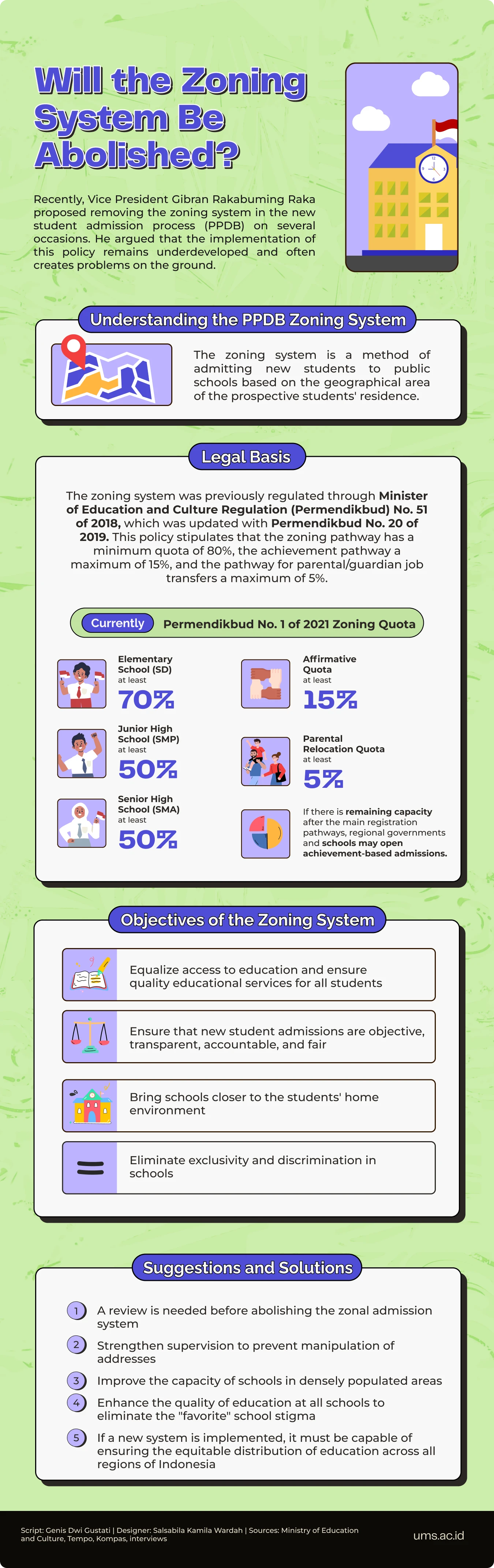
“The goal is noble. In the past, schools were labeled as ‘favorite’ or ‘elite.’ Those terms were precisely what this policy aimed to eliminate. It was created to remove the stigma of favoritism in schools and achieve equal education quality,” added the lecturer from the Faculty of Teacher Training and Education at UMS
One of the primary benefits of the zoning system, he said, is providing greater access to students from less fortunate families. Previously, academic achievement-based admissions often favored students from affluent families who had greater access to tutoring and additional educational facilities.
“With the zoning system, students from various backgrounds have the opportunity to be accepted at the same school. It helps create heterogeneity in the composition of students,” Harsono explained.
However, Harsono acknowledged that the zoning system often encounters various challenges in practice. In some cases, many parents have complained about their children not being accepted at the nearest school due to zoning discrepancies.
“The requirements for the zoning pathway rely heavily on the geographical proximity between a student’s residence and the school’s location. Ironically, students living close to certain schools may not be admitted because they are outside the designated zone,” Harsono elaborated.
The frustration over school zoning distances was also voiced by Maryani, a parent of a student at a junior high school in Sragen. Her child, Nanda, was excluded from the selection. “Our house is not far from the school, less than 2 km. If we ride a bike, it takes about 10 minutes. But she wasn’t accepted because we’re in zone 3,” said Maryani at her residence in Masaran, Sragen, Thursday (26/12/2024).
Maryani explained that being in zone 3 meant her child was not prioritized in the selection process. “If the school is closer, it’s easier to monitor the child. She has studied hard, but lost out because of distance. I just don’t understand why there has to be such restrictions,” she lamented in disappointment.
Another recurring challenge comes from cases of administrative manipulation, such as address migration to gain access to favored schools. Harsono mentioned encountering such cases several times in the field.
“In my experience in the education sector, I’ve come across several cases in Solo Raya. Some parents moved or even 'falsified' their residence addresses just so their children could fall into a school’s preferred zone. This undermines the very essence of the zoning policy,” Harsono said regretfully. As a result of zoning exploitation, the population around favored schools ends up increasing.
Harsono’s findings align with a report by Kompas.com on Monday, June 24, 2024, which revealed that 31 prospective students were disqualified from PPDB for high schools, vocational schools, and special education schools in West Java. They were caught manipulating family card addresses to gain entry into favored schools.
According to Harsono, if the zoning system is abolished, a selection system based on academic achievement is likely to be reintroduced. He believed this move could worsen disparities in access to education.
The elimination of the zoning system also risks bringing back social segregation in schools. Before zoning, elite or favored schools were dominated by students from affluent families, while students from less privileged families had limited opportunities to access quality education.
“What usually happens is that students from well-off families have a greater advantage in such competitions. They have access to private tutoring or test preparation courses,” explained the expert on education management.
Despite its shortcomings, the zonal PPDB system has proven effective in reducing the learning achievement gap by 20 percent in literacy and numeracy at the junior high school and senior high school levels. According to a report from Kompas.id, The National Research and Innovation Agency researcher Syahrul Ramadhan noted that this system has expanded access for students from lower-middle-class backgrounds to attend prestigious schools, thus increasing socio-economic diversity in public schools.
Syahrul's 2022 findings highlighted a rise in inclusivity, with more educational opportunities opening up for students with disabilities. His research was based on studies in nine regions, conducted through in-depth discussions and interviews with local leaders, admission committees, and parents of students.
Harsono suggested that the government should not rush to abolish the zoning system. Instead, the zoning policy needs to be improved and equipped with stricter mechanisms.
In addition to tighter oversight, the zoning system must be balanced with efforts to improve the quality of education in all schools. If successfully implemented, the public will no longer perceive certain schools as "favored" or "elite." “If all schools have equal quality, these labels will fade, and people will no longer compete for specific schools,” he added.
The proposed elimination of the zoning system, as suggested by Vice President Gibran, requires careful consideration, Harsono stated. The shortcomings of the zoning system need to be addressed with effective measures to achieve equitable access to education.
“However, if the zoning system is to be replaced with a new one, ensure the system can accommodate equitable education from Sabang to Merauke for all citizens of school age under the 12-Year Compulsory Education Program, including elementary, junior high, and high school levels. Everyone must be accommodated!” Harsono emphasized.
The journey toward equitable and quality education requires commitment from all stakeholders, including the government, the community, and educational institutions. Removing the zoning pathway requires a lot of consideration. If a new system is to be implemented, it must involve careful planning, strong public outreach, tests and trials, and other reinforcements.
Concluding the discussion, Harsono stressed, “The zoning system was initially designed to seek equal education. It’s not a perfect policy, but it serves as a foundation that can be improved and refined.”
Writer: Genis Dwi Gustati
Translator: Farizal Luqman Majid
Editor: Al Habiib Josy Asheva
Amid the FIFA World Cup 2026 euphoria, football betting is also spreading through digital platforms and conventional means.
Nothing’s more special than reading curated news just for you.
Subscribe to the UMS Newsletter for free today.