
How Sheep Manure Turns into Nutrient Rich Fertilizer
16 July 2026
Sheep dunged nutrient-rich organic fertilizer for plants, made with the help of maggots. Built on community empowerment and a zero-waste principle.




A shocking viral video has surfaced online, depicting a heated confrontation between a woman and a minimarket cashier. The woman’s anger was sparked by the UHT milk she purchased, which was not cold.
In the viral video, the woman is clutching a liter of UHT milk while shouting and demanding a refund for the milk and the online motorcycle taxi delivery fee.
“If it’s not cold, I want my money back. The milk should be cold, because I ordered the small milk before, and it was cold. I don’t care, and I’m already late,” said the woman in the video circulating on Tuesday (9/7/2024).
The video has sparked outrage among netizens, many of whom consider the woman’s actions unreasonable. Scathing comments have flooded the post, with some netizens even resorting to jokes and suggesting she simply store her UHT milk in the fridge at home to avoid such outbursts.
“FYI, there’s no UHT milk that goes into the chiller at the minimarket.”
“What she’s holding is the regular one-liter UHT from the shelf, which doesn’t need refrigeration, unlike the pasteurized kind.”
“Just refrigerate it at home, Ma’am.”
These were some of the comments left by Instagram users on @lambe_turah’s post.
Fitriana Mustikaningrum, Ph.D., the Head of UMS Basic Laboratory of Nutrition Science, explained that UHT (Ultra High Temperature) milk undergoes high-temperature heating in a short time. This process sterilizes the milk, making it safe to store at room temperature.
“Before being marketed, UHT milk undergoes a sterilization process using the thermal method, a food preservation process that utilizes heat energy. The temperature typically reaches 135-145 degrees Celsius for just two to three seconds,” explained Fitriana.
The heating process of UHT milk effectively preserves most of its nutritional content, including protein, fat, carbohydrates, vitamins (A, D, B2, B12), and minerals (calcium, phosphorus, magnesium, zinc, selenium). By maintaining a fast and precise heating process, UHT milk is able to retain its nutritional value without compromising its quality and safety.
“It is true that some nutrients in UHT milk cannot withstand high temperatures so the heating only lasts for two to three seconds. This is done to minimize the nutrition loss of UHT milk,” said the nutrition sciences lecturer.
The process of heating UHT milk to high temperatures effectively kills bacterial vegetative cells and most harmful microorganisms present in the milk. This treatment gives UHT milk a longer shelf life, allowing it to remain fresh from production to consumption without deterioration or damage.
“That’s why UHT milk is categorized as sterile milk, making it safe to store at room temperature. However, consumers should still watch for signs that UHT milk may no longer be consumable,” she warned.
According to Halodoc, UHT milk undergoes rapid high-temperature processing, making it more sterile than pasteurized milk, which is heated only at 72-85°C for 10-15 seconds.
Pasteurization doesn’t eliminate all microorganisms in milk, but the remaining bacteria are generally not harmful and don't cause dangerous diseases.
“To prevent the growth of any remaining bacteria, pasteurized milk should be stored at a cool temperature, which is between 2 and 6 degrees Celsius is ideal,” said Fitriana.
In addition, UHT milk available on the market comes in multi-layered aseptic packaging to ensure its safety and durability. This packaging protects the milk from external influences, keeping it free from moisture and oxygen.
“If we go to minimarkets, the UHT milk we typically find already uses Tetra Pak or aseptic packaging,” Fitriana added.
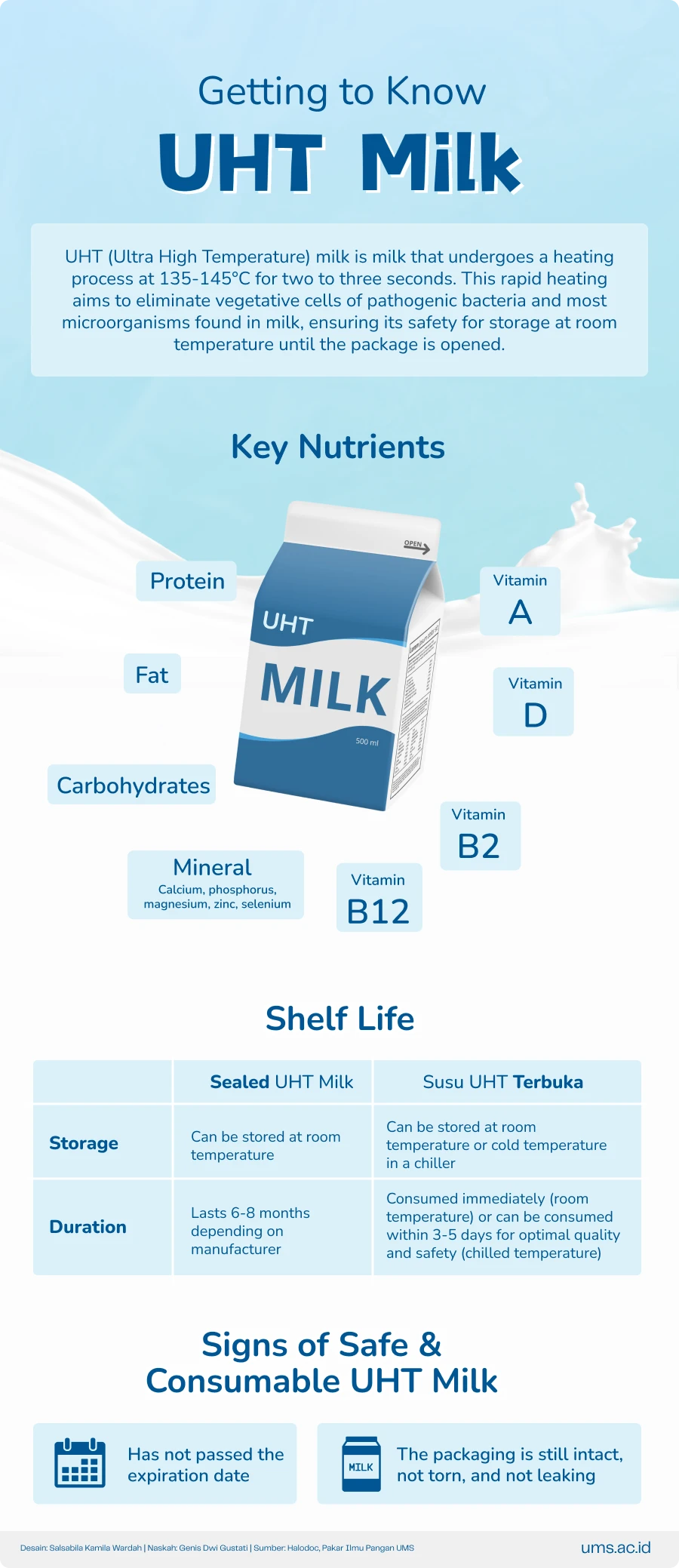
Sealed UHT milk can be stored at room temperature and has a long shelf life of around six to eight months, depending on the manufacturer. However, once opened, UHT milk has a shorter shelf life. If left at room temperature, it should be consumed immediately. It can last three to five days if stored in a chiller or refrigerator.
Aan Sofyan, M.Pd., M.Sc., a lecturer in Nutrition Sciences and researcher at UMS Center for Halal Studies, explained that UHT milk stored at room temperature can experience nutritional and microbiological damage.
“Nutritional and microbiological damage can occur due to packaging damage. If the packaging is compromised or not intact, bacteria from outside can enter and contaminate the milk. These bacteria can easily multiply and degrade the nutrients in the milk. Such conditions can cause the milk to become rancid or stale,” he explained.
The UMS food microbiology expert also reminded consumers to be more careful when buying UHT milk at minimarkets. Some people are indifferent and buy without checking the expiration date.
“Consumers must be careful! The expiration date is crucial as it indicates the safe period for consuming the product. Once the expiration date has passed, UHT milk can decline in quality and there is a risk of contamination, which could potentially jeopardize health,” said Aan.
According to Aan, the viral video’ highlighted the public’s lack of food safety literacy. However, the growing awareness and concern about safe food, particularly milk, encourages him. This is evident in consumers’ increased interest in the types of food they consume and how they are handled after production.
“People still need a lot of literacy. When people have a good understanding of food safety, they will be wiser in choosing, storing and consuming food, so that health risks can be minimized,” Aan suggested.
According to him, mass media is vital in spreading accurate and educational information about food safety. In-depth reporting and educational programs on television, radio, and social media can enhance public understanding of proper food storage and consumption practices.
Aan believes the government, through the Health Department and the Food and Drug Administration (BPOM), should take a more active role in conducting food safety campaigns and educational programs.
Educational institutions, particularly universities, also play a strategic role in food safety. Community service programs can focus on educating the public about food safety practices.
“Students from various majors, especially those in food and health-related fields like Nutrition Science, can play a crucial role,” said the UMS Nutrition Science lecturer. “Through community service programs, they can provide hands-on counseling and training on safe food storage and consumption directly to the community.”
He continued that consumer awareness is equally important. It’s about how consumers can take an active role in ensuring the food’s safety.
“Be a smart consumer, and be careful before buying!” he said.
Writer: Genis Dwi Gustati
Editor: Al Habiib Josy Asheva
Translator: Farizal Luqman Majid
Sheep dunged nutrient-rich organic fertilizer for plants, made with the help of maggots. Built on community empowerment and a zero-waste principle.
Nothing’s more special than reading curated news just for you.
Subscribe to the UMS Newsletter for free today.