
How Sheep Manure Turns into Nutrient Rich Fertilizer
16 July 2026
Sheep dunged nutrient-rich organic fertilizer for plants, made with the help of maggots. Built on community empowerment and a zero-waste principle.




The imbalance between income and the cost of living in Indonesia has pushed millions of workers to take on additional jobs. Consequently, working hours become longer and may pose risks to mental health.
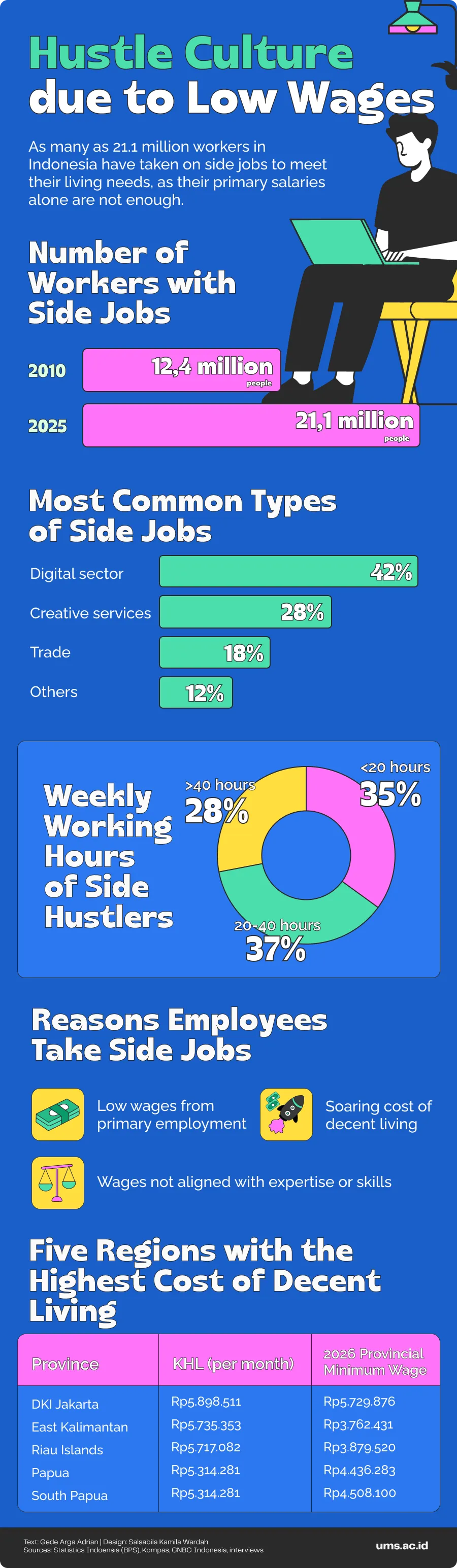
Newspaper Kompas, in its March 4, 2026 edition, reported that the number of workers with side jobs has surged 69 percent over the past 15 years. In 2010, about 12.4 million workers had side jobs. By 2025, that number had jumped to 21.1 million.
The same report also compared this with the disproportionately slower growth of the working population. The number of employed people increased from 109 million in 2010 to 146.5 million in 2025, representing only a 34 percent growth. Meanwhile, workers seeking additional income grew twice as fast as the overall workforce.
Among professionals, the number of workers with side jobs rose 11.5 times over the past 15 years, from 116,436 to 1.35 million.
A similar trend is seen among state personnel who already receive fixed incomes. An analysis by Kompas based on the 2025 National Labor Force Survey conducted by the Statistics Indonesia (BPS) shows that 6.43 percent of Indonesian military and police personnel, equivalent to 42,577 individuals, also hold side jobs.
Meanwhile, 16.4 percent of government employees, or about 1.7 million civil servants, have side jobs. Workers in the administration, defense, and mandatory social security sectors account for 17.3 percent, or 891,479 employees.
Prof. Muhammad Sholahuddin, S.E., M.Si., Ph.D., Professor of Sharia Entrepreneurship at Universitas Muhammadiyah Surakarta (UMS), explained that this phenomenon is largely driven by the imbalance between workers' incomes and the cost of decent living (Kebutuhan Hidup Layak/KHL) in Indonesia.
"Previously, side jobs were often taken up as hobbies. Now they are no longer hobbies but necessities. This means side jobs are taken to cover existing living needs," explained Sholahuddin when interviewed in his office at the Faculty of Economics and Business, UMS, on Saturday (14/3/2026).
The imbalance between income and the KHL is reflected in the KHL standard released by the Ministry of Manpower in December 2025. To live decently in Central Java, for instance, a person needs to budget around Rp3.5 million per month. However, the provincial minimum wage in Central Java is only around Rp2.3 million, meaning workers need an additional Rp1.2 million to meet the decent living standard.
A similar disparity is also visible in West Java. The provincial minimum wage there is also around Rp2.3 million, while the KHL standard in the region reaches Rp4.1 million. "Even from their main income alone, it is still not enough," he added.
Sholahuddin also noted that the salary structure in Indonesia has not adequately taken into account the expertise of professionals. According to him, the current wage system still follows a capitalist framework that does not favor the working class.
"In a capitalist system, wages are set based only on basic consumption needs, food and drink. In reality, wages should reflect the worker's expertise," he explained.
Sholahuddin said that this situation leads many people to work harder while feeling increasingly insecure about their economic conditions. Wage disparities between central and regional areas further aggravate the issue.
"The real problem lies in the economic structure that makes primary income too fragile when faced with living costs and price fluctuations," said the Head of the Master of Management Program at UMS.
Shaddam Hasan, S.M., M.Com., CFP., a Digital Business lecturer at UMS, acknowledged that current technological developments have opened up diverse opportunities for side jobs. The emergence of freelance platforms such as Fiverr and Upwork allows Indonesian workers to work remotely.
"That's why the term remote worker has become so common now, people who work from a distance and can potentially hold multiple jobs," Shaddam said in a virtual interview on Saturday.
In 2023, the BPS recorded that side jobs were distributed across three main sectors: 42 percent in the digital industry, 28 percent in creative services, and 18 percent in trade. The remaining 12 percent were spread across various other types of work.
This trend also affects the number of hours side workers put in each week. Around 28 percent of workers take side jobs for under 20 hours per week, 37 percent work 20–40 hours per week, and 28 percent work more than 40 hours per week.
Shaddam believed that taking on a side job is not actually an ideal situation. However, economic pressures often leave workers with little choice. "Ideally, one job should be enough to meet someone's living needs. People shouldn't have to look for side jobs," he explained.
Excessive working hours can affect workers' psychological and physical well-being. Nisrina Hanun Iftadi, S.Psi., M.Psi., Psikolog., a psychology lecturer at UMS, explained that the two are closely interconnected. "A high workload can trigger distress both physically and psychologically," Nisrina said.
According to her, the combination of physical and mental fatigue can potentially develop into more serious conditions, ranging from burnout to depression. Physical and mental exhaustion can also reduce an individual's fitness level, which may further worsen workers' mental health.
Nisrina added that each individual's physical response may differ. These differences depend on personal characteristics and the motivations that drive someone to take on a side job.
"Some people may naturally have a strong sense of ambition, so they intentionally challenge themselves by taking on additional activities beyond their main job," she explained.
In general, stress can actually help individuals grow and develop. However, excessive stress levels can instead reduce work performance. Nisrina emphasized that an optimal level of stress is needed to push individuals toward peak performance.
Good stress management skills are therefore necessary to maintain optimal performance at work. According to Nisrina, the key lies in managing one's perception, focusing on what can be controlled and letting go of what cannot.
"This helps us remain calmer and more accepting of the conditions we face," she added.
Family support is also important for workers who take on side jobs voluntarily. However, if individuals are forced to seek additional work because their salaries are insufficient, Nisrina stressed, "Firm regulations from the government and business actors play a far more crucial role."
Writer: Gede Arga Adrian
Translator: Farizal Luqman Majid
Editor: Al Habiib Josy Asheva
Sheep dunged nutrient-rich organic fertilizer for plants, made with the help of maggots. Built on community empowerment and a zero-waste principle.
Nothing’s more special than reading curated news just for you.
Subscribe to the UMS Newsletter for free today.