
How Sheep Manure Turns into Nutrient Rich Fertilizer
16 July 2026
Sheep dunged nutrient-rich organic fertilizer for plants, made with the help of maggots. Built on community empowerment and a zero-waste principle.




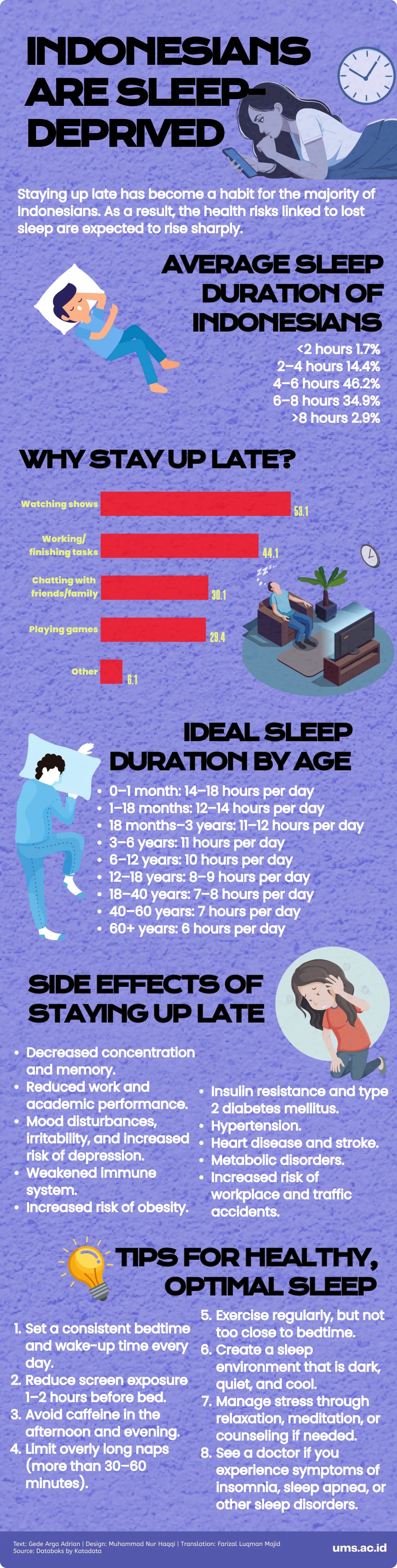
Staying up late is the habit of remaining awake at night, which steadily cuts into one's sleep hours. This habit, it turns out, has become commonplace among most Indonesians. No wonder Indonesians have earned the title of the most sleep-deprived.
A Kurious–Katadata Insight Center survey shows that 46.2 percent of Indonesian respondents typically sleep 4–6 hours per day. Meanwhile, 34.9 percent of respondents sleep 6–8 hours per day, 14.4 percent sleep 2–4 hours per day, and 1.7 percent sleep less than 2 hours per day. Only 2.9 percent of respondents sleep more than 8 hours per day.
The survey on staying up late was conducted among 875 respondents spread across Indonesia. The breakdown consisted of 52.1 percent male respondents and 47.9 percent female respondents.
Staying up late is most commonly practiced by respondents aged 35–44 (33.3 percent), followed by the 25–34 age group (31 percent), and the 45–54 age group (21.5 percent).
Staying up late has become an Indonesian habit due to several activities frequently done at night. Among the same respondents, 53.1 percent said they spend their late-night hours watching shows.
Some 44.1 percent of respondents are forced to stay up late to finish assignments or work through the night. Meanwhile, 30.1 percent of respondents choose to chat with friends or family, and 29.4 percent admit to playing games.
Another 6.1 percent of respondents engage in other activities, such as praying, looking after children, scrolling through social media, online shopping, or even searching for job openings.
Dr. Budi Hernawan, M.Sc., a lecturer at the Faculty of Medicine, Universitas Muhammadiyah Surakarta (UMS), says gadget use is the factor that most often drives people to stay up late.
"Physiologically, this is because exposure to light, particularly the blue light emitted by electronic screens, can suppress melatonin secretion, causing the circadian rhythm to shift later into the night," Budi said in an interview on Friday (12/6/2026).
Budi explained that sleeping 4–6 hours per day generally falls short of ideal. He recommends that adults aged 18–64 get 7–9 hours of sleep per night.
An ideal sleep duration helps maintain physical and mental health and keeps cognitive function performing at its best. However, Budi emphasized that this figure can vary. For a small portion of the population with certain genetic factors, shorter sleep durations can still be effective for their bodies.
"For the general population, consistently sleeping less than 6 hours per night over the long term can be associated with an increased risk of various health problems," Budi stressed.
According to Budi, sleep is vital to the body because it is a basic biological need, just like eating and breathing. During sleep, the body continues to carry out the following physiological functions:
Budi concluded that sleep is not a passive phase. "This sleep phase is actually an active phase that is essential for maintaining the body's homeostasis (internal stability)," he added.
The side effects of staying up late on the body are highly varied. If done occasionally, Budi said, "It usually only causes temporary fatigue."
When staying up late becomes a long-term habit, however, it can take a toll on the body's health, including:
The dangers of staying up late also differ between men and women. In general, the impact is felt in the reproductive organs of both sexes.
Side effects of staying up late in men include: lower testosterone levels, decreased libido, erectile dysfunction, reduced sperm quality, loss of muscle mass, and slower physical recovery.
"Men who lack sleep also show an increased risk of metabolic syndrome and cardiovascular disease," Budi added.
As for women, the side effects of staying up late include: irregular menstrual cycles, reduced fertility under certain conditions, worsened premenstrual syndrome symptoms, mood disturbances, and even risks of pregnancy complications such as gestational hypertension and gestational diabetes.
"Lack of sleep can also increase the risk of weight gain and metabolic disorders, just as it does in men," he continued
Staying up late too often is, as it turns out, linked to premature death. However, Budi explained that such deaths do not occur from a single night of lost sleep. "These deaths result from the increased risk of chronic diseases associated with sleep deprivation," he explained.
The consequences of chronic sleep deprivation on the body include coronary heart disease, stroke, diabetes, hypertension, drowsiness-related accidents, and certain mental health disorders.
The dangers of staying up late are also reflected in several epidemiological studies. These studies show that short sleep duration particularly less than 6 hours per night over the long term is associated with increased mortality.
Improving sleep quality is important, but on its own it is not enough; lifestyle improvements must follow as well.
To reduce the risks of staying up late, Budi recommends several tips the public can follow to achieve healthy, restful sleep:
Budi emphasized the importance of maintaining both sleep quality and sleep quantity. Both are equally important for protecting bodily health.
"Improving sleep quality is important, but that alone is not enough. It must be accompanied by improvements in lifestyle," he urged.
Writer: Gede Arga Adrian
Translator: Farizal Luqman Majid
Editor: Al Habiib Josy Asheva
Sheep dunged nutrient-rich organic fertilizer for plants, made with the help of maggots. Built on community empowerment and a zero-waste principle.
Nothing’s more special than reading curated news just for you.
Subscribe to the UMS Newsletter for free today.