
Beware of Brain Rot Symptoms
31 December 2024
Brain rot, or cognitive decay, is increasingly affecting Generation Z and Millennials due to technology addiction. What are the solutions?




Inside a house in Purwosari, Surakarta, Central Java, Rio Abei (24) a young entrepreneur surfed the apps on his mobile phone, completely absorbed. It was a habit for Rio to unwind after work. Her mother reprimanded him for being glued to his phone all the time. However, Rio turned a blind eye to her and continued his activity.
Rio said that he realized something was wrong. Despite being tired from working all day, he couldn’t stop looking for short video contents on Instagram Reels and TikTok. “My body was tired from work and my hands were really sore, but I keep scrolling through Instagram Reels and TikTok,” said Rio on Thursday (6/20/2024).
Rio feels that his excessive use of media has affected his work. “Even worse, when I’m working, sometimes I still want to open social media,” he continued. “This is really annoying” In fact, every time he wakes up, Rio admits that he reflexively opens his social media.
The social media that Rio commonly uses are TikTok, Instagram Reels, and YouTube Shorts. Rio said that whenever he opened these three apps, he would dive into the contents he liked, driven by the apps' algorithm. “There are a lot of things I like there,” he added.
For Rio, scrolling through social media is just a way to spend his free time. Unfortunately, the algorithm makes him lose himself in the content. Watching the content on the recommendation page isn’t enough for him, if he finds something he likes, he doesn’t hesitate to look deeper into the content creator’s profile.
“I’m getting more and more curious. Sometimes if there is funny content, I will definitely look into the creator’s account,” he continued.
There was a time when Rio cleaned up and got ready for bed. It was already 11 p.m. Just a moment before he had his eyes shut, he decided to open social media until the clock pointed at 2.30 a.m. “That was the point where I felt I had to detox from social media,” he said.
Rio’s habit of using social media has impacted his performance at the office. For instance, when he received a task that could be done in 1-2 hours, it took him up to two days. Every time an Instagram notification pops up, Rio feels compelled to open it immediately.
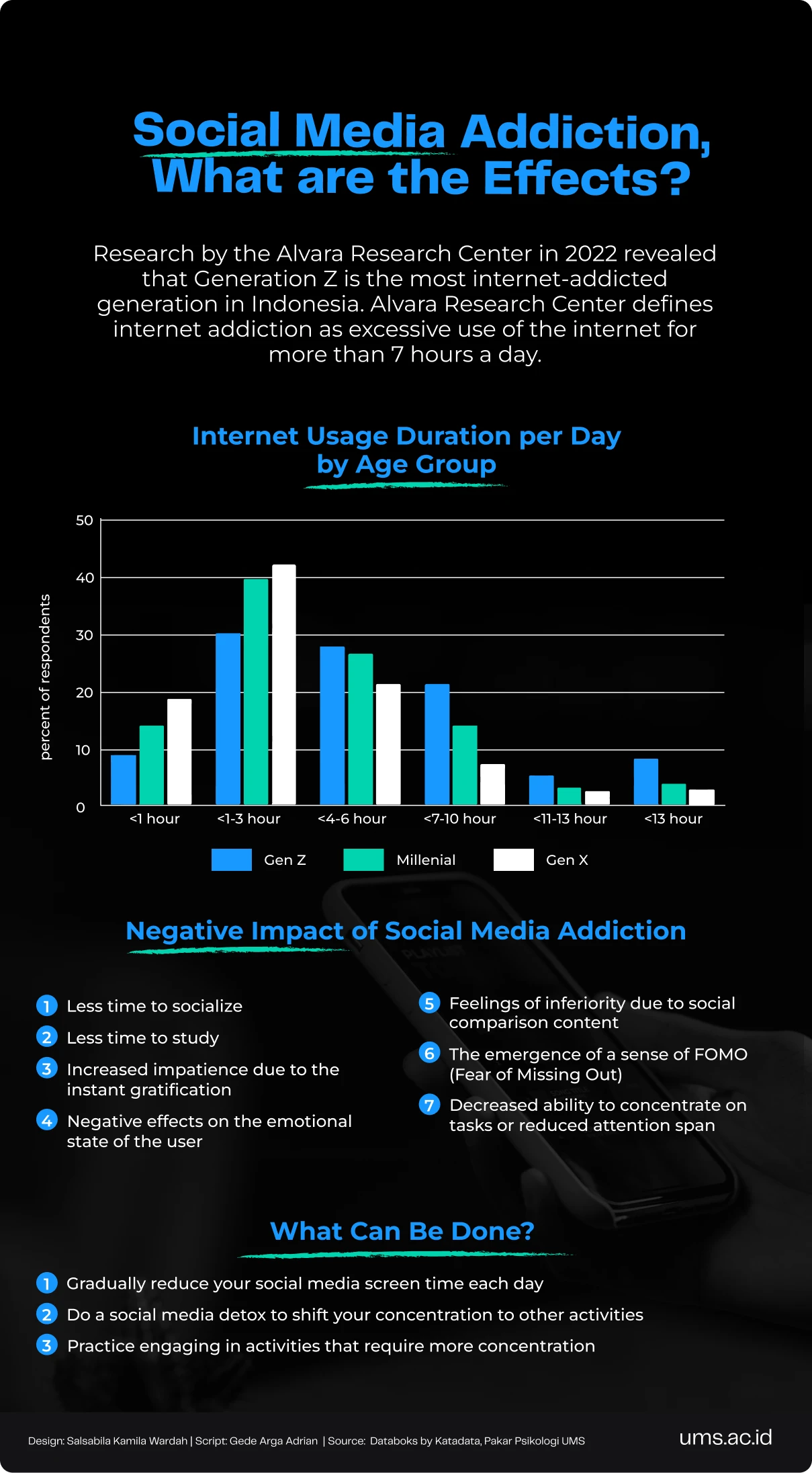
Rio’s experience is also felt by many other social media users in Indonesia. According to Databoks by Katadata, a survey conducted by Alvara Research Center 2022 found that internet-addicted users use the internet for more than seven hours a day.
The survey, conducted by interviewing 1,529 respondents from Generation Z, Millennials, and Generation X across Indonesia, revealed interesting findings. Among the respondents, those who access the internet for 7-10 hours per day accounted for 20.9 percent of Generation Z, 13.7 percent of Millennials, and 7.1 percent of Generation X.
Respondents who use the internet for 11-13 hours per day accounted for 5.1 percent of Generation Z, 3 percent of Millennials, and 2.4 percent of Generation X.
Meanwhile, respondents who access the internet for more than 13 hours per day accounted for 8 percent of Generation Z, 3.7 percent of Millennials, and 2.6 percent of Generation X.
Another survey from the State of Mobile 2023 report stated that Indonesia ranks first in the world for daily mobile screen time. On average, Indonesians spend 5.7 hours a day using their devices.
Bayu Suseno, S.Psi, M.Psi, a lecturer at the Faculty of Psychology at Universitas Muhammadiyah Surakarta (UMS), conveyed that excessive use of social media can negatively impact individuals. These include reduced time for socializing, decreased study time, and adverse effects on emotional well-being. Additionally, the addiction can lead to FOMO (Fear of Missing Out) and increased exposure to social comparison content, causing users to compare themselves with the lives of content creators.
“Sometimes, when we use social media and see other people’s content, we compare ourselves with others. For example, we might compare people’s achievements or vacation destinations,” he explained. Bayu added that similar to drug addiction, excessive use of social media can lead to withdrawal effects, a condition of discomfort in the body when not engaging with social media.
“It also appears when you have been engaging on social media for a while but suddenly stop,” continued Bayu. “Excessive use increases the body’s tolerance to social media, making it harder to quit.”
Although social media addiction often interferes with users’ daily lives, Bayu noted that this behavior is not yet classified as a medical disorder.
Bayu based his argument on the Diagnostic and Statistical Manual of Mental Disorders (DSM) released by the American Psychological Association and the International Classification of Diseases (ICD) from the World Health Organization (WHO).
“The DSM does not specifically mention social media usage but focuses on internet games. Even so, it is only a proposed addition and must be evaluated before it can be classified as a disorder in the DSM,” said the Master of Psychology Professional at Universitas Gadjah Mada.
According to Bayu, a psychological condition could be classified as a disorder if it involved a specific criteria, one of which was dependence or addiction. He used drug addiction as an example, explaining, “If addicts don’t use the drugs, we experience uncomfortable physiological or emotional sensations.”
He continued by explaining that addiction is also caused by distress in various aspects of life. Bayu noted that excessive social media use has not yet been categorized as an addiction. “So it is more accurately referred to as excessive behavior or excessive use of social media,” he added.
He explained that excessive behavior is maladaptive, leading to negative effects or unwanted outcomes. Such behavior is often accompanied by actions that reduce human productivity.
Bayu emphasized the importance of being aware of the negative effects of excessive behavior, including depression, mental disorders, psychological issues, and feelings of inferiority. According to him, the longer people are exposed to content on social media, the more stimuli their brains receive, which can lead to overload.
According to Bayu, the ease of accessing apps on mobile devices today impacts users’ psychology, especially children. Quickly switching between apps makes people, particularly children, more prone to tantrums and impatience.
“As soon as you click on it, you get information, so the tolerance for delayed gratification, the ability to wait for satisfaction, is decreasing,” Bayu explained.
Bayu emphasized that social media use should not interfere with other aspects of life. He stressed the importance of social media users monitoring.
According to the American Psychological Association, attention span refers to the length of time a person can maintain their concentration on a specific task.
Bayu explained that the duration of concentration can be influenced by a person’s level of development and the mental task at hand. Tackling a task requiring a high concentration level demands a lot of energy, which can lead to physical fatigue and a reduced attention span.
Addiction to social media is predicted to be the culprit for the decline in attention span. Bayu regrets that social media content currently allows users to get information quickly, even straight to the point, without any other explanation.
“Such content enables us to spend less mental effort than reading a full book,” Bayu explained. “Our effort to stay focused is actually exhausting because it requires more attention. When you’re using social media, if the information doesn’t interest you, you can just swipe.”
So, how do you restore that attention span? Bayu mentioned some tips to improve human concentration. First, reduce exposure to short content. This is because the information in short content is typically easy to digest and doesn’t require much mental effort.
Second, mentally train yourself to focus on things requiring more concentration. According to Bayu, practicing concentration should be done gradually and continuously. Training can start with short durations of concentration, and over time, the duration can be gradually increased.
“It’s like sports, if you want to run long distances, you can’t start immediately. You have to build up gradually,” he added.
Third, do a social media detox by reducing daily social media usage. According to Bayu, a social media detox allows users to temporarily avoid exposure to short content on social media.
“Attention span is related to mental effort and mental performance. We have to train our mentality to get used to things that require more attention,” Bayu concluded.
Writer: Gede Arga Adrian
Editor: Al Habiib Josy Asheva
Designer: Salsabila Kamila Wardah
Translator: Farizal Luqman Majid
Brain rot, or cognitive decay, is increasingly affecting Generation Z and Millennials due to technology addiction. What are the solutions?
Nothing’s more special than reading curated news just for you.
Subscribe to the UMS Newsletter for free today.