
How Sheep Manure Turns into Nutrient Rich Fertilizer
16 July 2026
Sheep dunged nutrient-rich organic fertilizer for plants, made with the help of maggots. Built on community empowerment and a zero-waste principle.



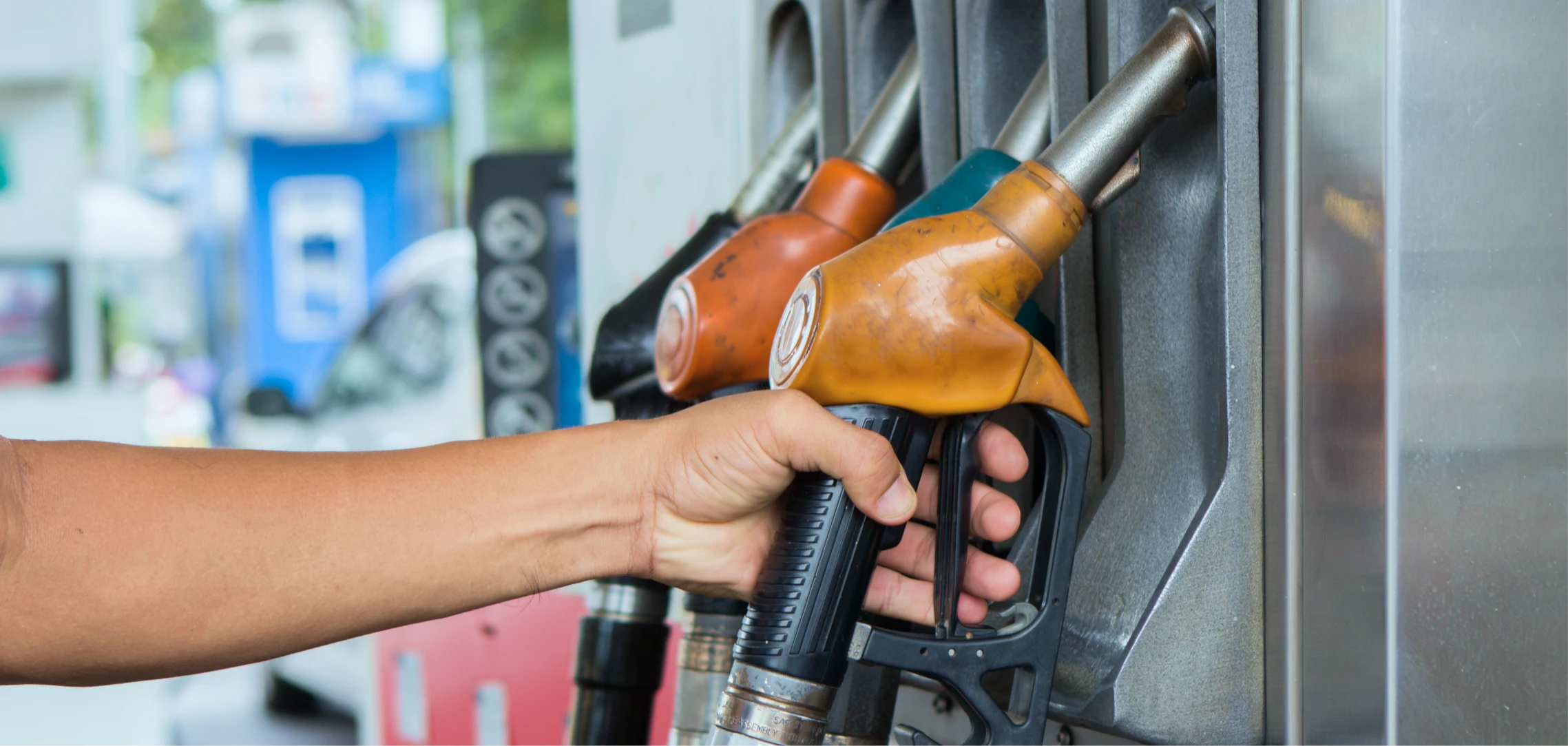
Suspicions of Pertalite being turned into Pertamax shake public trust, what are the impacts on vehicle engines?
The corruption scandal involving PT Pertamina Patra Niaga that has surfaced in recent days is no longer just a passing issue. The suspicion that fuel, which should be of high quality, has been “adulterated” to make quick profits has sparked concern among vehicle users.
According to a report from Solopos on Wednesday, February 26, 2025, PT Pertamina Patra Niaga’s President Director, Riva Siahaan, allegedly made it appear as though he was importing RON 92 fuel, commonly known as Pertamax. However, in practice, the fuel purchased was actually RON 90 or Pertalite. RON 92 and RON 90 were mixed together and then falsely labeled as RON 92 to secure higher crude oil prices through collusion with brokers.
A report from Tirto stated that the initial estimate of the total corruption at Pertamina reached IDR 193.7 trillion. However, Indonesia’s Attorney General’s Office clarified that this figure only accounts for losses in 2023. Worse still, Pertamina’s fraudulent activities reportedly spanned from 2018 to 2023, bringing the estimated total state losses to IDR 968.5 trillion, or possibly even more, reaching IDR 1 quadrillion.
Meanwhile, according to Kompas.id, as of Wednesday evening (26/2/2025), Indonesia’s Attorney General’s Office officially named several suspects in the Pertamina corruption case. They include Riva Siahaan (the main suspect), Sani Dinar Saifuddin (Director of Feedstock and Product Optimization at PT Kilang Pertamina Internasional), Yoki Firnandi (President Director of PT Pertamina International Shipping), Agus Purwono (Vice President of Feedstock Management at PT Kilang Pertamina Internasional), Muhammad Kerry Andrianto Riza (Beneficial Owner of PT Navigator Khatulistiwa), Dimas Werhaspati (Commissioner of PT Navigator Khatulistiwa), Gading Ramadhan Joedo (Commissioner of PT Jenggala Maritim), Maya Kusmaya (Director of Central Marketing and Trade at PT Pertamina Patra Niaga), and Edward Corner (Vice President of Trading Operations at PT Pertamina Patra Niaga).
Frustrated, angry, and deceived, that’s likely how loyal Pertamax customers feel. Due to the alleged fuel tampering, the product they paid for was not what they actually received.
On social media, netizens have been voicing their outrage over the Pertamax adulteration scandal. “Where is their conscience? May they be impoverished for seven generations! I don’t want to hear that they only get 20 years in prison after this!” wrote an Instagram user, @riri.rubus, in a comment on @kompascom’s post covering the Pertamina corruption case.
Dr. Nur Aklis, S.T., M.Eng., Head of the Master of Mechanical Engineering Program at Universitas Muhammadiyah Surakarta (UMS), who has long been involved in energy conversion, has weighed in on the effects of adulterated Pertamax fuel on vehicle engines.
“When we talk about fuel, there are other characteristics that determine how optimally gasoline is used in an engine. If the widespread narrative is that the gasoline is adulterated, then it’s not up to standard; the mixing is reckless,” Aklis said when met at Room H.4.4, Faculty of Engineering UMS, on Monday morning (3/3/2025).
In the automotive industry, the research octane number (RON) is the primary parameter for assessing gasoline quality. The higher the RON, the better its resistance to premature combustion, a phenomenon known as detonation or knocking.
Gasoline-powered vehicle engines are designed to operate with controlled combustion. If the fuel does not meet specifications, combustion may occur earlier than it should, leading to detonation.
If a vehicle designed for Pertamax’s RON is forced to use lower-quality gasoline, the effects will become noticeable over time. “A lower RON increases the likelihood of detonation, causing the engine to knock (an abnormal sound resulting from incomplete combustion in the engine), loss of power, and reduced efficiency,” explained Aklis, who is also the Vice Dean IV of the Faculty of Engineering at UMS.
Blending is the process of mixing gasoline with precise calculations to achieve a final product of a specific quality. In the oil industry, fuel mixing is a common practice.
“Blending is legitimate in the oil industry. For example, if we have a stock of RON 90 and RON 95 gasoline, we can mix them with precise calculations to obtain RON 92. This is a legal and widely practiced method in the industry,” he elaborated.
However, adulteration is a different matter. It is not just about mixing but rather manipulation without standard controls.
“If Pertamax RON is mixed with other substances without clear standards, that's no longer blending, that’s adulteration. The technical risks vary, from inconsistent RON levels to the presence of additives that could affect engine performance,” he said with frustration.
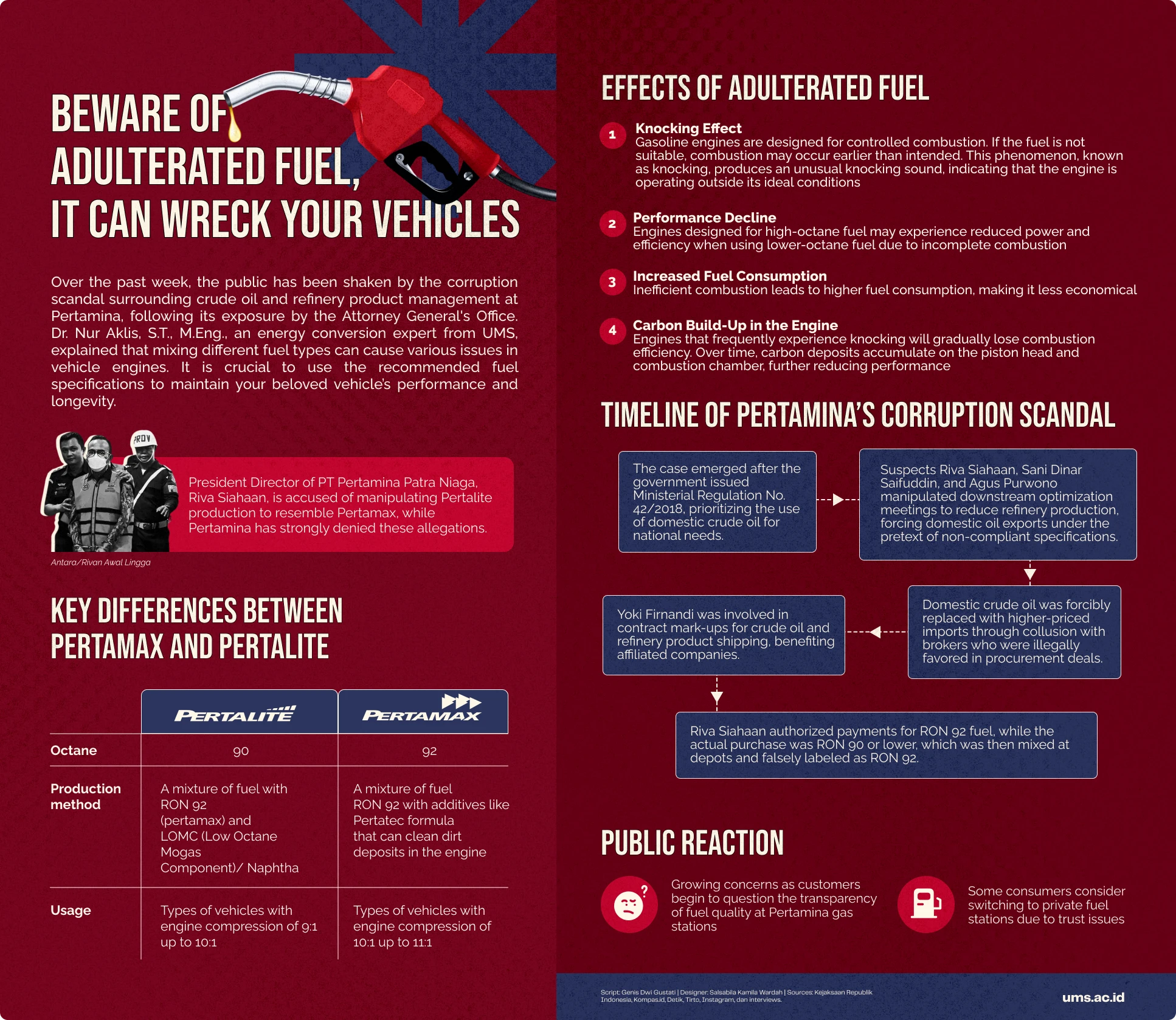
Aklis explained that vehicles running on substandard gasoline tend to experience detonation. This phenomenon produces a knocking sound, an abnormal ticking noise indicating the engine is operating outside its optimal limits.
“An engine that continuously experiences knocking will lose combustion efficiency. Over time, carbon deposits will accumulate on the piston head and combustion chamber, drastically reducing performance,” he said. As a result, the vehicle requires more fuel to generate the same power, making gasoline consumption increasingly inefficient.
Concerns about the quality of adulterated Pertamax have become more apparent through several posts from car and motorcycle users on the platform X. One such post came from the account @farhan_fauzani, who tweeted:
“I regularly fill up with Pertamax. Just last week, my motorcycle ended up in the repair shop because the fuel was clogged, turns out the tank had so much residue that it blocked the fuel line. Ended up replacing the tank for 800 rupiahs. Hope the Pertamina people who degraded the fuel quality until it gunked up engines also ended up gunked up in the deepest pits of hell.”
Responding to this outrage, Aklis said, “Complaints like this require further investigation. Is the issue caused by the fuel itself or the quality of the tank material, which may not be compatible with the substances in the gasoline mixture?”
So, if adulterated Pertamax is widely circulated, how is it being monitored? Shouldn’t there be a standard ensuring that every drop of fuel reaching the public complies with regulations?
The reality is that the current rules are still not strong enough to prevent fuel tampering. “Pertamina has strict standards in fuel production. But once it enters distribution, is the quality still maintained? That’s what makes us all skeptical,” Aklis said.
When a scandal is exposed, fuel testing may be conducted, and the issue temporarily corrected. But who ensures that once the storm passes, the same practice won’t happen again? “It’s hard to trust Pertamina if this really is fuel adulteration, then it’s a clear violation!” he exclaimed.
According to him, monitoring shouldn’t be done sporadically. There must be a regular inspection mechanism at every distribution point, from upstream to downstream. The loopholes in the distribution chain are exactly what irresponsible individuals exploit to manipulate fuel quality.
Beyond technical aspects and oversight, there is a moral dilemma within society that Aklis acknowledges: energy subsidies. RON Pertalite is sold at a lower price due to government subsidies, while RON 92 Pertamax costs around 30% more as it is unsubsidized.
"Some well-off individuals still choose Pertalite simply because it's cheaper. While it may be legally acceptable, ethically, it raises questions. Subsidies should be for those who truly need them," he said.
Many vehicle owners opt for Pertamax to maintain engine performance. However, with the recent Pertamax adulteration scandal, some users have decided to stop refueling at Pertamina stations, opting instead for private gas stations. No surprise then, that images of long queues at private fuel stations have surfaced across social media.
“The public is told to follow the rules, yet those managing the fuel supply are dishonest. This is what erodes public trust,” Aklis remarked with unease.
When the fuel consumers rely on for optimal engine performance fails to meet standards and lacks strict oversight, skepticism continues to grow. Consumers deserve the assurance that the gasoline they purchase truly matches its advertised quality.
“The quality of the fuel we use doesn't just affect our engines; it reflects how we manage our energy resources, honestly and responsibly,” he concluded.
Writer: Genis Dwi Gustati
Translator: Farizal Luqman Majid
Editor: Gede Arga Adrian
Sheep dunged nutrient-rich organic fertilizer for plants, made with the help of maggots. Built on community empowerment and a zero-waste principle.
Nothing’s more special than reading curated news just for you.
Subscribe to the UMS Newsletter for free today.