
How Sheep Manure Turns into Nutrient Rich Fertilizer
16 July 2026
Sheep dunged nutrient-rich organic fertilizer for plants, made with the help of maggots. Built on community empowerment and a zero-waste principle.




Speaking before members of Commission IX of the Indonesian House of Representatives (DPR-RI), Minister of Health Budi Gunadi Sadikin revealed findings of 51 malpractice cases in Indonesia between 2023 and 2025. Budi stated that the data was compiled by the Ministry of Health (Kemenkes) through public complaints, social media posts, and news media coverage.
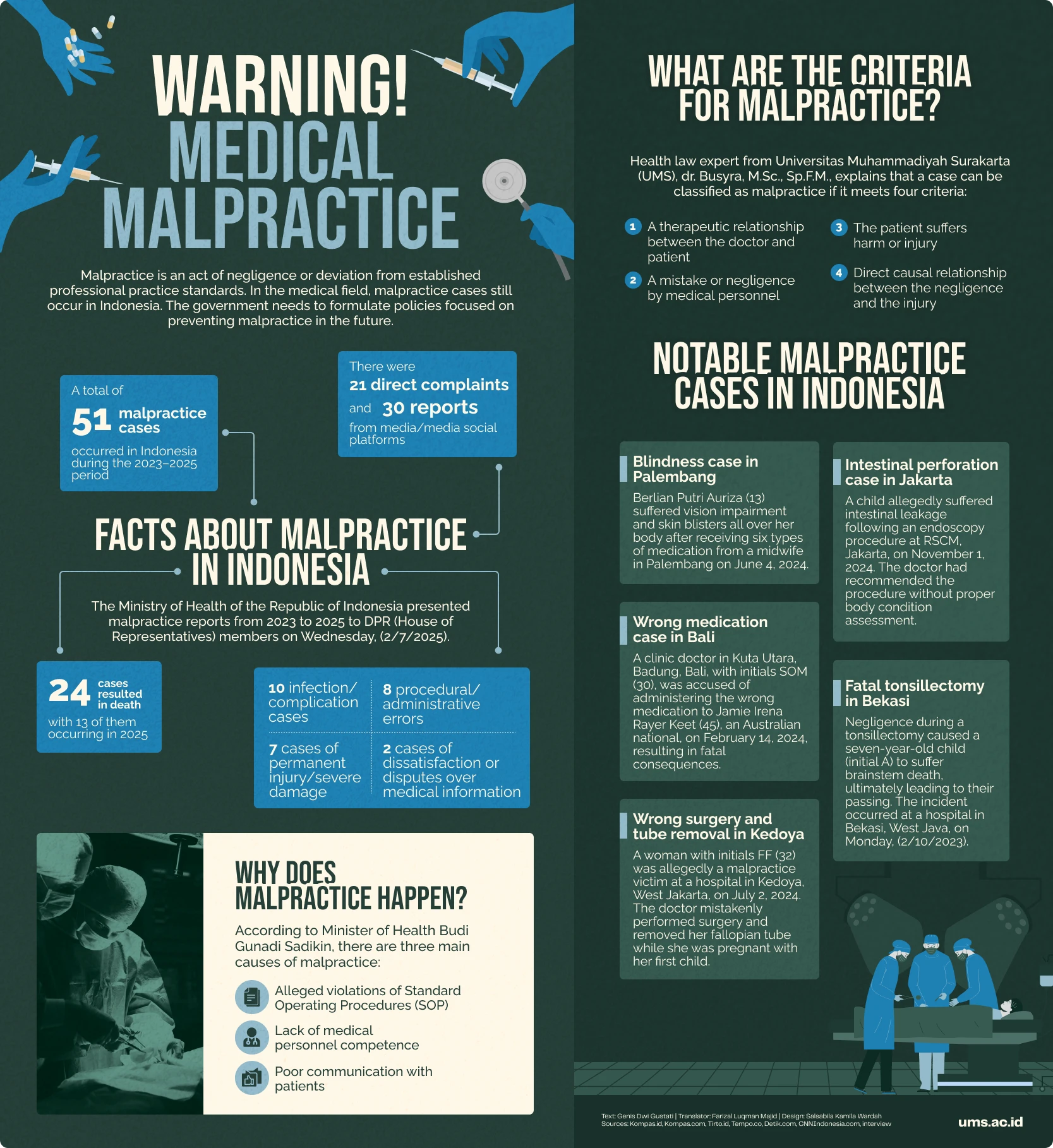
“There were 21 direct complaints and 30 cases from media/news sources, totaling 51,” said Budi during a working meeting with the Ministry of Health at the Parliament Building, Senayan, Central Jakarta, Wednesday (2/7/2025).
Budi explained that most cases reported to the Ministry had serious consequences. Twenty-four cases resulted in patient deaths, with 13 of those occurring in 2025.
The Ministry also recorded, 10 cases of infection or complications, 8 cases of medical or administrative procedural errors,, 7 cases of disability or severe injury, 2 cases related to information disputes or patient dissatisfaction
The types of violations, Budi said, include alleged deviations from standard operating procedures (SOPs), lack of medical staff skills, and poor communication with patients.
The Ministry noted that several complaints have already been addressed, while others remain under investigation by the Health Department and the Professional Discipline Council. Budi emphasized that the Ministry continues to monitor health facilities beyond formal accreditation requirements. “This incidental monitoring is mostly based on incoming reports. Now we’ve also started monitoring through social media,” Budi affirmed.
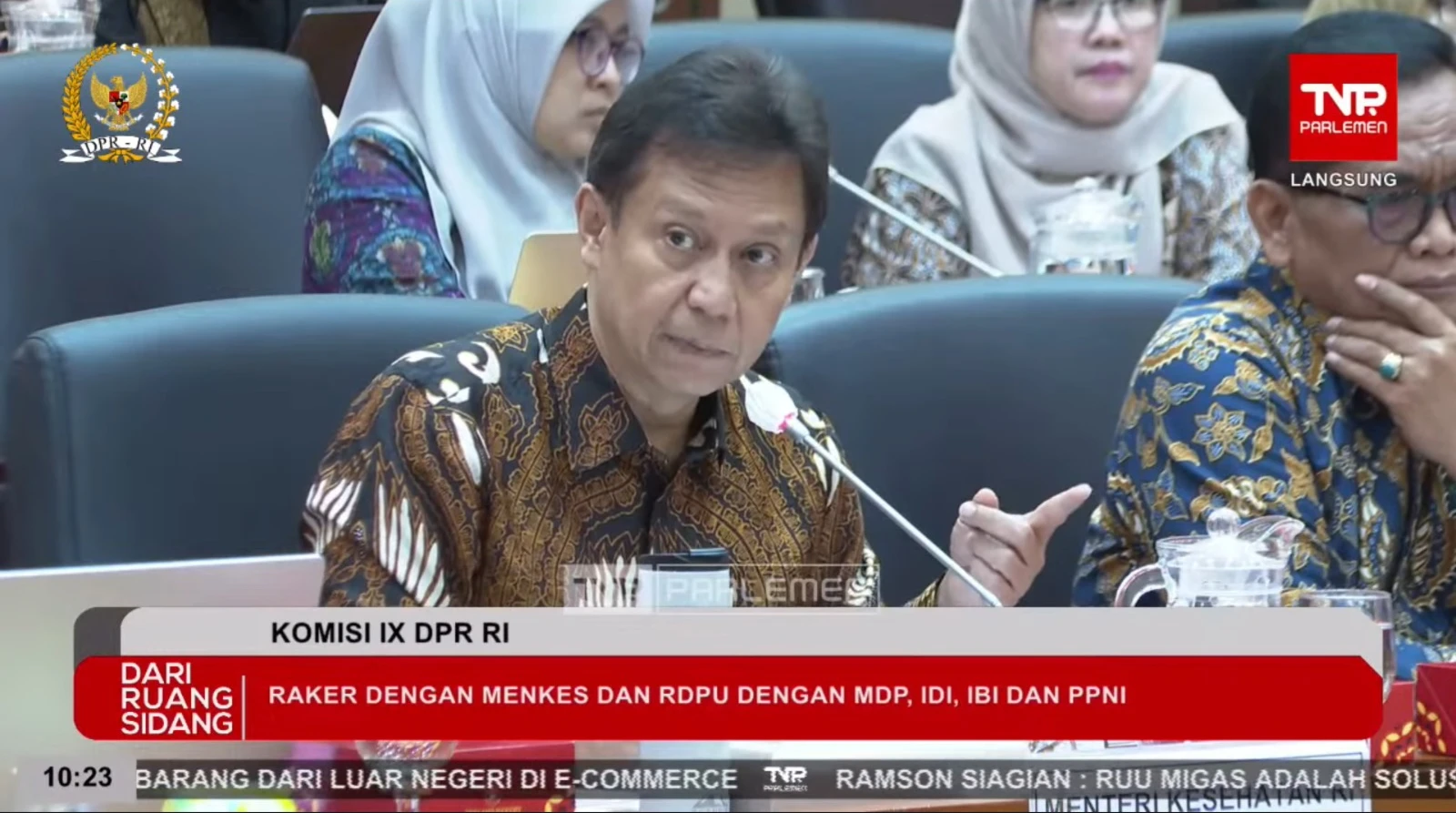
Health Minister Budi Gunadi Sadikin presenting the malpractice report during a Working Meeting with the Indonesian House of Representatives at the Parliamentary Complex, Senayan, Central Jakarta, Wednesday, 2 July 2025. Source: YouTube TV Parlemen.
Malpractice is an act of negligence or deviation from established professional standards of practice. According to the Indonesian Dictionary (KBBI), malpractice is defined as improper, incorrect, or unlawful medical practice that violates the law or ethical code.
Forensic and medicolegal specialist doctor from Universitas Muhammadiyah Surakarta (UMS), dr. Busyra, M.Sc., Sp.F.M., stated that the term "malpractice" is not explicitly defined in Indonesian statutory regulations. Nevertheless, he explained that malpractice cases must undergo legal verification.
“If, for instance, these dispute cases enter the legal realm, there must be sufficient evidence before they can be classified as malpractice,” said Busyra when met in his office, Friday (18/7/2025).
A case can be considered malpractice if it fulfills four elements: there is a therapeutic relationship between doctor and patient, a negligence or error done by the medical personnel, the patient suffers harm or injury, and a direct link between the negligence and the injury.
“Medical errors can also be related to the work system. For example, whether the work environment supports the doctor in performing their duties properly, that too is one of the influencing factors,” Busyra added.
Busyra expressed concern over the 51 malpractice cases reported by the Kemenkes. He emphasized the need for a thorough review of the reported figure
Especially since some cases originated from social media posts. He urged the Kemenkes to conduct a deeper investigation into these findings.
Nevertheless, the report of 51 malpractice cases in Indonesia deserves the attention of all stakeholders. “Clearly, many parties need to make improvements,” said the forensic and medicolegal specialist.
Reform can begin at the smallest level, medical education. In the service sector, clear communication between healthcare professionals and patients is key to preventing malpractice.
Healthcare workers must have a strong understanding of standard practice procedures, which should be reinforced through regular field monitoring. At the same time, medical personnel must uphold professional ethics.
At a broader level, the Ministry of Health, as a regulator, is vital in reducing malpractice risks. If such incidents persist, Busyra believed malpractice may be rooted in systemic failures within Indonesia’s healthcare institutions.
“That would mean the issue isn't solely the medical worker, but possibly the system itself that's unsupportive,” she said.
Kemenkes role must go beyond merely addressing existing cases or punishing doctors and healthcare workers involved. The ministry must create a healthcare ecosystem that prioritizes prevention of future malpractice.
Busyra underlined the importance of considering doctors’ workloads. Kemenkes should regulate the number of patients per doctor to prevent reduced concentration due to excessive workload. This recommendation must be supported by adequate healthcare facilities.
According to idionline.org, Article 77 of Law No. 13 of 2003 on Employment regulates a standard 40-hour work week. However, doctors often work more. General practitioners work for an average of 42 hours per week.
In the same article, resident doctors in Indonesia are reported to work 60–80 hours per week, with some even working 36 consecutive hours. Such excessive hours, combined with other job demands, put both doctors and patients at serious risk.
A study by Claire Caruso, a researcher at the National Institute for Occupational Safety and Health, CDC (USA), found that 40% of medical errors result from fatigue. This leads to patient dissatisfaction regarding service speed, consultation, and diagnostic errors.
“The healthcare facility itself may also be a factor. Is the available infrastructure adequate to support the healthcare services?” Busyra added.
Law No. 17 of 2023 on Health only vaguely refers to patient harm. The term “malpractice” is not explicitly stated in the regulation.
Even so, the law allows families of harmed patients to file lawsuits directly in court over medical treatment. However, both patients and medical professionals deserve legal protection.
“To this day, there remains a legal vacuum regarding fair legal sanctions for medical professionals in such disputes,” said Busyra.
Some malpractice cases have resulted in patient deaths. Busyra noted that general criminal law, namely the Indonesian Penal Code (KUHP), is often used to penalize medical personnel involved in malpractice.
However, using KUHP articles is deemed unfair to doctors. “Doctors try to heal. When outcomes differ due to unforeseen reasons, that should not be equated with someone deliberately hurting another during a conflict,” she emphasized.
Busyra advocated for the formulation of specific laws on malpractice, covering both criteria and fair sanctions for medical professionals found guilty. The Ministry of Health must clarify and strengthen regulations to mitigate malpractice risks in the future.
“The Ministry must build a system that not only punishes or determines right and wrong but also ensures that our system delivers safe healthcare for all patients,” she concluded.
Writer: Gede Arga Adrian
Translator: Farizal Luqman Majid
Editor: Al Habiib Josy Asheva
Sheep dunged nutrient-rich organic fertilizer for plants, made with the help of maggots. Built on community empowerment and a zero-waste principle.
Nothing’s more special than reading curated news just for you.
Subscribe to the UMS Newsletter for free today.