
The Sin of Football Betting
26 June 2026
Amid the FIFA World Cup 2026 euphoria, football betting is also spreading through digital platforms and conventional means.

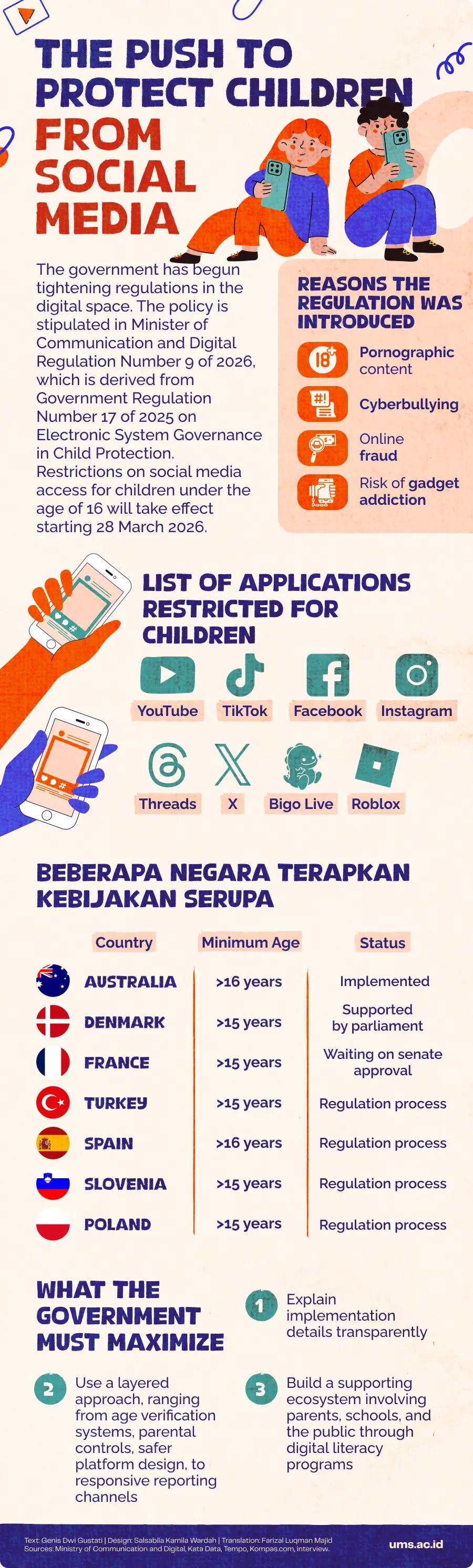
The government will enforce social media restrictions for children as part of an effort to protect the younger generation from various risks in the digital space. This policy, issued by the Ministry of Communication and Digital (Komdigi), regulates the deactivation or postponement of social media account access for users under 16 on platforms categorized as high risk.
According to a Komdigi press release, the regulation is stipulated in Minister of Communication and Digital Regulation No. 9 of 2026, which is derived from Government Regulation No. 17 of 2025 on Electronic System Governance in Child Protection (PP TUNAS). Under this regulation, social networking and social media services are classified as high-risk digital services, meaning accounts belonging to children below a certain age must be deactivated.
Endang Wahyu Pamungkas, S.Kom., M.Kom., Ph.D., an Informatics Engineering lecturer at Universitas Muhammadiyah Surakarta (UMS), considers the policy direction fundamentally reasonable, as it stems from a real need to protect children from various digital threats.
"In my opinion, the policy direction is good because it stems from a real need to protect children from digital risks such as addiction, cyberbullying, fraud, exploitation, and exposure to age-inappropriate content," he said in an online interview on Tuesday (17/3/2026).
Endang noted that as a parent, he welcomes the regulation. However, he believed the biggest challenge lies not in its intention or objective but in its implementation on the ground.
"On paper, this regulation looks progressive. But in practice, we are talking about millions of users, global platforms, highly diverse device ecosystems, and the varying digital habits of Indonesian families," he explained.
Restrictions on social media for children are not entirely new in digital regulation. Endang explained that similar policies have begun to emerge in various countries in response to growing concerns over children's safety in digital spaces.
One such country is Australia, which has enforced restrictions on social media accounts for users under the age of 16 since December 2025. Under the regulation, platforms are required to take reasonable steps to prevent children below that age from having accounts.
In addition, the European Union has been developing an age verification approach that prioritizes user privacy. "Other countries usually do not only talk about bans, but also build age verification systems that protect user privacy. So users only need to prove that they are above a certain age threshold without having to disclose excessive personal data," he explained.
Komdigi will deactivate social media on March 28, 2026, through a stricter age verification mechanism. The government requires digital platforms to use AI-based age verification technology, including facial scanning to estimate users' ages. However, the technology still has limitations.
Endang explained that AI age estimation systems have developed rapidly, but they are not yet fully accurate. The average error in age estimation from such technology is still around 2.5 years.
This means the risk of misclassification remains quite high, especially for users near the age threshold, such as those aged 15 to 17. Endang believed facial scanning methods are relatively fast and convenient, but less reliable for users in that borderline range.
"This technology can be useful as an initial screening tool, but it cannot be the sole source of truth. It should be combined with other methods such as parental consent, document verification, or an appeal mechanism," he said.
Aside from technological accuracy, social media restrictions for children may also face circumvention attempts. Nearly all digital restriction systems are eventually met with ways to bypass them.
"The use of VPNs, alternate identities, or manipulation during the age verification process are some methods that can be used to bypass the system," he added.
Endang suggested that the government needs to be realistic in assessing the impact of the policy. This restriction will likely not eliminate children's access to social media entirely, but at the very least it can raise the barriers for children to enter those platforms.
Another expected impact is greater public awareness, both among parents and teenagers, of the importance of limiting social media use.
The social media restriction also presents a number of technical challenges for major digital platforms such as TikTok, Instagram, and YouTube. These platforms must be able to verify millions of user accounts, both existing and new ones, on an ongoing basis.
In addition, each platform has different service characteristics. On YouTube, for example, most content can still be accessed without creating an account, so account-based restrictions are not always effective in reducing content exposure.
In Indonesia, implementation challenges are also influenced by disparities in device quality, internet connectivity, and digital literacy among parents.
"Not to mention old accounts that are already active, shared family accounts, or users' digital identities that are not always consistent," Endang said.
The social media restriction has also sparked discussion about data security, especially if the age verification system later involves integration with digital identity such as the national identification number.
According to Endang, the risks that need to be anticipated include potential identity data leaks, misuse of data for user profiling, and the merging of data from different databases.
These risks will become even greater if the age verification process also uses biometric data such as facial data. "Biometric data is highly sensitive. If it is not managed properly, the consequences could be far more serious than ordinary identity data," he said.
Therefore, the government needs to be cautious in determining the technical methods of age verification to avoid creating new problems in personal data protection.
On the other hand, Endang believed there are loopholes that may allow children to continue accessing social media even if their accounts are restricted. One of the most realistic ways is by using the accounts of parents, siblings, or friends. Access can also occur through shared family devices or platforms that do not always require a login process.
Therefore, in his view, the age restriction policy cannot stand alone as a single solution. "If households are not involved, schools do not take part in educating, and platforms do not design experiences that are safe for children, then children will still find other ways," he said.
In closing, Endang stated that the government needs to strengthen several aspects for this policy to work effectively. First, the government must explain the implementation details transparently, from the list of platforms categorized as high-risk to the age verification methods that are allowed.
Second, the government needs to build a supporting ecosystem involving parents, schools, and the public through digital literacy programs. Third, the approach used should be layered, ranging from age verification systems and parental controls to safer platform design and responsive reporting channels.
"In principle, I support the spirit of child protection in the digital space. But the success of this policy cannot rely on age restrictions alone. The key lies in accurate technical implementation, strong personal data protection, parental involvement, and government transparency," he concluded.
Writer: Genis Dwi Gustati
Translator: Farizal Luqman Majid
Editor: Al Habiib Josy Asheva
Amid the FIFA World Cup 2026 euphoria, football betting is also spreading through digital platforms and conventional means.
Nothing’s more special than reading curated news just for you.
Subscribe to the UMS Newsletter for free today.