
The Scholar Behind UMS's Master's Program in IQT
27 July 2026
Prof. Andri Nirwana, S.TH., M.Ag., Ph.D., pioneered the Master of Al-Quran and Tafsir Studies as a first step in strengthening Quranic studies within Muhammadiyah.



The people of Rancaekek will never forget that stormy Wednesday. Situated on the border of Bandung and Sumedang Regencies, the fierce winds tore houses, factories, trees, vehicles, and billboards.
According to Detik.com, BPBD Jabar reported that the storm on Wednesday (21/02/2024) affected five sub-districts: Rancaekek District, Cicalengka District, Cileunyi District (Bandung Regency), Jatinangor District, and Cimanggung District (Sumedang Regency). The affected area was comparable to one-third of Jakarta.
Indonesia was surprised when the powerful winds in Rancaekek proved more devastating than typical puting beliung disasters. Detik.com revealed that the strong wind wreaked havoc in the Rancaekek Dwipapuri Abadi Industrial area, destroying six factories and causing several trucks to overturn. Some mistakenly labeled it as a tornado. So, how do experts explain the “tornado” in Rancaekek last week?
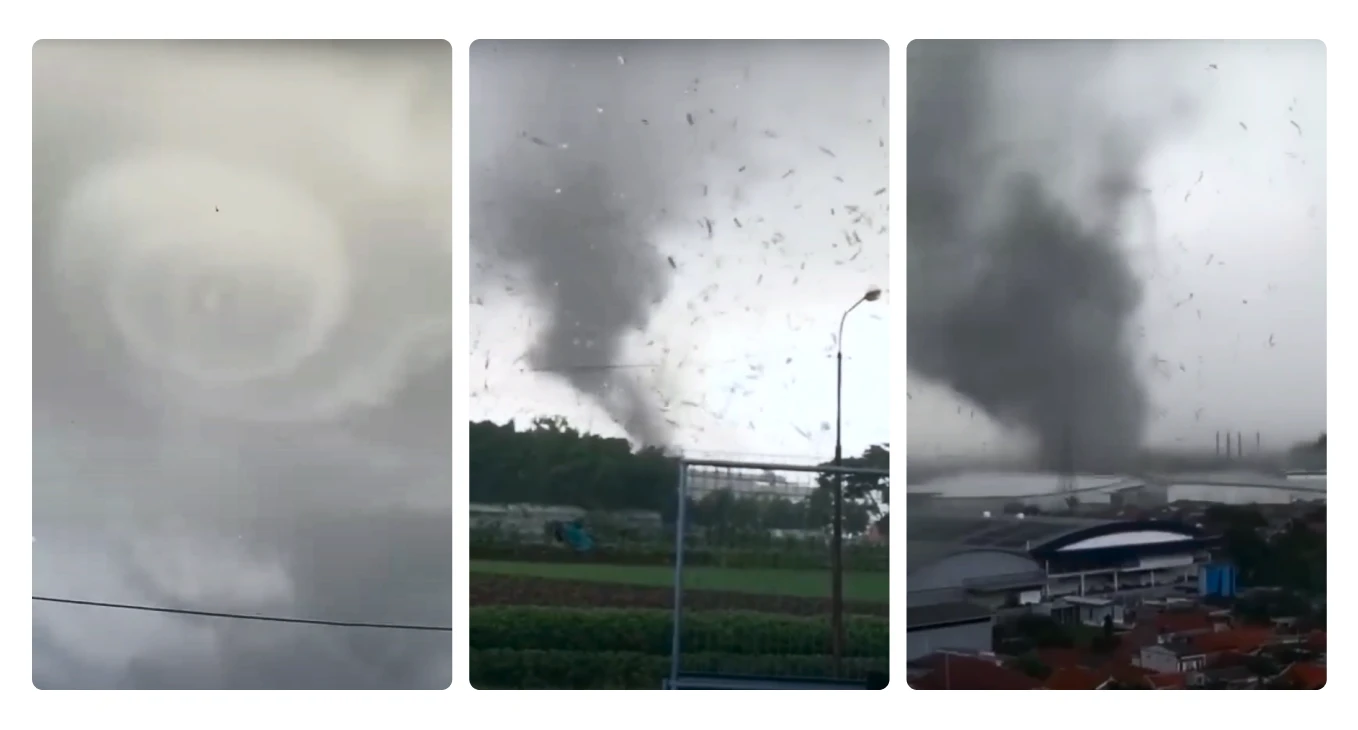
Screenshot of video footage of the Rancaekek "tornado", Wednesday (21/2/2024). (Doc.Internet)
To unravel the mystery of the strong winds in Rancaekek, we contacted climatology expert Drs. Yuli Priyana, M.Si., at Universitas Muhammadiyah Surakarta (UMS). Affectionately known as Pak Yuli, he clarified that the strong winds in Rancaekek do not meet the criteria for being classified as a tornado. Pak Yuli explained that the wind’s diameter and speed in Rancaekek are smaller than those typically associated with tornadoes.
“Yesterday’s disaster almost resembled a tornado but with a smaller speed and diameter. So it is more fitting to call it a puting beliung,” said Yuli when contacted via Whatsapp Tuesday (27/02/2024).
While tornadoes and puting beliung share characteristics as destructive strong wind phenomena, Yuli highlighted several distinctions. According to Yuli, tornadoes are powerful winds generated by extreme disparities in temperature and humidity within the atmosphere.
The UMS Geography lecturer elaborated on the dynamics of tornado formation, stating, “When warm, moist air collides with cold air, the lighter warm air ascends. As the warm air rises, it prompts the cold air to take its place, resulting in a robust vertical movement. Tornadoes gain strength from additional factors like powerful horizontal winds or vigorous air loops.”
The atmospheric conditions initiate the formations of cumulonimbus clouds, characterized by their thickness and high water content (Cb clouds). These clouds are notorious for inducing severe weather conditions. “However, not every cumulonimbus cloud leads to a tornado, as it depends on the atmosphere’s stability.” He continued
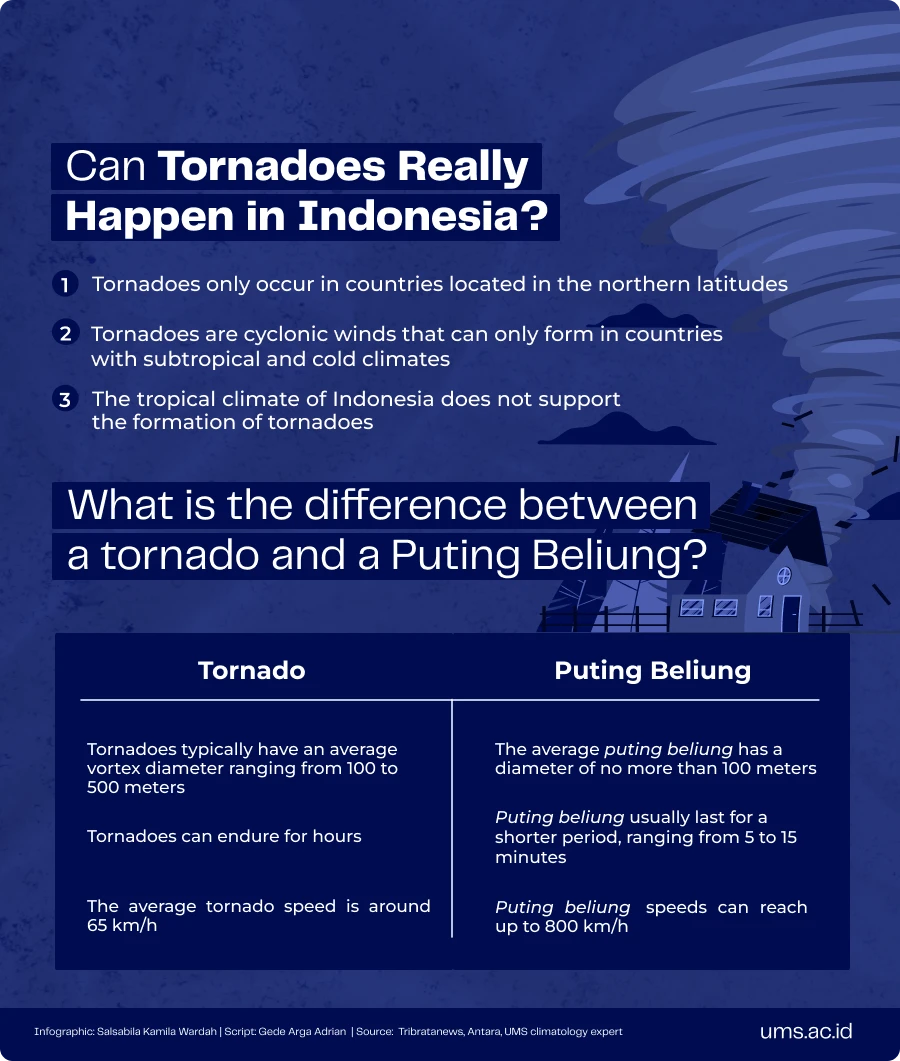
Tornadoes, frequent in the United States, usually measure 100 to 500 meters in diameter and can travel up to 100 kilometers along their path. These powerful natural phenomena can achieve speeds of up to 800 kilometers per hour. Typically, tornadoes last anywhere from a few minutes to several hours.
“Puting beliung are similar to tornadoes. It’s just that puting beliung occurs on a smaller scale and at a lower speed than tornadoes,” he added.
Meanwhile, tornadoes have a relatively brief rotation time, lasting between five to fifteen minutes. Yuli explained the various factors that contribute to the formation of tornadoes, such as temperature variations, differences in humidity, atmospheric dynamics, and topography.
So, what is the difference between tornadoes and puting beliung? Yuli outlines some of the characteristics of a tornado:
The characteristics of a puting beliung are as follows:
Puting beliung is not a new phenomenon in Indonesia. It typically occurs during the peak of the rainy season and transitional periods. Historical records indicate that Indonesia has experienced destructive puting beliung in the past.
The Sidoarjo puting beliung in 2022 serves as an example. According to information gathered from Okezone.com, a puting beliung swept through 23 houses in Grogol and Sudimoro Villages, Tulangan District, Sidoarjo Regency, on Wednesday (6/2/2022). The strong winds impacted an electricity pole, three trees, a public facility, and a local business. Fortunately, despite the destruction, the puting beliung did not result in any casualties.
According to Yuli, puting beliung like the one in Sidoarjo is formed due to extreme differences in temperature and humidity in the atmosphere. When warm and humid air encounters cold air, the lighter, warm air rises, causing the cold air to move down and replace it.
Yuli explains that the movement of the air mass generates a strong vertical motion. “If this condition is further intensified by other factors, such as strong horizontal winds or existing air loops, it can create puting beliung,” she stated.
Puting beliung can occur in various locations that are prone to extreme weather. Yuli explains, “It usually occurs in areas with abundant vegetation and strong thermal convection, such as large plains.” Typically, these winds manifest during transitional seasons where the air temperature is hot and stifling, and black clouds gather in the daylight/in the day.
“Temperature changes induce temperature dynamics on Earth. The contrast in air temperature between two adjacent layers can lead to horizontal air pressure. This disparity has the potential to initiate the formation of rotating winds,” explained the Head Lecturer at UMS Geography Study Program.
The question of whether Indonesia can experience tornadoes arises. Yuli clarifies that Indonesia is not conducive to the formation of tornadoes. The explanation lies in Indonesia’s geographical position on the equator, which grants the country a tropical climate.
Yuli provides further insight: “Tornadoes typically form in high-latitude areas or regions with cold climates. They are cyclonic winds that generally do not thrive in subtropical and tropical areas.”
Disaster mitigation actions are taken to address similar threats. “The formation of a puting beliung is challenging to prevent but can be avoided when it occurs,” said Yuli. He emphasized the need for communities and relevant institutions to be vigilant about various symptoms accompanying extreme weather.
People should be vigilant against the potential occurrence of hydrometeorological disasters such as heavy downpour rain lasting more than an hour, puting beliung, and hail that can result in impacts such as floods, landslides, fallen trees, and other damages.
Additionally, they should also be alert to extreme weather conditions such as moderate to heavy rain accompanied by lightning and strong winds in the afternoon, especially on days with intense heating between 10:00 a.m. to 02:00 p.m. This condition is usually marked by dark clouds towering high, resembling cauliflower and sometimes having a base at the top (Cb cloud type).
Yuli emphasized that people living in steep/mountainous or landslide-prone areas should be vigilant against light to moderate rain events occurring for several days.
“In addition to being vigilant about weather conditions such as floods, people should also be alert to their surroundings. Puting beliung can topple trees, billboards, and even debris from buildings that can endanger residents,” Yuli concluded.
Writer: Gede Arga Adrian
Editor: Al Habiib Josy Asheva
Translator: Farizal Luqman Majid
Prof. Andri Nirwana, S.TH., M.Ag., Ph.D., pioneered the Master of Al-Quran and Tafsir Studies as a first step in strengthening Quranic studies within Muhammadiyah.

A UMS pencak silat athlete successfully claimed gold at the 10th Asian Pencak Silat Championship 2026.

The Klanceng Edufarm startup is planning international expansion after being named national champion at the 2026 Studentpreneur Bootcamp organized by the Muhammadiyah Center for Entrepreneurship and Business Incubator.

Nothing’s more special than reading curated news just for you.
Subscribe to the UMS Newsletter for free today.