
Officials' Lackluster Public Communication
17 July 2026
The public officials’ statements continue to draw scrutiny, ending in blunders and stirring public disappointment.
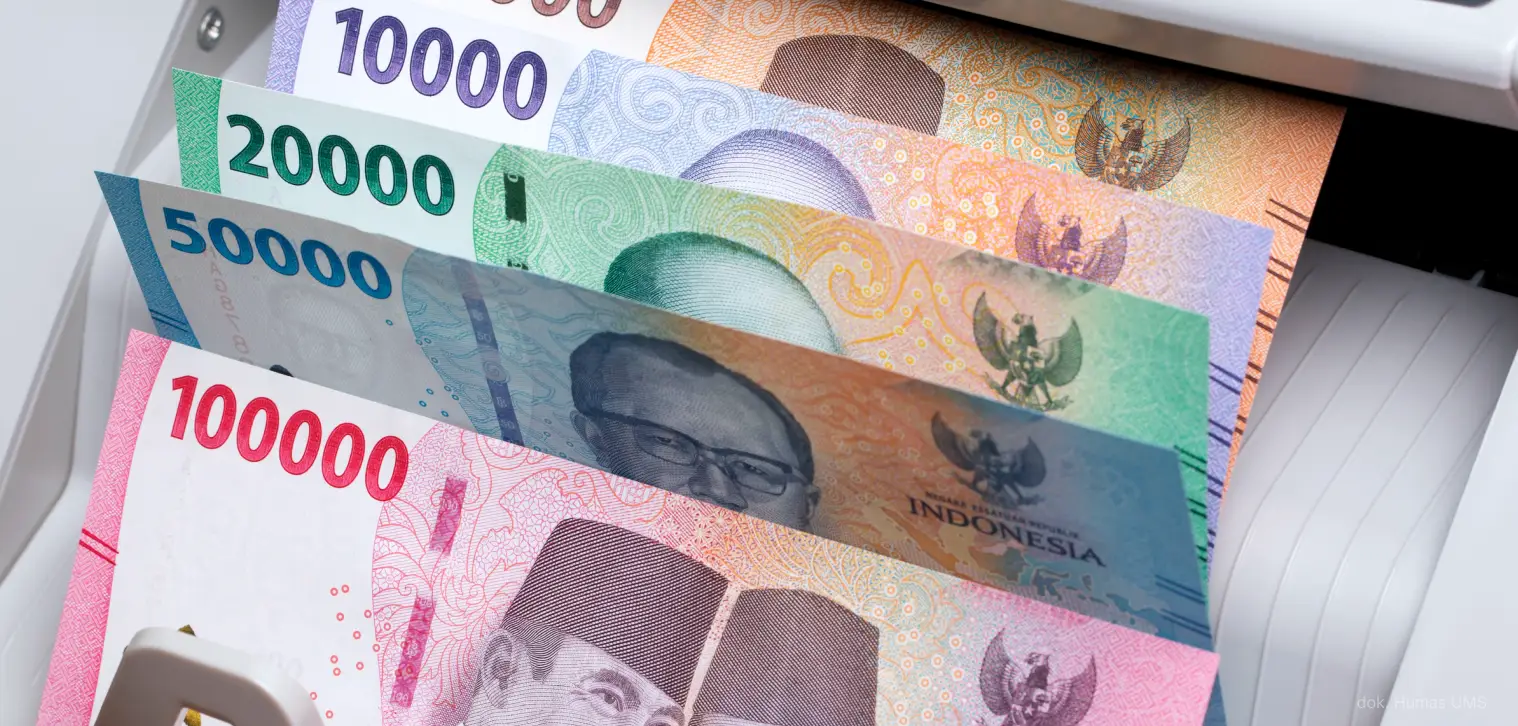
The government’s plan to redenominate the rupiah has resurfaced after being raised again by Minister of Finance Purbaya Yudhi Sadewa. The plan has returned to public discussion after being radio silent over the past few years.
The redenomination discourse is stated in the Minister of Finance Regulation (PMK) Number 70 of 2025 concerning the Strategic Plan of the Ministry of Finance for 2025–2029. The draft law is currently being formulated and is targeted for completion in 2027.
“The Bill on Changes to Rupiah Value (Redenomination) is a carried-over bill that is planned to be completed in 2027,” Purbaya wrote in the regulation.
Redenomination is the simplification of currency denominations without changing the actual value of the currency. This is done by removing several zeros from the nominal value.
With this redenomination, the Rp1,000 banknote would change to Rp1, and the same applies to higher denominations.
Minister Purbaya argued that redenomination can create economic efficiency by improving national competitiveness. It is also considered capable of sustaining national economic development, maintaining the stability of the rupiah to support people’s purchasing power, and enhancing the rupiah’s credibility.
The idea of redenomination is not new in Indonesia. President Soekarno once issued a redenomination policy in 1965 to address hyperinflation at the time. However, inadequate preparation and a rushed implementation caused the program to fail, plunging Indonesia into even deeper inflation, up to 650 percent.
Redenomination was also discussed during the New Order government in the 1990s. However, it was never carried out because the government’s focus was on stability and achieving food self-sufficiency.
The issue resurfaced again in 2013. The Minister of Finance at the time, Agus Martowardojo, even proposed to parliament that the draft law on redenomination be included as a priority in the National Legislation Program. Yet once again, the discourse on redenomination faded away.
Several countries have implemented redenomination, such as Argentina, Zimbabwe, Turkey, and Germany. However, their preparations and economic conditions were carefully calculated. Turkey needed up to seven years to implement the redenomination of the Lira. Meanwhile, the redenomination of the German Mark was carried out during the recovery period after World War I.
The plan by Minister of Finance Purbaya Yudhi Sadewa to redenominate the rupiah has left Prof. Dr. Anton Agus Setyawan, S.E., M.Si., from Universitas Muhammadiyah Surakarta (UMS), shaking his head. Anton believed the move is too risky and does not hold strong urgency to be implemented at this time.
He tends to see Purbaya’s redenomination discourse as a way of “testing the waters.” According to him, the government wants to observe how the market reacts to the redenomination issue. “If they think that when this (redenomination policy) is announced the situation remains stable and there’s no reaction, then the policy might be continued,” said Anton when met in his office, Saturday (14/11/2025).
Implementing a monetary policy like redenomination, Anton added, is not without risks. The government must secure full trust from both the private sector and the wider public.
If the redenomination does not run smoothly, public reluctance to hold rupiah or even capital flights could increase. “When conditions become unstable, people will prefer to hold foreign currencies instead of the rupiah. As a result, the rupiah weakens,” he explained.
Redenomination will also force companies, banks, and government institutions to overhaul their financial recording systems. Anton predicts that this system overhaul will require an enormous amount of funding.
The redenomination plan is also overshadowed by uncertainties in the global economy. Anton noted that since the Asian financial crisis of 1997/1998, global economic conditions have been turbulent, such as the Russian crisis in 1998, the Argentine crisis in 2001, the U.S. crisis in 2008, and the global recession following the Covid-19 pandemic.
“Hoping for economic stability is a costly expectation. The world is no longer like it was in the 90s,” he said.
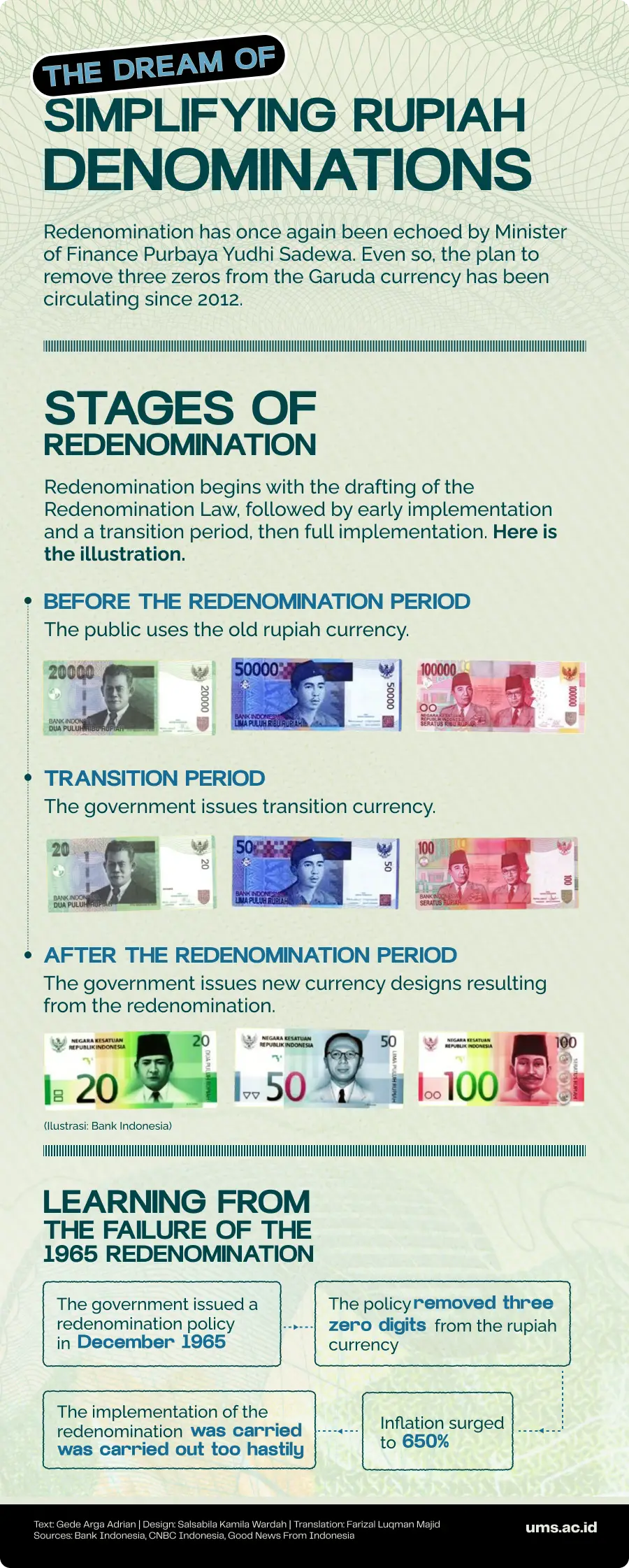
One of the reasons the government is promoting redenomination is to create a psychological effect of strengthening the rupiah. Currently, Indonesia is the second country in Southeast Asia after Vietnam with the highest number of zeros on its currency.
The simulation is simple: when 1 US dollar equals Rp16.700, after redenomination, the nominal figure would be written as Rp16,7 per US dollar.
However, Anton does not see redenomination as something that would attract investors. Instead, he believed foreign investors already have a relatively strong level of trust in Indonesia’s current economic conditions. According to him, investors tend to look at stock index prices, which have been rising and relatively stable. “That trust is what we really need to safeguard,” he said.
Anton argued that foreign investors prefer to invest in countries with clear and firm law enforcement, supported by an improvement in the quality of skilled human resources. In this context, redenomination becomes only a secondary factor, far from being a key driver of investment in the country.
He leaned toward urging the government to boost the real sector, such as labor-intensive industries capable of absorbing a large workforce. That way, economic growth and investor confidence can be achieved without spending an enormous amount of money just to remove zeros from the Indonesian currency.
Writer: Gede Arga Adrian
Translator: Farizal Luqman Majid
Editor: Al Habiib Josy Asheva
The public officials’ statements continue to draw scrutiny, ending in blunders and stirring public disappointment.
Nothing’s more special than reading curated news just for you.
Subscribe to the UMS Newsletter for free today.