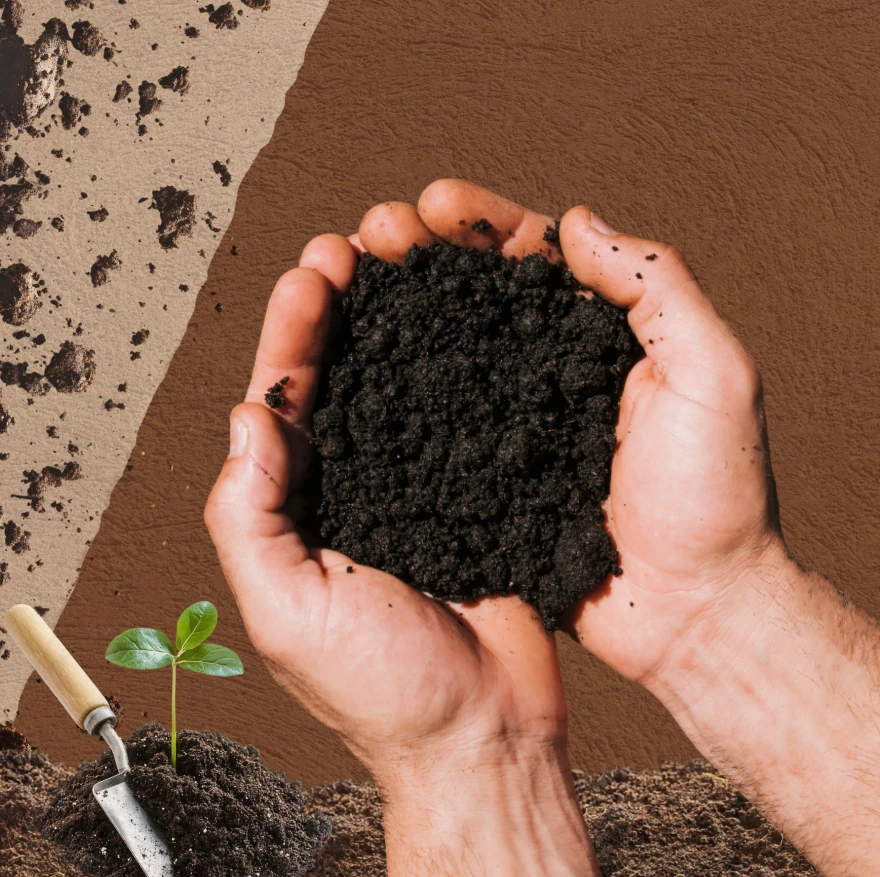
How Sheep Manure Turns into Nutrient Rich Fertilizer
16 July 2026
Sheep dunged nutrient-rich organic fertilizer for plants, made with the help of maggots. Built on community empowerment and a zero-waste principle.




Times Higher Education (THE) released its latest THE Impact Rankings in sustainable development on Wednesday (12/6). This year, Universitas Muhammadiyah Surakarta (UMS) is ranked 1001-1500 out of 1963 universities worldwide.
THE Impact Rankings is the only ranking firm that measures universities’ contributions based on the 17 Sustainable Development Goals (SDGs). The firm’s assessment methodology involves reviewing several relevant metrics for each SDG point.
Rama Rizana, M.Sc., Director of the UMS SDGs Center, explained that THE requires each university to select at least three SDGs points in addition to the 17th SDG point: Partnerships for The Goals to be included in the overall ranking.
“Each SDGs point has two to five metrics with several sub-metrics within them. We submitted the requested data for our first participation in THE Impact Rankings, we submitted some of the data requested by THE on each SDG as well as the indicators and metrics therein specifically for SDG points 1, 3, 4, and 17. UMS received commendable scores for these four points,” said the UMS Civil Engineering lecturer who is also Secretary of Transportation Research Center.
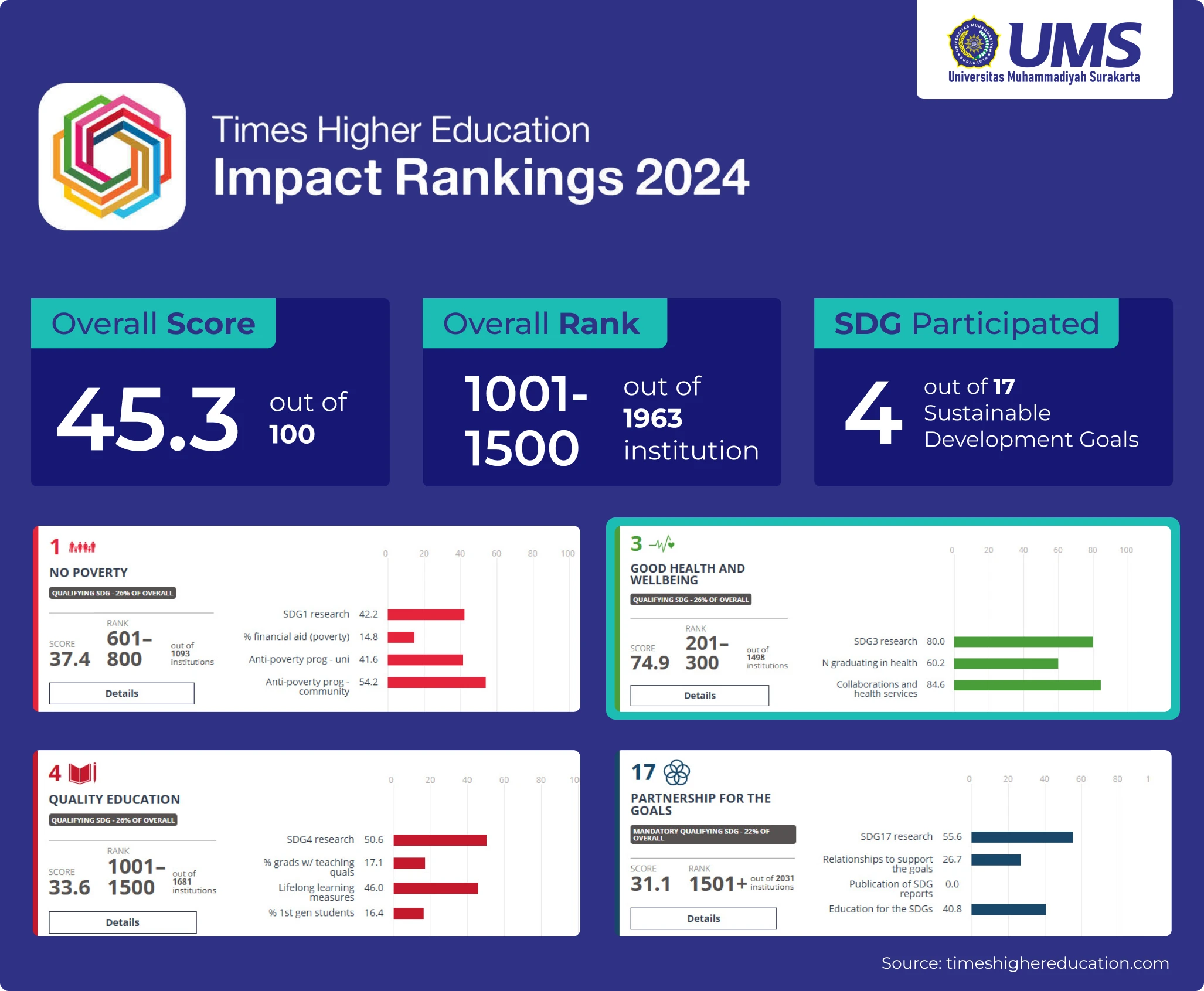
Total score achieved by UMS for points 1, 3, 4, and 17 of the SDGs.
UMS achieved a total score of 45.3 out of 100 across the categories of No Poverty, Good Health and Well-Being, Quality Education, and Partnerships for the Goals. Notably, in the Good Health and Well-Being category, UMS achieved an impressive score of 74.9. This accomplishment placed UMS in the 201-300 rank globally.
“Of course, we are grateful for the highest achievement in the 3rd SDG point. The ranking team and I had predicted this outcome, considering that the UMS Medicine program received ‘5 Stars’ from the Quacquarelli Symonds (QS) Rating System. Hopefully, this success will encourage faculties, study programs, and research centers to continue working together to support the achievement of the 17 SDGs,” said Rama optimistically.
Sharing the same optimism, Gunawan Ariyanto, Ph. D., Head of UMS Office of Public Relations and Rankings, revealed that based on these results, UMS will continue to develop new innovations and breakthroughs that benefit society.
“One example is that to improve the quality of education and research, UMS assists every lecturer who wants to apply for an internal grant. Both research and community service are closely related to the SDGs points,” he explained.
“With this grant assistance, we hope the quality of research and community service will improve significantly,” he said.
Gunawan emphasized that UMS is committed to creating an academic environment that supports innovation and creativity. As part of its long-term strategy, UMS has established the SDGs Center, which will drive the achievement of 17 SDG points.
“We want to ensure that every step taken by UMS aligns with global efforts to achieve sustainable and inclusive development,” Gunawan said.
Writer: Genis Dwi Gustati
Editor: Al Habiib Josy Asheva
Translator: Farizal Luqman Majid
Sheep dunged nutrient-rich organic fertilizer for plants, made with the help of maggots. Built on community empowerment and a zero-waste principle.
Nothing’s more special than reading curated news just for you.
Subscribe to the UMS Newsletter for free today.