Bank Indonesia Holds Interest Rate at 5.75%, What Is the Impact?
24 July 2026
Bank Indonesia has held its benchmark rate at 5.75 percent, ending speculation of a hike to 6 percent that had circulated in recent weeks.


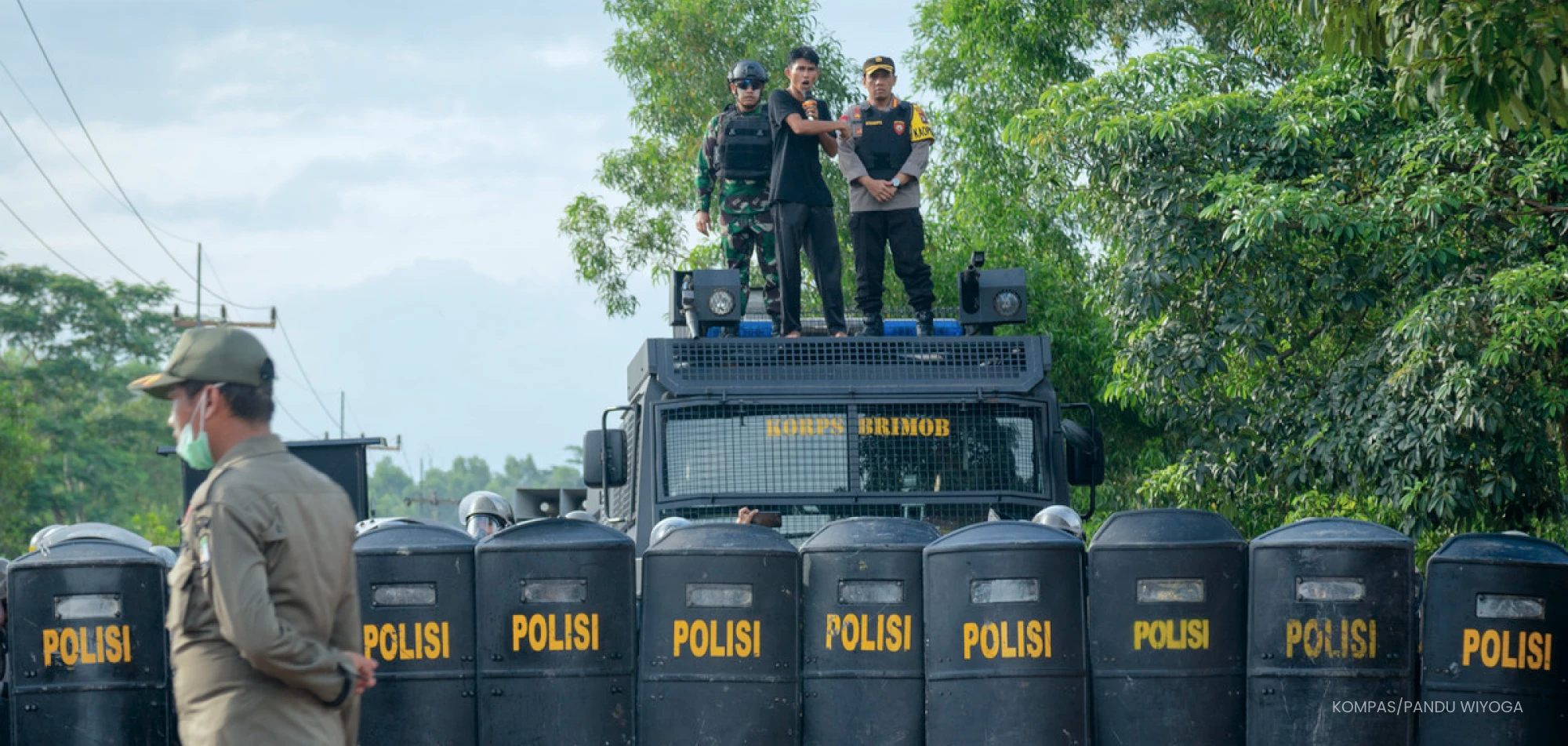
Violence has again disturbed the peace of fellow citizens. This incident occurred in Rempang Island, Riau Islands, on August 7, 2023. While no casualties were reported, the excessive use of force by security forces is deeply concerning. Violence against citizens can have a profound impact on society, and it has the potential to lead to long-standing resentment. The government must ensure that justice is served in this case and that all parties involved are treated with respect. As Allah SWT has said:
“And if two groups of believers fight each other, then make peace between them. But if one of them transgresses against the other, then fight against the transgressing group until they are willing to submit to the rule of Allah. If they do so, then make peace between both groups in all fairness and act justly. Surely Allah loves those who uphold justice.” [Q.S. Al-Hujurat: 9].
The stakeholders involved in the Rempang Island case must approach the issue with empathy and open-mindedness, giving consideration to the aspirations of the residents. The interests of significant investments and foreign megaprojects, particularly from China, should not be the sole determining factors.
Historical records indicate that communities have inhabited Rempang Island since 1834. In the book Tuhfat An-Nafis by Raja Ali Haji (first published in 1890), Galang and Bulang was said to be the descendant of the soldiers of the Riau Lingga Sultanate in 1720 during Sultan Sulaiman Badrul Alamsyah I’s reign.
In 2007, the residents were informed of the Batam City tourism development project (Rempang Eco City) and expressed opposition. The project involved various stakeholders, including PT MEG Group Artha Graha, owned by Tommy Winata, and Singapore and Malaysia investors. PT MEG was granted a development license for 30 years, extendable up to 80 years.
Subsequently In July 2023, the government signed a memorandum of understanding with China’s Xinyi Group for a glass and solar panel factory on Rempang Island, part of the Rempang Eco-City concept, with a project value of 11.5 billion USD. While the project promises Rp 318 trillion investment by 2080, it will result in forced eviction of the residents, many of whom have inhabited the area for generations, particularly in the 16 old villages on Rempang Island.
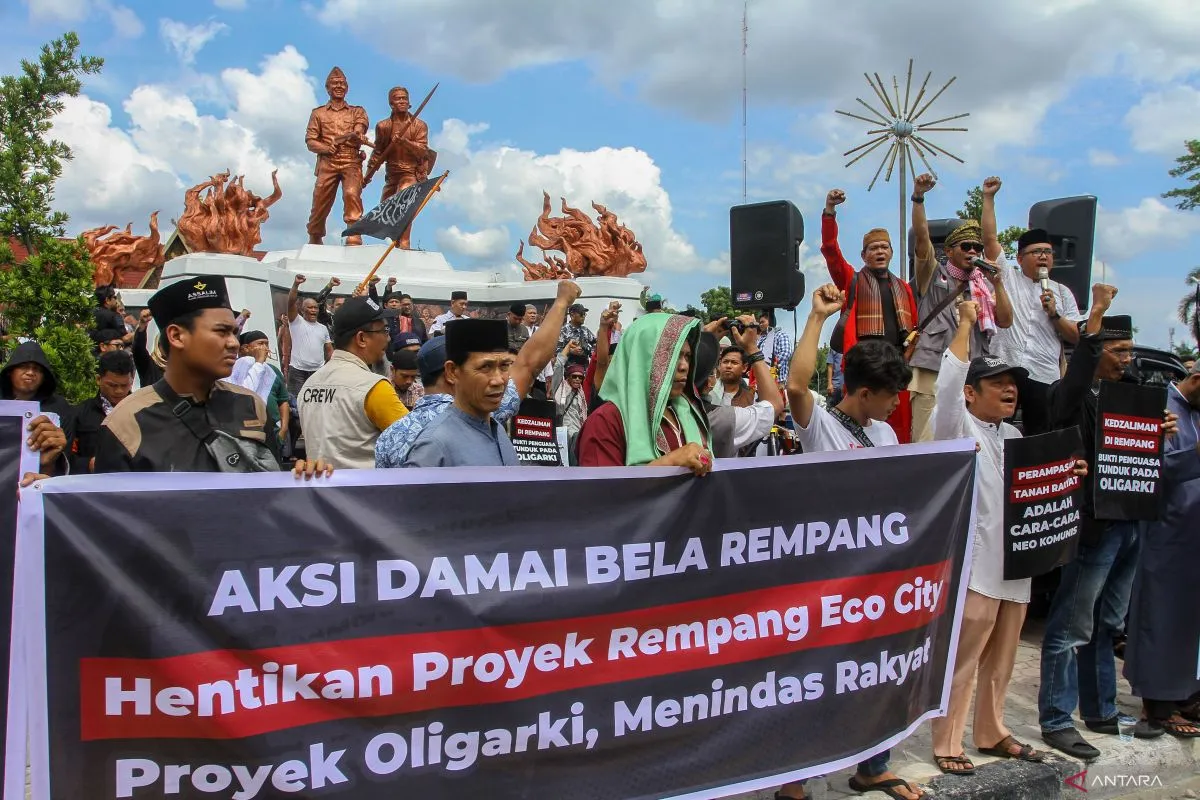
Source: antaranews.com
Modern development hinges on the principle of “development for humans (humanism)” rather than “humans for development.” It is no longer acceptable to pursue development through oppressive means that cause hardship to local communities. Unfortunately, according to reports, the Rempang residents have been compelled to leave their homes without apparent alternatives.
There is a lack of clarity regarding new housing and relocation arrangements for the residents, as well as compensation for the land and homes they are leaving behind. Thus, the residents’ rejection of the mega project is entirely justified. At a time when nations worldwide are moving towards development and civilization centered on the welfare of their citizens, Indonesia appears to be moving in the opposite direction.
This prompts the question: how can citizens lead healthy and fulfilling lives amidst government threats and displays of power? Is it not the government’s duty, as mandated by the 1945 Constitution, to safeguard all Indonesian citizens and territories?
Development, whether in developing or developed nations, is pursued to enhance the well-being and happiness of humanity. This emphasizes that humans are the ultimate focus of development, not merely a means to an end. This collective understanding led to the formulation of the Human Development Index (HDI) to measure human development success.
In 1990, the United Nations Development Programme (UNDP) underscored that "Humanity is a nation's true wealth. The primary goal of development is to create an environment enabling people to lead long, healthy, and productive lives. While seemingly straightforward, this fundamental principle is often overshadowed by short-term pursuits of accumulating wealth and resources" [UNDP, 1990].
The HDI comprises three fundamental dimensions. First, it assesses longevity and health, gauged by life expectancy at birth which yields the health index. Second, it evaluates knowledge through two indicators: (i) Expected years of schooling and (ii) Average years of schooling, culminating in the education index. Third, it considers a decent standard of living, appraised by per capita expenditure, or since 2010, Gross National Product (GDP) per capita. This leads to the expenditure index. The sum of the health, education, and expenditure indices constitutes the HDI.
While the human development concept places more emphasis on human-centric values compared to the traditional focus on economic growth, it still does not fully accommodate spiritual and non-material aspects essential for genuine human well-being.
This was also the main point of academic inquiry of Seers (1969), who asked: What is the status of poverty? What about unemployment? And what of injustice or income disparity? If these three issues have diminished significantly, then it is reasonable to assume that development has transpired in that country. Conversely, if any of these problems worsen, particularly if all three do, it is illogical to claim that development has occurred even if per capita income has doubled.
Development, from the Islamic perspective, encompasses not only material prosperity but also true well-being, known as al-falah in Islamic terminology. The term al-falah and its derivatives are reiterated 40 times in the Qur’an, and the synonym for al-falah, fawz, is mentioned 29 times. Al-falah is even emphasized five times daily in the call to prayer or iqamah, underscoring its significance in Islamic teachings. This highlights that al-falah holds a paramount position in Islamic guidance, and it cannot be achieved through economic growth rooted in secularism, atheism, or materialism.
Chapra (2001) explains that genuine well-being, according to Islamic law, isn’t solely about maximizing wealth and consumption. It necessitates a balanced fulfillment of both the material and spiritual aspects of human beings. Material needs include clothing, sustenance, housing, education, transportation, life security, adequate possession, and all goods and services contributing to real comfort and well-being.
Conversely, spiritual needs involve devotion to Allah, inner tranquility, inner contentment, harmony within family and community, and the absence of social vices. Therefore, the primary component of well-being is spirituality, as humanity’s core purpose is to serve and worship Allah. As stated by Allah: “And I did not create jinn and mankind except to worship Me.” [QS. Adz-Dzaariyaat: 56].
Furthermore, the Qur’an documents the dialogue between humanity (at the moment the soul is instilled into the body) and the Creator of the soul, affirming that the worship of Allah is the fundamental purpose of humanity’s existence. As Allah has proclaimed:
“And [mention] when your Lord took from the children of Adam – from their loins – their descendants and made them testify of themselves, [saying to them], “Am I not your Lord?” They said, “Yes, we have testified.” [This] – lest you should say on the day of Resurrection, “Indeed, we were of this unaware.” [QS. Al-A'raf: 172].
Islam also teaches that a person's well-being and happiness encompass prosperity in this world and prosperity hereafter. This holistic concept is encapsulated in the widely recited du’a known as the “sapu jagad” prayer by Muslims, found in Surah Al-Baqarah, verse 201:
“But among them is he who says, “Our Lord, give us in this world [that which is] good and in the Hereafter [that which is] good and protect us from the punishment of the Fire.”
Hence, to achieve al-falah, the objective of human development must be in line with the maqashid asy-syariah (objectives of Islamic law). Its principal goal is to enhance human well-being, which is based on the safeguarding of faith (din), life (nafs), intellect or rationality (aql), lineage (nasl), and property or material wealth (maal). In Islam, any development that safeguards these five crucial aspects is seen as being in the public's best interest and is strongly supported. On the other hand, even if a development appears impressive, if it puts these five aspects at risk, it contradicts the public's best interest and should be avoided.
In light of this concept of development, it is only fitting for all citizens to appreciate and wholeheartedly support Muhammadiyah (through LHKP and MHH) in urging the President and the Coordinating Minister for Economic Affairs of the Republic of Indonesia to reevaluate and remove the Rempang Eco-City project from the list of National Strategic Projects. Wallahu'alam bishowab.
Bank Indonesia has held its benchmark rate at 5.75 percent, ending speculation of a hike to 6 percent that had circulated in recent weeks.
Nothing’s more special than reading curated news just for you.
Subscribe to the UMS Newsletter for free today.