
Bank Indonesia Holds Interest Rate at 5.75%, What Is the Impact?
24 July 2026
Bank Indonesia has held its benchmark rate at 5.75 percent, ending speculation of a hike to 6 percent that had circulated in recent weeks.



Babies deserve the best nutrition right from birth, and breast milk is the best source of nutrition. Numerous studies have shown that breast milk significantly benefits a baby’s growth and development.
The Ministry of Health highlights several benefits of breast milk, including illness prevention, support for brain development, enhancement of the baby’s immune system, and a reduced risk of allergies and chronic diseases.
Siti Nurokhmah, S.Gz., M.Sc., a maternal and child nutritionist at Universitas Muhammadiyah Surakarta (UMS), stated that one of the benefits of breast milk is the prevention of stunting.
Stunting is a condition of growth failure in children under five due to chronic malnutrition, especially in the first 1,000 days of life. According to Siti, children who experience stunting will have height and weight below the average for their age. “Stunting is an external sign of what is happening inside the baby’s body,” Siti explained in a virtual interview on Monday, May 20, 2024.
The period after birth until the two years of age is crucial for their growth and development. Nutritional intake from breast milk, especially during the first six months, is essential to ensure optimal growth.
“When the nutritional supply is insufficient by the age of two, the baby’s development is not optimal,” said the woman, who graduated from the London School of Hygiene & Tropical Medicine, University of London.
Breast milk is packed with numerous essential nutrients that benefit the body. The World Health Organization (WHO) considers breast milk the perfect food for babies. It contains antibodies against many common childhood illnesses as well as being safe, hygienic.
The Indonesian Pediatric Association (IDAI) states breast milk comprises 87.5 percent water, carbohydrates, protein, fat, carnitine, water-soluble vitamins, minerals, and vitamins K, D, E, and A.
“Breast milk meets the nutritional needs of babies for at least the first six months,” said Siti, a doctoral student in Nutrition Sciences at the University of Indonesia.
Since 2003, the Ministry of Health has promoted exclusive breastfeeding for newborns. Exclusive breastfeeding involves providing only breast milk to an infant from birth to six months of age without supplementing with any other food or drink.
Exclusive breastfeeding is crucial because it provides all the energy and nutrients a baby needs during the first months of life. Between 6 and 12 months, breast milk supplies half or more of a child’s nutritional needs, and it continues to provide up to a third of the necessary nutrients between 18 and 24 months.
Breastfed children tend to perform better on intelligence tests, are less likely to become overweight, and have a lower risk of developing diabetes later in life. Additionally, breastfeeding mothers have a reduced risk of breast and ovarian cancer.
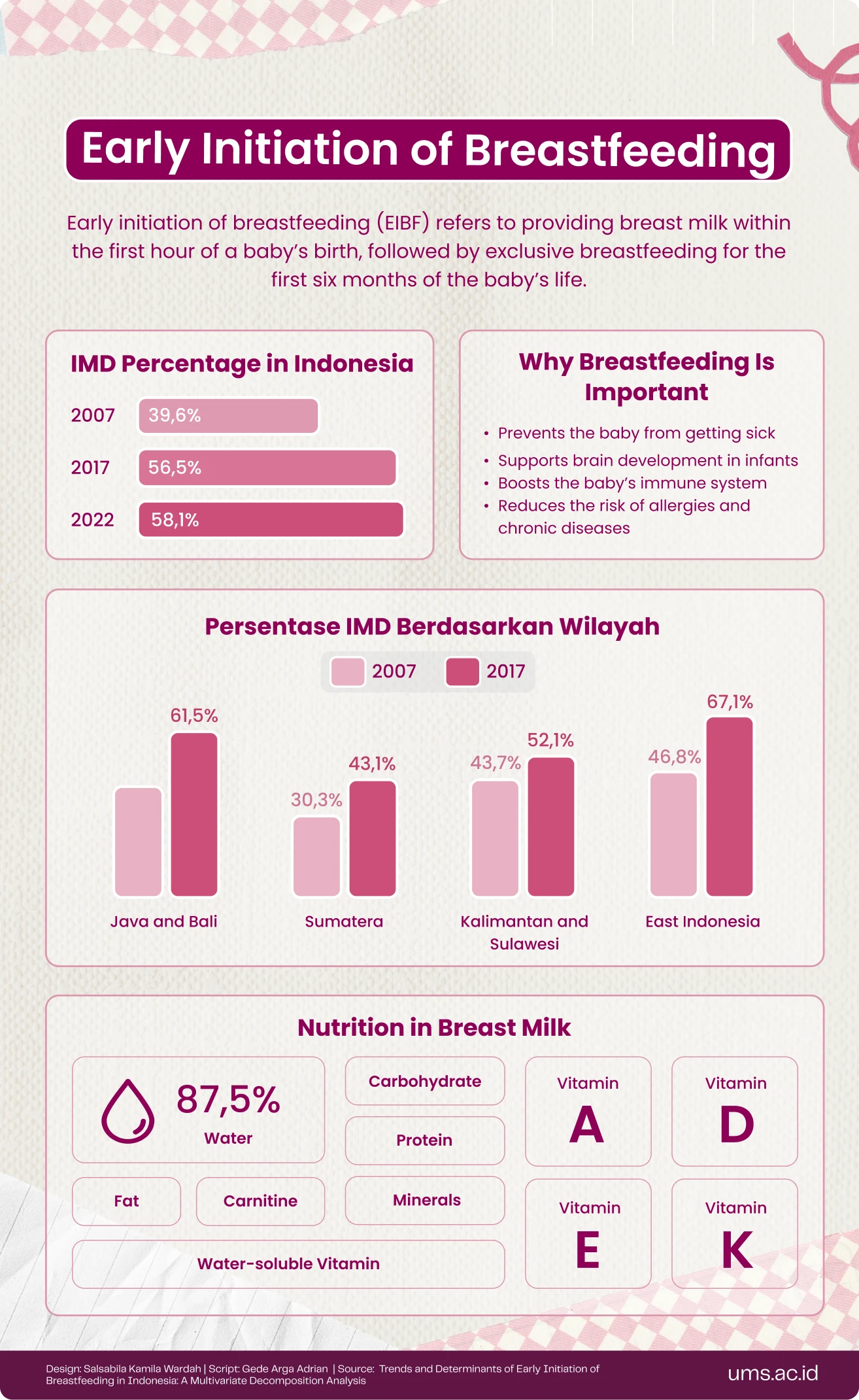
Early initiation of breastfeeding (EIBF) is a crucial stage immediately after delivery. Health workers are encouraged to assist mothers in performing immediate mother-to-child contact within one hour of birth, which involves placing the baby on the mother’s chest. This practice is followed by exclusive breastfeeding for the first six months of the baby's life.
“EIBF involves placing the baby on the mother's chest for skin-to-skin contact,” explained the UMS Faculty of Health Sciences lecturer. “This is one of the WHO recommendations which has many benefits, such as stimulating breast milk secretion, maintaining the baby's body temperature, and fostering an emotional bond between the baby and the mother. It significantly increases the success rate of exclusive breastfeeding."
Siti Nurokhmah's research, titled “Trends and Determinants of Early Initiation of Breastfeeding in Indonesia: A Multivariate Decomposition Analysis," found that globally, in 2017, 56 percent of mothers initiate breastfeeding within the first hour of a baby's life.
The Lancet Breastfeeding Series 2023 has highlighted the low coverage of EIBF due to the lack of practice of immediate mother-to-child contact, particularly influenced by the extensive marketing of commercial formula products.
Fortunately, Indonesia has explicitly regulated exclusive breastfeeding through Government Regulation No. 33/2012. This regulation requires every mother to provide exclusive breastfeeding to her newborn baby.
The research, published in the Scopus-indexed journal PLOS ONE Q1, analyzed three data sets from Indonesian Demographic and Health Survey (IDHS) from 2007, 2012, and 2017. 70 percent of the IDHS respondents were in reproductive age (20-34 years). “Through this research, I aim to assess the progress of EIBF practices in Indonesia and identify the factors contributing to this progress,” said Siti.
The survey results showed an increase in the percentage of mothers who performed EIBF over a decade. In 2007, 39.6 percent of mothers practiced EIBF . By 2017, this figure had risen to 56.5 percent.
Siti analyzed the survey data and identified several factors that contributed to the increase in the percentage of EIBF in Indonesia. These factors include the rate of cesarean deliveries, birth patterns, perceptions of baby size, geographical location, and maternal behavior.
Cesarean deliveries increased by almost 11.1 percent in 2017 compared to 2007. Previous studies have suggested that cesarean delivery negatively impacts early breastfeeding initiation. This finding aligns with the analysis of the 2002-2017 IDHS, which indicates that the rising percentage of cesarean deliveries has adversely affected the increase in EIBF practices.
“The findings indicate that health workers must assist in performing EIBF during cesarean deliveries. Interventions are needed to prevent the practice of separating mothers and newborns after a cesarean section,” Siti explained.
Another important factor is the birth pattern of the mother. First-time mothers are less likely to perform EIBF. They often have inadequate knowledge about EIBF and breastfeeding practices in general, which affects their attitude, confidence, and decision to implement the practice.
Data over the past decade shows a downward trend in the percentage of first-time mothers. In 2007, first-time mothers comprised 36.4 percent of new mothers. By 2017, this number had dropped to 32.7 percent.
The decline in the percentage of first-time mothers contrasts with the increase in EIBF practices over the decade. “These findings are favorable because they contribute positively to the rise in EIBF rates,” she explained.
Another factor is the perception of baby size. The 2017 IDHS survey reported that fewer babies were considered small. In 2017, 46.9 percent of mothers perceived their babies as small, 58.3 percent as average-sized, and 56.7 percent as large. This trend aligns with the increasing percentage of EIBF in Indonesia.
The research concluded that EIBF is less common in babies perceived by their mothers as smaller than average. This perception could be due to certain conditions, such as illness or premature birth, which require the baby to be separated from the mother for treatment in the Neonatal Intensive Care Unit (NICU).
In 2007, the EIBF percentage in Java and Bali was 41.3 percent. The figure rose in 2017 to 61.5 percent.
In 2007, the percentage of mothers who performed EIBF was 30.3 percent. In 2017, the figure rose to 43.1 percent.
These two islands in 2007 had an EIBF percentage of 43.7 percent. A decade later, the figure increased to 52.1 percent.
Eastern Indonesia experienced an increase from 46.8 percent in 2007, to 67.1 percent in 2017
The findings led Siti to encourage local governments to promote EIBF through local regulations. These regulations should include strict sanctions for violators and focus on strengthening the capacity of health workers, especially those involved in the cesarean delivery process.
“One of the earliest regions to regulate EIBF and exclusive breastfeeding is Klaten. They implemented explicit regulations for EIBF in 2008, which were then complemented by additional regulations in 2018 and revised in 2019," said the public health nutrition expert.
Unfortunately, some mothers still give formula milk to their babies, which tends to hinder the implementation of IEBFand exclusive breastfeeding. The widespread presence of formula milk and its massive advertising campaigns have made exclusive breastfeeding less appealing. In some cultures, formula feeding is even associated with wealth and modernity.
"This phenomenon is accompanied by rapidly growing formula milk marketing, which may explain why mothers, especially from wealthier groups, neglect IEBF," Siti Nurokhmah continued.
The government has implemented regulations requiring mothers to refuse formula milk after childbirth. This is written in Article 12 Paragraph 1 of Government Regulation No. 33/2012, which states that every mother who gives birth must refuse the provision of infant formula milk and/or other baby products.
Achieving widespread exclusive breastfeeding across Indonesia remains an urgent task. The global target for 2030 is for 70 percent of infants to be exclusively breastfed, and this goal is a shared responsibility. Exclusive breastfeeding must continue to be promoted because each drop of breast milk represents eternal motherly love.
Writer: Gede Arga Adrian
Editor: Al Habiib Josy Asheva
Translator: Farizal Luqman Majid
Bank Indonesia has held its benchmark rate at 5.75 percent, ending speculation of a hike to 6 percent that had circulated in recent weeks.
Nothing’s more special than reading curated news just for you.
Subscribe to the UMS Newsletter for free today.