
Bank Indonesia Holds Interest Rate at 5.75%, What Is the Impact?
24 July 2026
Bank Indonesia has held its benchmark rate at 5.75 percent, ending speculation of a hike to 6 percent that had circulated in recent weeks.



Since UNESCO recognized batik as an intangible cultural heritage in 2009, its popularity has soared. In response, the Indonesian government has also urged its people to wear batik while also actively promoting the products in international markets.
According to the Indonesian Batik Export Realization Report released by the Ministry of Trade, Indonesia exported 21.66 thousand tons of batik valued at US$590.91 million between January and November 2023. The market for Indonesian batik exports are the United States, Japan, Germany, Australia, and the Netherlands.
Since 2018, the United States has emerged as the dominant market, consistently accounting for over 50% of Indonesia’s total batik exports. In 2023, the value of batik exports to the U.S. reached an impressive 53.63% of the total exports.
The substantial export number demonstrates the immense potential of batik exports as a crucial pillar of the Indonesian economy. However, the government's massive promotion clashes with concerns about the lack of awareness among entrepreneurs regarding the importance of sustainable practices.
Dr. Etika Muslimah, S.T., M.M., M.T., a sustainability expert from Universitas Muhammadiyah Surakarta (UMS), has observed that small and medium-sized businesses (MSME) in the batik industry often overlook the environmental consequences of their operations.
“On one hand, batik boosts the country’s economy. On the other hand, waste from the batik industry pollutes the environment. This must be addressed,” said Etika in her office Wednesday (8/14/2024).

Sustainability researcher from Universitas Muhammadiyah Surakarta (UMS), Dr. Etika Muslimah, S.T., M.M., M.T. Imam Safii/UMS Public Relations
The batik industry is still closely tied to production processes that often disregard the surrounding environment, such as synthetic dyes, single-use wax, color fixatives, and poor industrial waste management.
Etika further explained, “The high use of chemicals in the batik industry makes it a significant potential source of contamination.”
Some areas known as centers of the batik industry face significant issues with waste contamination. According to Solopos, two rivers in Solo, Central Java, the Premulung and Jenes Rivers, have dangerous chemicals from batik industry waste. The water in these rivers is so polluted that it is no longer suitable for agricultural irrigation or fisheries.
In Pekalongan, Central Java, Tribun Jateng has reported significant river pollution, primarily caused by the batik industry. According to a survey by the Pekalongan Environment Department, thousands of batik industries in the city produce 5,190 cubic meters, more than 5 million liters, of waste daily. As a result, several rivers in Pekalongan have become discolored due to this contamination.
One of the main contributors to environmental pollution in the batik industry is synthetic dyes. Etika noted the industry’s inability to completely phase them out despite their negative impact on the environment and human health.
In Etika’s research, titled “Environmental Impact Analysis on Dyes in Handwritten Batik,” she identified two commonly used synthetic dyes in the batik industry: indigosol dyes and reactive dyes. Her study was conducted at a batik tulis MSME in Kendal, Central Java.
According to Batikbumi.com, Indigosol is a water-soluble dye. The fabric must be oxidized by immersing it in an acid solution, such as hydrochloric acid (HCl) or sulfuric acid (H2SO4), to achieve the desired color.
Reactive dyes are capable of bonding directly with fabric fibers. They can be applied through dyeing, dipping, or brushing. These dyes are water-soluble, produce vibrant colors, and are resistant to fading.
Etika employed the Life Cycle Assessment (LCA) method to evaluate field data. This method examines the batik industry’s entire life cycle and environmental impact.
She used three indicators to assess environmental pollution: human health, quality of ecosystem, and resources. The human health impact indicators include carcinogen levels, radiation, and inorganic and organic respiratory effects.
Ecosystem quality indicators encompass ecotoxicity, eutrophication, and land use. Resource indicators, on the other hand, focus on mineral content in water and fossil fuel consumption.
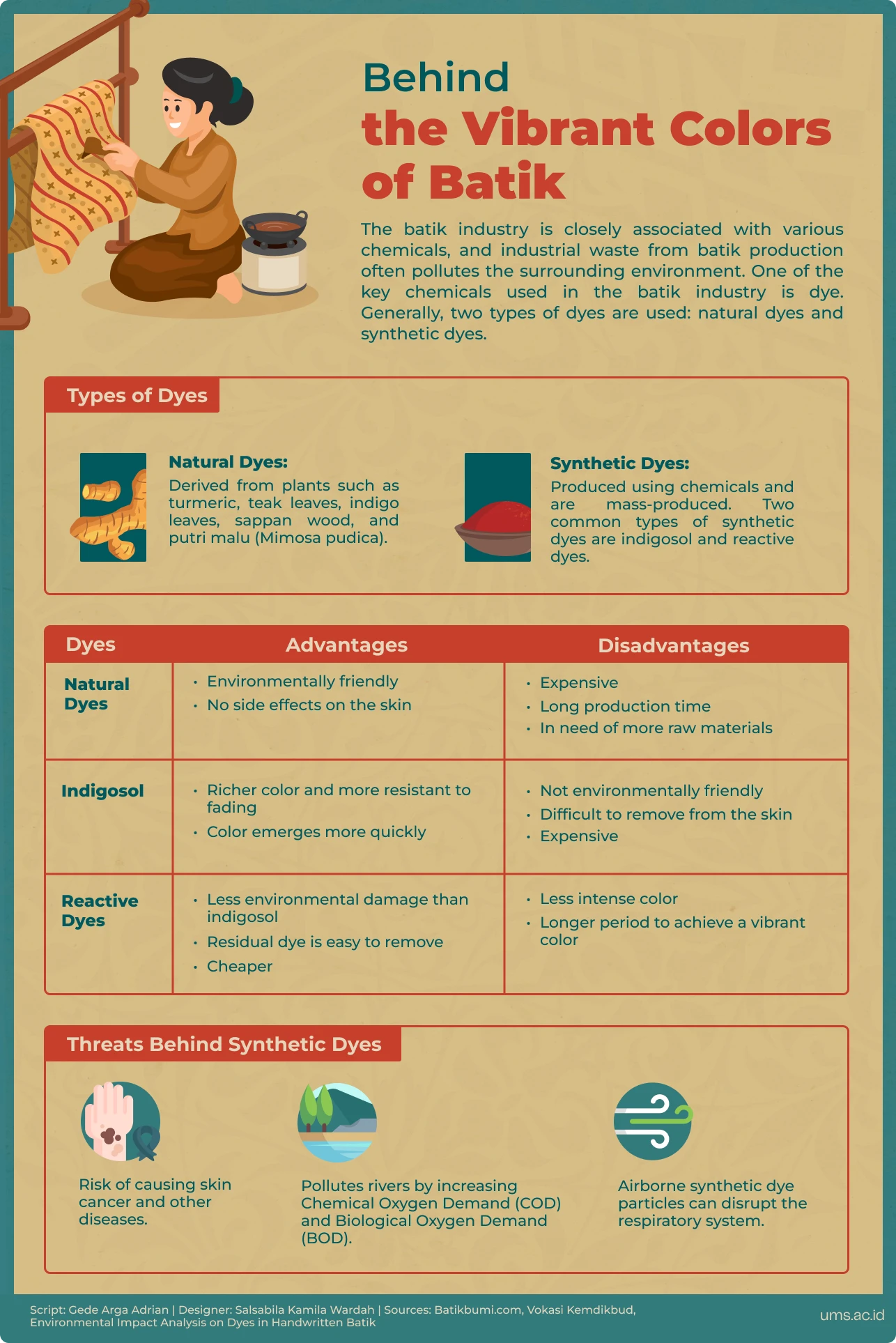
She used Simapro software to analyze her data, revealing that Indigosol dyes are more harmful than reactive dyes. The health impact score for Indigosol is 0.000799, compared to 0.000794 for reactive dyes.
“These dyes are highly dangerous and can cause skin cancer, along with other skin diseases,” Etika noted in her research journal.
The ecosystem quality score for Indigosol is 288.254, slightly higher than the 287.9871 score for reactive dyes. In terms of resource impact, Indigosol has a score of 840.656, compared to 836.9056 for reactive dyes.
The UMS Center for Logistics and Industrial Studies researcher views these findings as a call for the batik industry to reduce its use of Indigosol. While both synthetic dyes negatively impact the environment and human health, the industry can choose less harmful alternatives.
Natural dyes are an ideal option as they do not pollute the environment. However, they have drawbacks, including a higher cost and a longer production time.
“The recommendation is clear, natural dyes are better. However, if replacing synthetic dyes isn’t possible, using reactive dyes is an alternative, as they have a lower environmental impact compared to indigosol dyes,” said the doctor from Brawijaya University. This research was presented at The International Conference on Emerging Smart Cities in Kuching, Malaysia, in 2022.
Etika acknowledged that the batik industry has not yet been able to fully transition away from synthetic dyes. However, she emphasized the importance of choosing dyes with a lower environmental impact.
In addition to the endeavor to use natural dyes, another effort to reduce environmental pollution is to reuse used malam (wax). During the batik-making process, the cloth undergoes a boiling stage to remove the wax. The leftover wax that settles can be mixed with new wax in a 1:1 ratio.
“If you mix used wax with new wax, it not only benefits the environment but also reduces wax usage and cuts production costs,” she said.
Waste treatment must also be optimized. Several batik industry centers have installed wastewater treatment plants (WWTP). The purpose of using WWTP is to reduce Chemical Oxygen Demand (COD) and Biological Oxygen Demand (BOD) levels in batik industry waste. Unfortunately, the use of these WWTPs has not yet been fully maximized.
The wastewater treatment plant (WWTP) works by receiving wastewater from the batik industry. The water is collected in a storage pond before its COD and BOD are neutralized. Once the chemical content in the wastewater is reduced, the wastewater is then discharged into the river.
When Etika conducted research in Kendal, the batik UMKM only used a septic tank to dispose of batik production waste. “These small industries usually discharge directly into the river or through a septic tank because they don’t have a WWTP,” she said.
In some locations, such as Kampung Batik Laweyan, some batik producers dispose of waste directly without any treatment, despite having a Wastewater Treatment Plant (WWTP). “Some MSMEs are not connected to the WWTP due to operational costs. The WWTP needs to run daily to effectively treat the waste,” she added.
According to her, sustainability in the green industry takes major involvements from producers and the government in terms of using more environmentally friendly raw materials and backing the waste treatment. Either way, the goal is to preserve Nusantara wastra (traditional textiles).
Writer: Gede Arga Adrian
Editor: Al Habiib Josy Asheva
Translator: Farizal Luqman Majid
Designer: Salsabila Kamila Wardah
Bank Indonesia has held its benchmark rate at 5.75 percent, ending speculation of a hike to 6 percent that had circulated in recent weeks.
Nothing’s more special than reading curated news just for you.
Subscribe to the UMS Newsletter for free today.