
Far From Home, Closer to the Dream
6 July 2026
Sili built a good life as a government engineer in Fiji. To answer his father's promise, he had to leave all of it behind


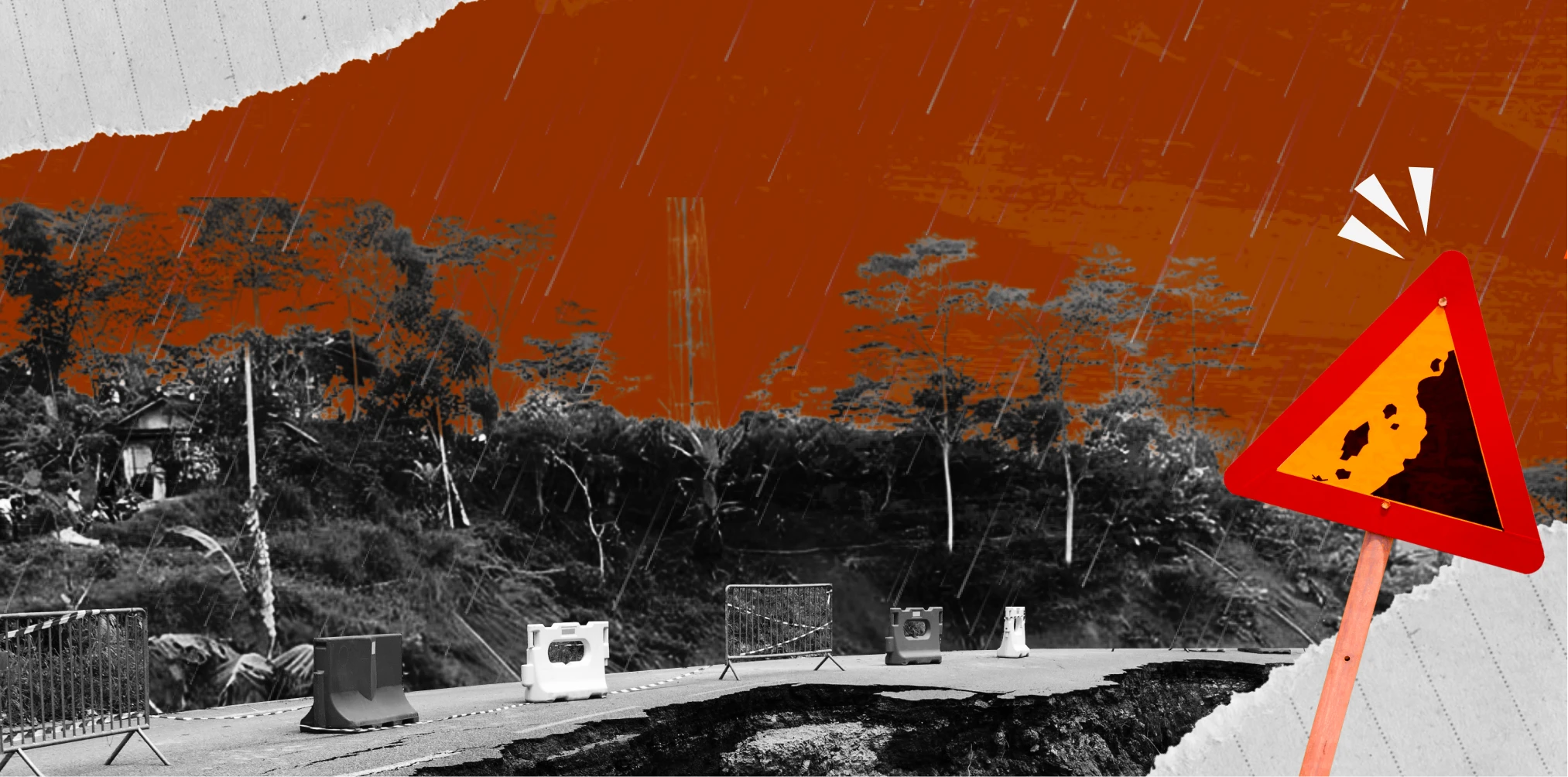
The Wanayasa-Banjarnegara route is the main access road connecting the Karangkobar highlands to the center of Banjarnegara City. This route is also known to be prone to landslides. Every rainy season, the soil along the slopes often shifts, leading to severe landslides that damage road access.
According to Mojok.co, a landslide disaster in Karangkobar on December 12, 2014, claimed many lives. In just about five minutes, soil material from Bukit Telaga Lele, located near residential areas, almost buried an entire village. A total of 125 people were affected, with 102 confirmed dead and 23 others reported missing.
A slope stability and unsaturated soil expert from Universitas Muhammadiyah Surakarta (UMS), Gayuh Aji Prasetyaningtiyas, S.T., M.Eng., Ph.D., stated that the landslides in Banjarnegara are a national issue requiring significant attention.
“Landslides in Banjarnegara have been occurring for years. If I remember correctly, even Indonesia's 7th President, Joko Widodo, once visited the affected area,” said Gayuh, who has been researching landslide zoning in Java and Sumatera since 2016.
Before delving into research topics, the UMS civil engineering lecturer also highlighted several facts, including the economic dilemma, economic development versus nature, and environmental balance issues in Banjarnegara.

Gayuh Aji Prasetyaningtiyas, S.T., M.Eng., Ph.D. (Imam Safi'i/UMS PR)
“This problem is not just about soil properties or rainfall characteristics that trigger landslides. Banjarnegara's economy relies on agriculture, particularly salak (snake fruit) trees. However, these trees have taproots, meaning their roots are not strong enough to reinforce the surrounding soil,” she explained.
According to RRI reports, landslides have also caught the attention of Japanese scientists, Professor Hayashi Takehiro and Dr. Fujikawa Yoshinori. After a week of research from February 24–28, 2025, they concluded that Banjarnegara's soil is highly susceptible to landslides due to heavy rainfall and the dominance of vegetable crops in agricultural land.
“Fibrous roots do not spread sideways. Besides salak, some areas are also planted with potatoes. And potatoes? Their roots are shallow. These are different from large trees, whose roots spread out and can hold the soil more firmly,” Gayuh observed.
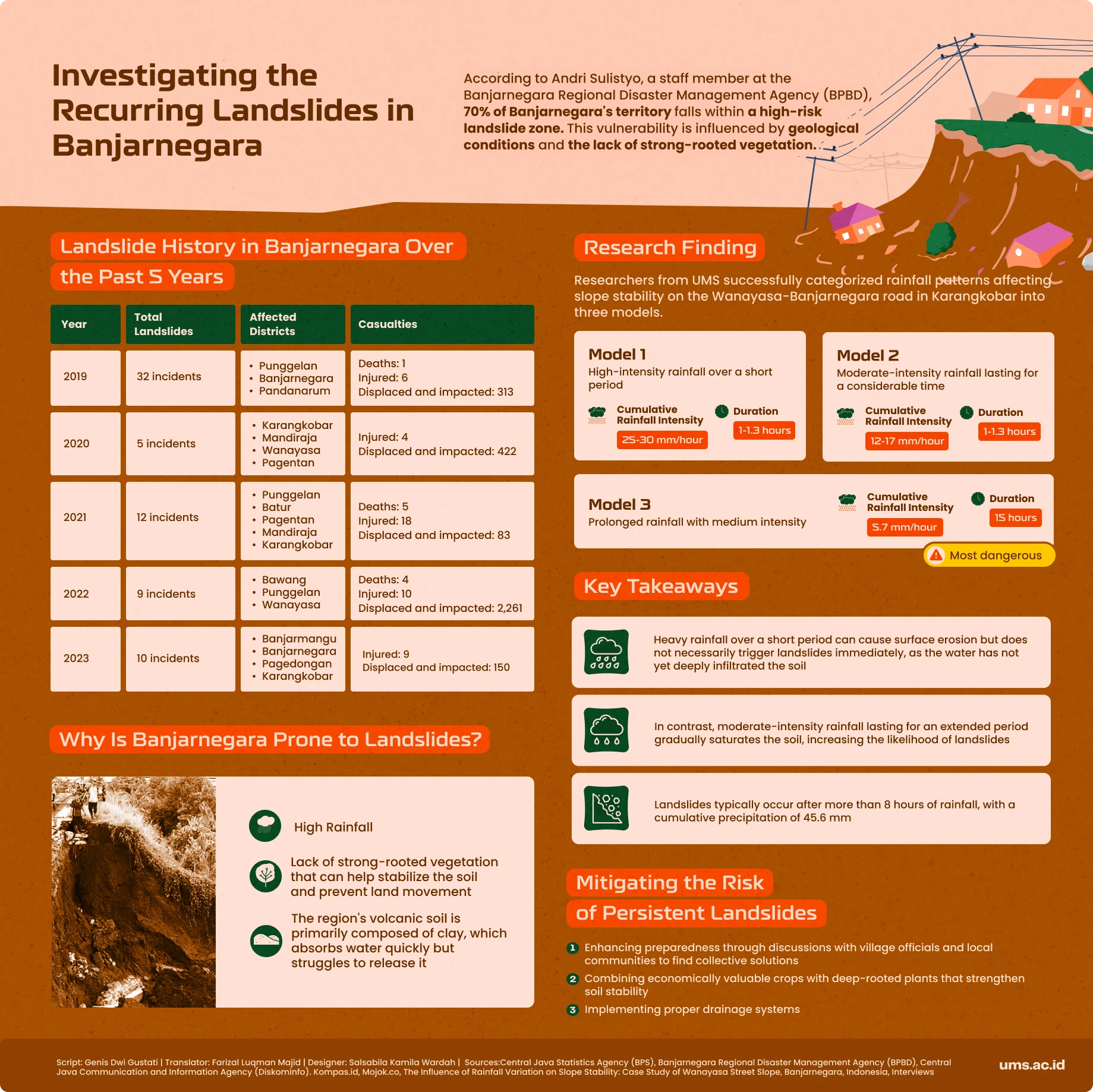
The soil in Banjarnegara is volcanic and dominated by clay due to its mountainous location. It has the ability to absorb water quickly but struggles to release it.
The accumulation of water in the soil significantly increases its mass, while weak plant roots are not strong enough to support this load. As a result, slopes become increasingly prone to movement, especially during prolonged rainfall.
Geotechnically speaking, Gayuh's research, titled “The Influence of Rainfall Variation on Slope Stability: A Case Study of Wanayasa Street Slope, Banjarnegara, Indonesia,” aims to reveal the relationship between rainfall patterns and landslide occurrences in the area. By analyzing 11 years of rainfall data (2009–2019), he seeks to determine the rainfall threshold that could trigger landslides along the Wanayasa-Banjarnegara route.
Gayuh's findings indicate that the duration of rainfall has a greater impact on landslides than its intensity. Heavy rain over a short period does not necessarily trigger landslides, but prolonged moderate rainfall can increase soil saturation and accelerate slope movement.
“Rainfall lasting more than 8 hours with a cumulative precipitation of 45.6 mm can serve as the threshold for triggering landslides in Banjarnegara,” she stated.
The Soil Mechanics lecturer categorized rainfall patterns affecting slope stability into three main types. First, high-intensity rainfall over a short period can trigger landslides if the soil is dry and not yet saturated with water. Second, moderate-intensity rainfall lasting for a considerable time increases the risk of landslides when the soil begins to reach saturation.
Third, and the most dangerous, is prolonged rainfall with moderate intensity, which allows water to continuously seep into the ground until the soil loses its absorption capacity. This leads to stronger surface water flow, causing erosion on the soil surface and reducing soil bearing capacity, making slopes increasingly prone to movement.
Gayuh validated his findings by applying numerical modeling using the back analysis method. He and his research team input historical rainfall data, soil characteristics, and slope geometry to simulate the effects of rainfall on slope stability.
”The results show that the longer the rain continues, the greater the likelihood of landslides,” he explained. According to him, if landslide-triggering rainfall patterns can be identified early, an early warning system can be implemented with greater precision.
One of the main challenges in this research is the limited availability of rainfall monitoring instruments in Banjarnegara. Rain stations in Central Java typically record only daily cumulative rainfall, without capturing specific changes in rainfall intensity over time.
“The limitations of these stations in Central Java mean they can't detect how many hours it rained in a day or how long it paused between showers,” she added.
To overcome this limitation, Gayuh utilized satellite data and statistical validation to refine prediction accuracy. One approach that could be developed is cloud condensation monitoring, similar to the method used in the Tropical Rainfall Measuring Mission (TRMM).
This satellite relies on radar, microwave imaging, and lightning sensors to map precipitation across tropical and subtropical regions. With this technology, rainfall patterns in Banjarnegara can be mapped in greater detail.
Landslide mitigation cannot rely solely on monitoring systems. Gayuh underpinned the importance of bio engineering, an engineering approach that integrates environmental and agricultural aspects to enhance soil stability. While infrastructure such as retaining walls and drainage systems is necessary, its effectiveness remains limited without an ecological-based approach.
“We can't just build retaining walls and expect landslides to stop. Nature has its own pattern. The soil will continue to move if the water flow system within it isn’t properly managed,” she explained.
The problem of landslide mitigation is not just a technical issue, it also involves social and economic factors, especially for communities that rely on agriculture for their livelihood. Instead of merely providing one-way education, Gayuh chooses to engage in discussions with locals to find a balanced solution.
“We can't just say, ‘Don’t plant this, it’s dangerous!’ as if we're teaching them from the assumption that they know nothing,” Gayuh carefully pointed out. Maintaining slope stability cannot be separated from the economic realities of farmers. They need productive land, while the slopes need to remain stable. Both interests must go hand in hand.
Gayuh proposed a compromise: integrating economically valuable crops with deep-rooted plants that reinforce slopes, alongside drainage improvements, as part of his ongoing research.
Citing Kompas.id (14/3/2025), the Head of the Banjarnegara Agriculture, Fisheries, and Food Security Office, Firman Sapta Ady, highlighted the importance of crop diversification in Banjarnegara, such as avocados and durians, which have higher economic value. However, farmers tend to prefer salak (snake fruit) because it is easy to cultivate and can be harvested year-round.
If balance is achieved, soil stability will improve without sacrificing farmers’ livelihoods. “It really requires the involvement of all parties. Perhaps village officials could initiate discussions and invite us to meet with the community. If we achieve this balance, the recurring landslides that come without warning can gradually be reduced, and farmers can remain productive without feeling that their livelihoods are being taken away,” Gayuh concluded.
Writer: Genis Dwi Gustati
Translator: Farizal Luqman Majid
Editor: Al Habiib Josy Asheva
Sili built a good life as a government engineer in Fiji. To answer his father's promise, he had to leave all of it behind
Nothing’s more special than reading curated news just for you.
Subscribe to the UMS Newsletter for free today.