Bank Indonesia Holds Interest Rate at 5.75%, What Is the Impact?
24 July 2026
Bank Indonesia has held its benchmark rate at 5.75 percent, ending speculation of a hike to 6 percent that had circulated in recent weeks.



According to the National Agency for Disaster Countermeasure (BNPB) report for 2023, Central Java ranked fourth out of ten provinces with the highest number of floods. The report, published on Goodstats.id, indicates 95 flood cases in Central Java throughout 2023.
The potential for flooding in Central Java is not a recent phenomenon. Civil Engineering lecturers at Universitas Muhammadiyah Surakarta (UMS), Purwanti Sri Pudyastuti and Isnugroho, highlighted this in a book chapter titled “Flood Risk and Urban Sustainability in A Developing Country.” They mentioned that in 1966, Solo City experienced a severe flood that broke the Bengawan Solo River embankment. Then, the flood swept through Gladak area.
Severe flooding also occurred in 2007. There were 91 cases of flooding in Central Java, resulting in 1.337 deaths and caused extensive damage to infrastructure, including 211.159 houses, 635 km of roads, and 16 bridges.
The highest number of floods in Central Java ever recorded occurred in 2016, totaling 521. These floods disrupted housing infrastructure and affected other public facilities such as irrigation channels, agricultural land, terminals, and stations.
“Flooding certainly has significant impacts, affecting numerous sectors. One notable impact is on urban infrastructure,” explains Purwanti. “For example, the flooding in Semarang disrupted train travel at Semarang Tawang Station. This impact extends beyond transportation, affecting the flow of goods distribution.”
Central Java frequently experiences three types of flooding: pluvial flooding (flooding in urban areas due to rainwater runoff that cannot be accommodated by drainage channels), fluvial flooding (caused by rainfall upstream and river overflow), and coastal flooding (resulting from extreme offshore weather).
According to Purwanti, several factors contribute to the high risk of flooding in Central Java, including drainage issues, unsustainable development practices, and land subsidence.
Drainage systems are vital infrastructure in urban areas, as they are essential for draining rainwater runoff and minimizing puddles on streets. However, not all areas have well-established drainage networks. Even poor maintenance of constructed drainage can lead to high sedimentation in drainage channels, reducing the drainage’s water capacity.
Purwanti emphasizes that people intending to construct buildings should pay attention to drainage systems to channel rainwater runoff.
“Indeed, the significant challenge lies in the fact that infrastructure in each region of Central Java cannot be generalized. While infrastructure may be in place, the effectiveness of its operation and maintenance may not,”
She emphasized that sustainable infrastructure is one of the solutions to mitigate flooding in Central Java. “Given our awareness of flood potential and its various impacts, prioritizing sustainability is imperative,” she stressed.
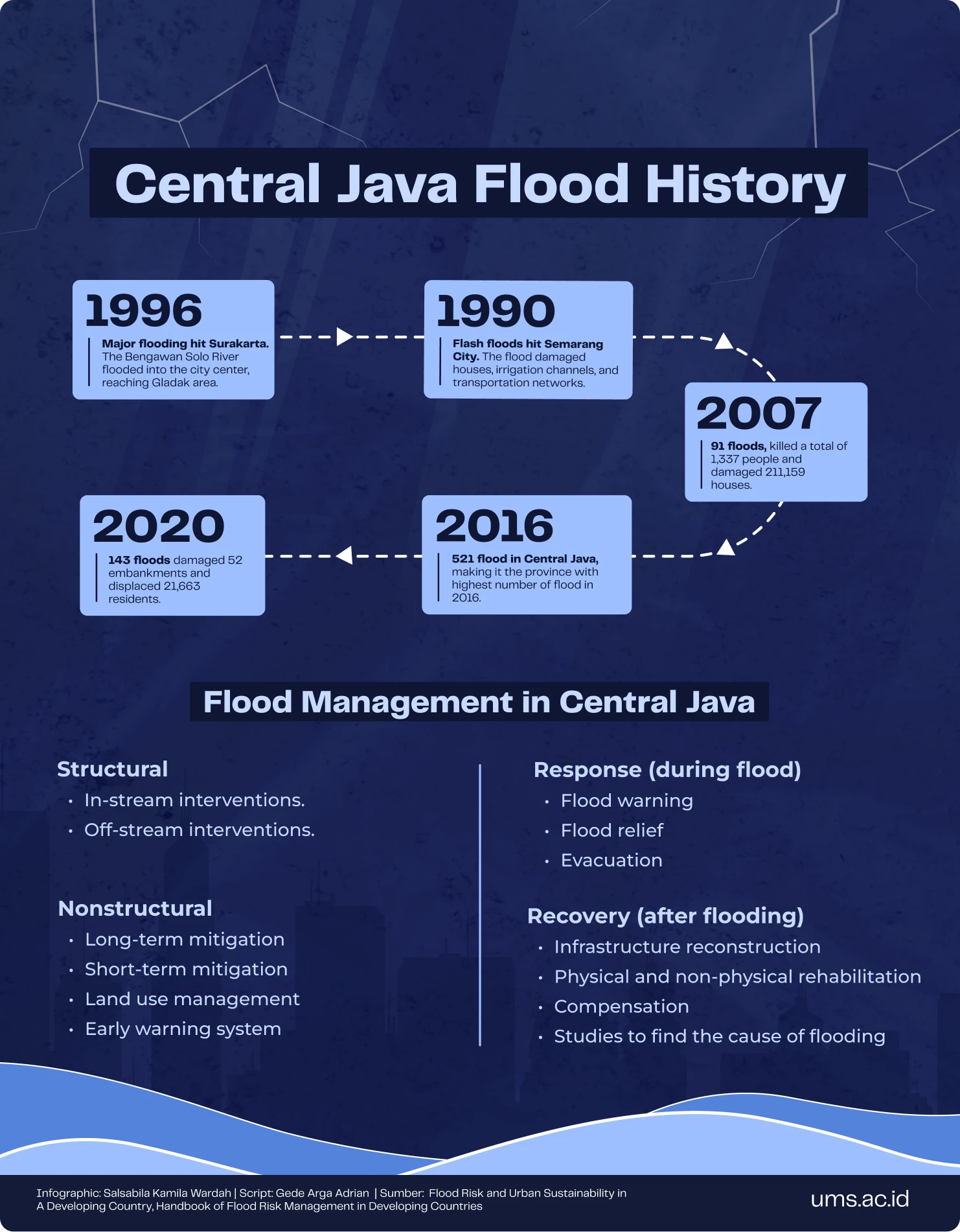
Purwanti and Isnugroho’s paper, published in the Handbook of Flood Risk Management in Developing Countries, outlines the significance of sustainable infrastructure in mitigating flood risk in Central Java.
There are three types of sustainable infrastructure that the government can build to mitigate flood risk: building reservoirs or rainwater storage ponds, constructing infiltration wells, and establishing mangrove forests along the coast of Central Java.
In Central Java, 16 reservoirs have been built, with the majority serving as multipurpose reservoirs for flood control, fisheries, irrigation water supply, and hydropower generation.
Infiltration wells are also a solution because they collect rainwater and infiltrate it into the ground. However, Purwanti and Isnugroho in their book explain that not all areas are suitable for infiltration wells,” especially in coastal areas because coastal areas are low-lying areas where rivers flow into. Infiltration wells are more ideal in higher altitudes.”
In addition to mitigating flooding, planting mangrove forests is a solution to prevent tidal flooding in the northern coastal areas. Purwanti stressed the significance of planting mangroves or establishing mangrove barriers along the north coast of Central Java to reduce the risk of tidal flooding.
Tidal flooding is an annual occurrence in Central Java. The Loughborough graduate lecturer, highlighted the factors contributing to tidal flooding on the coast of Central Java, including tidal currents, land subsidence on the north coast, and climate change.
According to Kompas.com, on Wednesday (24/04/2024), land subsidence in Central Java reached 20 cm per year.
“One contributing factor is uncontrolled groundwater extraction. Continuous groundwater pumping leads to land subsidence, resulting in increased flood risk. As supported by numerous studies, climate change contributes significantly to the worsening of flooding in Central Java,” stated the lecturer.
However, according to Purwanti and Isnugroho, Central Java faces three challenges in realizing sustainable infrastructure. Firstly, the environmental aspect is impacted by the lack of hydrological and hydraulic data. While there are numerous rainfall measuring stations in Central Java Province, many are not functioning correctly. Moreover, rarely calibrated water level gauges compromise the availability of hydraulic data in the province.
Secondly, there is the political aspect, where the absence of sustainable policies between regional leaders renders flood control policies unsustainable.
Thirdly, there is the social aspect, which presents Central Java with complex social issues. This is due to the diverse population of Central Java in terms of religion, ethnicity, race, tribe, economic, and educational background.
Flood management in Central Java becomes even more challenging due to poor waste management. Much of the waste is disposed of in open dumps, and some communities still dispose of waste directly into rivers and drainage channels.
Addressing the flood problem in Central Java requires more than just building sustainable infrastructure. It needs synergy between regions and institutions to enhance the quality of flood risk management.
In fact, Flood risk management in Central Java has been implemented for decades and is supported by four key factors. These include disaster management agencies at provincial and city/district levels, disaster risk reduction movements at the community level, community solidarity, and government support in building infrastructure to mitigate flood risk.
Unfortunately, there are still some weaknesses in the flood risk management that has been implemented so far. Purwanti highlighted six points, including:
According to Purwanti, flood risk management requires an approach that considers structural and nonstructural efforts and involves all stakeholders.
“The structural approach involves technical measures aimed at reducing the risk of flooding, such as constructing drainage networks, maintaining them to prevent sediment and garbage buildup, and creating space for rivers,” she explained. “Additionally, riverbank areas can be cleared of illegal buildings.”
Meanwhile, nonstructural efforts that the government can undertake to reduce the risk of flooding include educating people on the creation of infiltration ponds, raising awareness about keeping riverbank areas free from residential development and relocating residents residing in flood-prone areas.
The government has made repeated attempts to evacuate residents from flood-prone areas. However, these efforts have often been unsuccessful due to continued resistance from local residents.
“Actually, there are already regulations to evacuate residents, especially those living on the coast. However, residents often refuse to comply. There are socio-economic aspects that must be considered,” explained Purwanti.
The socio-economic aspect is closely tied to the livelihoods of the residents. Therefore, if residents are to be relocated, it must be accompanied by viable livelihood solutions in their new place. The government must carefully consider these factors before proceeding with any relocation efforts in flood-prone areas. Whether regional head candidates will address this polemic in the 2024 Pilkada (Regional Elections) remains to be seen. Let’s wait and see what happens next.
Writer: Gede Arga Adrian
Editor: Al Habiib Josy Asheva
Translator: Farizal Luqman Majid
Bank Indonesia has held its benchmark rate at 5.75 percent, ending speculation of a hike to 6 percent that had circulated in recent weeks.
Nothing’s more special than reading curated news just for you.
Subscribe to the UMS Newsletter for free today.