Bank Indonesia Holds Interest Rate at 5.75%, What Is the Impact?
24 July 2026
Bank Indonesia has held its benchmark rate at 5.75 percent, ending speculation of a hike to 6 percent that had circulated in recent weeks.



Traffic congestion remains a significant issue in several regions of Indonesia. To address this, the Ministry of Transportation continues to promote the development of public transportation to reduce congestion. One of the initiatives is the National Movement to Return to Public Transportation.
Buses have recently become a major focus of development. Buses are a cost-effective public transportation option that can be implemented in various regions across Indonesia.
However, not many provinces have adequate public transportation systems. One of the provinces with a good public transportation system is Central Java. This is evidenced by the presence of Trans Semarang in Semarang City, Trans Jateng, and Batik Solo Trans in Surakarta City.
Nonetheless, the number of private vehicles has steadily increased over time is a significant issue. The Association of Indonesian Automotive Industries reports that there are 153.4 million motor vehicles in Indonesia. This figure includes 147.15 million private vehicles, with 127.97 million being motorcycles (87 percent) and 19.17 million private cars. The remaining vehicles consist of 5.7 million large trucks, 213,788 buses, and 85,113 special vehicles.
The large number of private vehicles has caused severe traffic congestion in several cities. In response, the Ministry of Transportation has introduced the Push and Pull policy. According to the Ministry of Transportation's website, the pull policy aims to attract public interest in switching to public transportation, while the push policy focuses on enhancing the public's experience when using public transportation.
The Push and Pull strategy involves five key pillars: prioritizing public transportation, traffic engineering, reducing air and noise pollution, managing transportation needs, and providing non-motorized public transport options.
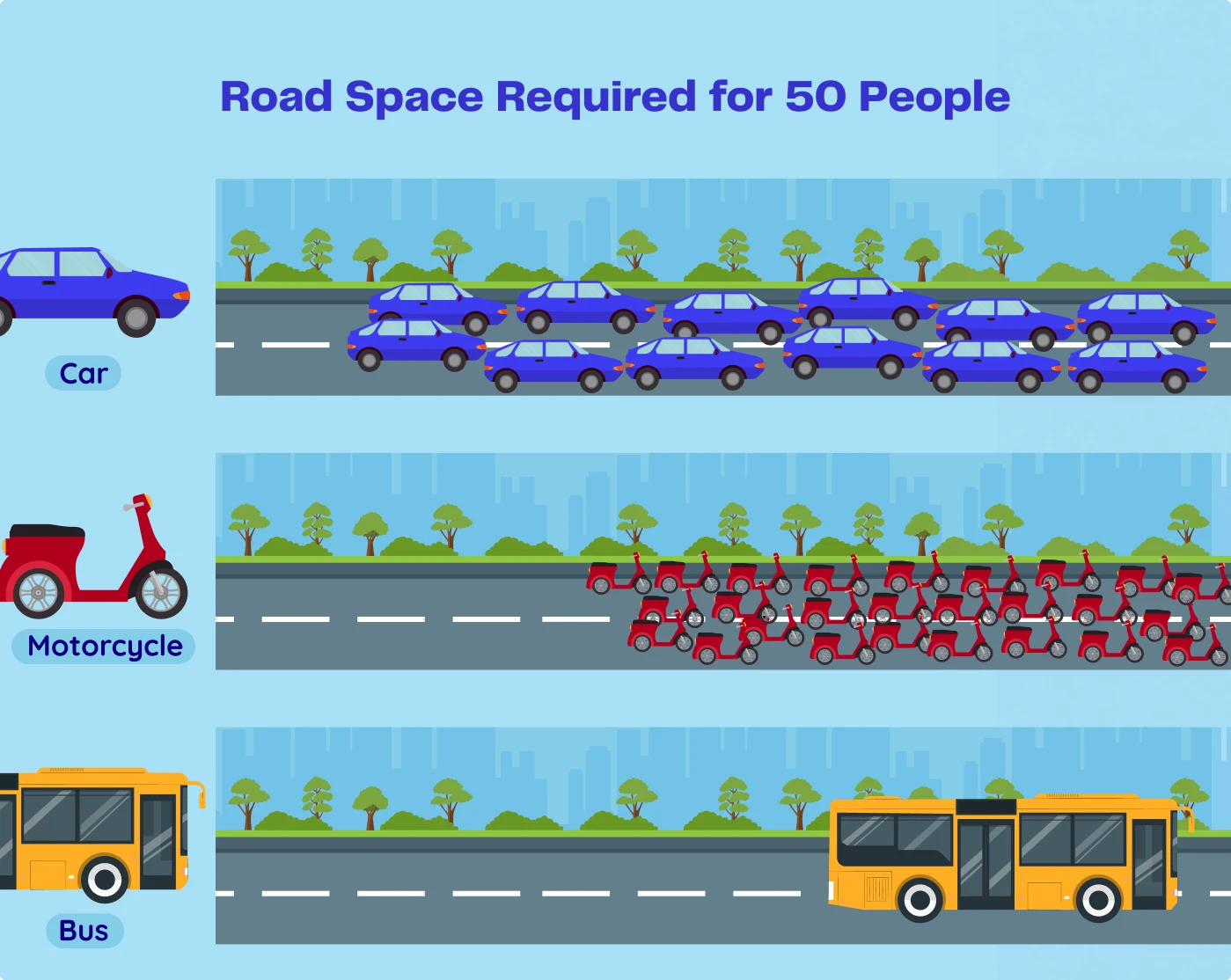
In line with government efforts, Nurul Hidayati, S.T., M.T., Ph.D., a transportation and traffic safety expert from Universitas Muhammadiyah Surakarta (UMS), strongly supports public transportation as a means of community mobility. She notes that a single bus with a capacity of 50 people traveling to the same destination can significantly reduce the amount of road space used compared to 50 individual cars.
“When compared to 50 people each driving their own car, the total space occupied includes not only the size of 50 vehicles but also the gaps between them,” explained the doctor from the Institute for Transport Studies at the University of Leeds, UK.
Nurul observed that the public transportation system in Central Java requires evaluation. Her research, titled “Evaluation of Public Transportation Implementation as Part of Supporting Sustainable Transportation,” investigates the challenges faced by the public transportation sector in Central Java Province.
The research, published in the journal Civil Engineering and Architecture, examines elements related to bus-based mass transportation in Central Java, including terminals, buses, and bus stop facilities. Nurul conducted a survey at fourteen terminals across Central Java and found that several terminals still face issues.
“For instance, the main facilities at bus stops need improvement, such as adding route information boards and stop signs," she stated during a WhatsApp interview on Wednesday (08/28/2024).
Nurul, in undertaking her research, surveyed users by distributing questionnaires to respondents at bus stops and terminals, as well as through social media. The analysis methods used were Importance Performance Analysis (IPA) and Customer Satisfaction Index (CSI).
The evaluation indicators proposed by Nurul were based on the Minimum Service Standards in the transportation sector set by the Ministry of Transportation. The results, processed using the IPA method, discussed level of conformity performance, with an average of 80.78 percent for terminals, 87.98 percent for bus stops, and 84.26 percent for buses. Nurul indicated that these figures show a correlation between respondents' satisfaction with the facilities' performance and their expectations. Meanwhile, using the CSI method, respondents expressed satisfaction with the facilities at bus stops and on buses, but showed moderate satisfaction with terminal facilities.
Maintaining comfort at bus stops is crucial. In her research, Nurul cited the example of bus stops along Jalan Slamet Riyadi in Surakarta, which have complete facilities such as bus stop identification, directional signs, route information boards, lighting, and seating. In contrast, bus stops located in less densely populated areas, such as along Jalan Gadjah Mada in Surakarta, appear to be more rudimentary.
Additionally, Nurul is not holding back on the need to improve safety-related facilities. The interior design of buses, especially the placement of ticket machines, has to be reviewed. The goal is to facilitate passenger’s movement from the origin bus stop to the destination.
During observations on the Batik Solo Trans, Nurul noted that all buses on corridors 1 to 6 used high-deck buses. Passengers are directed to board through the front door and climb stairs, which poses difficulties for wheelchair users. Some smaller buses also had relatively narrow movement spaces and lacked space that could accommodate wheelchair users.
For terminal facilities, three factors under 50 percent ratings contributed to moderate satisfaction levels safety at 39 percent, convenience at 46.03 percent, and equality at 25 percent.
Safety elements within terminals include evacuation routes, pedestrian lanes, road signs and markings, fire extinguishers, and health posts. Convenience elements encompass information on onward transportation, separation of passenger arrivals and departures, and route information. Meanwhile, equality elements comprise disabled facilities and lactation rooms.
Improving terminal facilities is crucial because terminals serve as the hub of public transportation activities. They are not only spaces where passengers board and disembark but also serve as transit points for connecting to other forms of transportation. “It is essential to make these improvements to attract public interest in switching to public transportation," added Nurul.
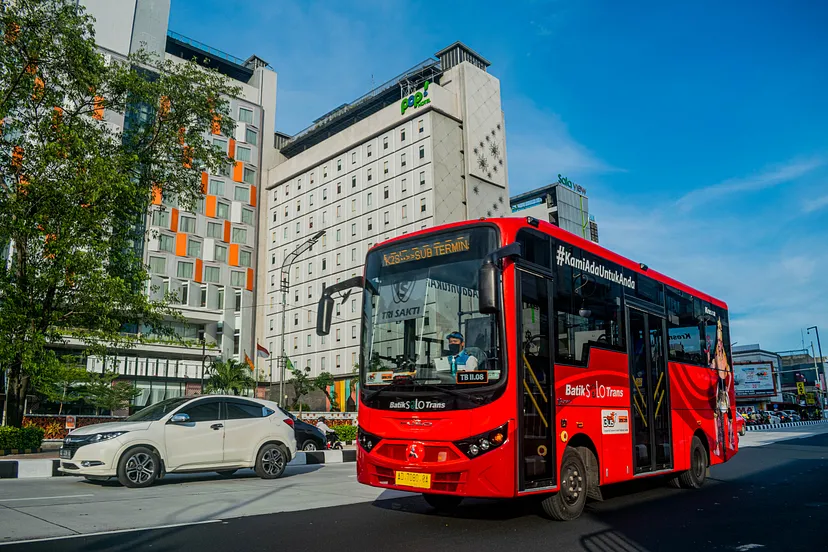
Batik Solo Trans in the Purwosari area, Surakarta, Central Java. Gede Arga/UMS Public Relations
The use of public transportation, particularly buses, makes road space utilization more efficient. This aligns with efforts to conserve fossil fuels and supports the goal of achieving sustainable transportation. Additionally, public transportation encourages people to engage in active mobility, shifting the focus from moving cars to moving people.
Nurul believes that the development of public transportation in Central Java, particularly in Surakarta, is progressing well. This is evident in the integration of the Surakarta Yogyakarta KRL (commuter rail) with Batik Solo Trans. KRL passengers can seamlessly board Batik Solo Trans buses from stops located in front of Purwosari and Solo Balapan stations.
The advancement of technology is also seen in the implementation of a cashless payment system for Batik Solo Trans, which reduces payment time and eliminates the need for bus conductors as in the past.
Although cashless payments are relatively efficient, Nurul suggests that a cash payment option should still be available. “Some people prefer paying in cash because they don't have to top up their e-money cards beforehand," added the Civil Engineering lecturer at UMS.
On the other hand, the operation of public transportation faces challenges such as limited budgets. According to Solopos.com, the management of three Batik Solo Trans feeder corridors has been handed over to the Surakarta City Government, which allocated a budget of approximately IDR 14 billion operational cost.
"Additionally, the increasing number and variety of online transportation options pose a unique challenge in optimizing public transportation," she explained.
When asked about the option of introducing rail-based public transportation, Nurul stated that it is not yet necessary, given that Surakarta is not a particularly large area, covering just 46.72 square kilometers. The option to build LRT (Light Rail Transit) or MRT (Mass Rapid Transit), which are also forms of mass public transportation, would be more appropriate for a larger area.
This consideration is related to the provision of infrastructure, which is not cheap, including facilities, resources, and management. "Careful consideration is needed to determine the extent of the benefits that would be gained if rail-based transportation were implemented," she concluded.
Writer: Gede Arga Adrian
Editor: Al Habiib Josy Asheva
Translator: Farizal Luqman Majid
Bank Indonesia has held its benchmark rate at 5.75 percent, ending speculation of a hike to 6 percent that had circulated in recent weeks.
Nothing’s more special than reading curated news just for you.
Subscribe to the UMS Newsletter for free today.