
Bank Indonesia Holds Interest Rate at 5.75%, What Is the Impact?
24 July 2026
Bank Indonesia has held its benchmark rate at 5.75 percent, ending speculation of a hike to 6 percent that had circulated in recent weeks.



Antenatal checkups at community health centers (puskesmas) generally focus on physical conditions such as blood pressure, body weight, vitamin supplementation, and monitoring fetal development. Yet one crucial aspect is frequently neglected: the mother’s psychological state. In fact, maternal mental health during pregnancy holds the key in the well-being of the mother and the child’s growth and development.
This concern prompted Prof. Dr. Yuli Kusumawati, S.K.M., M.Kes., a Professor at the Faculty of Health Sciences, Universitas Muhammadiyah Surakarta (UMS), to research the need for mental health screening for pregnant women in primary health care services. Her findings, which highlight the lack of early detection for maternal mental disorders, are presented in a study entitled Qualitative Study on Mental Health Screening Needs of Pregnant Women in Primary Health Care.
Pregnancy is often described as a joyful time, but for some women it can turn into a nightmare. According to Yuli, many expectant mothers begin to experience anxiety as early as the first trimester.
Her interviews with 15 respondents revealed that pregnant women’s thoughts are frequently clouded by fear and worry, whether the fetus is developing properly, the risk of miscarriage, or the anticipation of childbirth. “If not managed, this anxiety can develop into depression,” Yuli explained.

Depression during pregnancy carries serious consequences. Mothers may become reluctant to attend prenatal checkups, neglect consuming nutritious food, and lose the motivation to care for themselves.
As a result, babies are at risk of being born with low birth weight. In the long run, this condition can increase the likelihood of stunting, a major public health challenge that continues to affect Indonesia.
Mental health problems can also continue after childbirth. The phenomenon of baby blues, feelings of sadness, anxiety, or frequent crying that usually appear a few days after delivery, or even postpartum depression, which is more severe and lasts longer, can make it difficult for mothers to bond with their babies.
In some cases, mothers may refuse to breastfeed or feel incapable of caring for their child. The impact extends beyond the baby’s physical health to their emotional and psychosocial development.
The triggers of mental disorders vary. Yuli’s research across five community health centers in Surakarta, Gajahan, Gilingan, Kratonan, Penumping, and Sangkrah, revealed factors such as economic pressures, unplanned pregnancies, and domestic violence. A lack of support from husbands and families further worsens the situation.
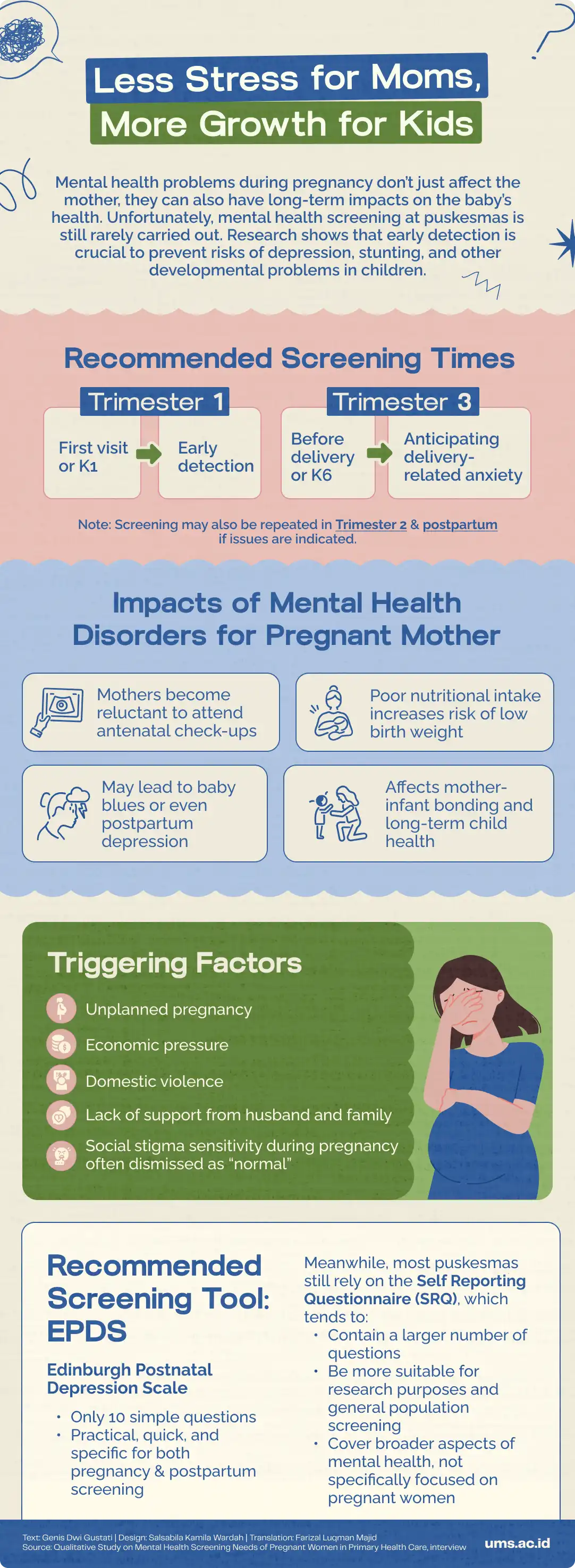
Unfortunately, many in society still downplay these issues. Pregnant women’s emotions are often dismissed as mere “moodiness” or normal hormonal changes.
This stigma discourages mothers from speaking up, while healthcare workers rarely inquire specifically about their emotional state. “What mothers need is not judgment, but attention,” Yuli noted.
Yuli’s research highlights a major gap in primary healthcare services. So far, puskesmas only records severe mental disorders such as schizophrenia, suicide, or addiction.
Mild depression and anxiety in pregnant women are never included in the reporting system. As a result, there is no accurate data on the prevalence of mental health problems in this group.
Yet the purpose of screening is to detect early symptoms before they worsen. Yuli stressed that screenings should ideally be conducted at least twice during pregnancy, precisely on the first antenatal visit and before delivery.
“If signs of problems are found, screenings can be repeated in the second trimester or even after childbirth. This way, healthcare providers can immediately offer counseling, education, or referrals to specialist services,” she explained.
Another challenge lies in the screening instruments themselves. Up to now, several puskesmas have used the Self-Reporting Questionnaire (SRQ), a general tool for adults.
According to Yuli, this instrument is considered too lengthy and insufficiently specific for pregnant women. She recommends the use of the Edinburgh Postnatal Depression Scale (EPDS), a questionnaire consisting of ten simple questions. More suitable for both pregnant and postpartum women.
“If the questionnaire is too long, pregnant women become reluctant to fill it out. EPDS is more practical, and the results can be read immediately,” Yuli explained. This instrument has even started to be adopted by the Ministry of Health as part of efforts to improve mental health services.
Yuli’s research did not stop at the academic level. Through scientific publications and dissemination activities, her findings reached the Health Office and puskesmas officials in Surakarta. A year later, a local policy was introduced to begin implementing mental health screening for pregnant women, although its application remains limited.
Currently, Yuli is also developing a digital application that allows midwives to read screening results automatically. This innovation, still in progress, is expected to reduce manual workload since the results will directly indicate whether a pregnant woman needs education, counseling, or referral.
The lecturer, who was recently inaugurated as a Professor in Health Promotion and Behavioral Science, pointed out that medical screening is only one part of the solution. Social support from family, especially from the husband, is equally important.
The antenatal classes at puskesmas are actually designed to involve partners, but the husband’s attendance is often hindered by work schedules or limited program budgets. Yet, the involvement of husbands can make a significant difference.
Partner involvement has been proven to greatly impact the psychological well-being of mothers. The presence of a husband helps mothers feel more cared for, thereby significantly reducing the risk of depression.
Yuli hoped that soon, there will be stronger national policies regarding mental health screening for pregnant women. Such policies would allow mental health data to be recorded more comprehensively, ensuring that vulnerable groups like pregnant women are properly monitored.
“This issue concerns the quality of future generations. Neglecting the mental health of pregnant women is tantamount to putting the future of the next generation at risk,” she concluded.
Writer: Genis Dwi Gustati
Translator: Farizal Luqman Majid
Editor: Al Habiib Josy Asheva
Designer: Salsabila Kamila Wardah
Bank Indonesia has held its benchmark rate at 5.75 percent, ending speculation of a hike to 6 percent that had circulated in recent weeks.
Nothing’s more special than reading curated news just for you.
Subscribe to the UMS Newsletter for free today.