Bank Indonesia Holds Interest Rate at 5.75%, What Is the Impact?
24 July 2026
Bank Indonesia has held its benchmark rate at 5.75 percent, ending speculation of a hike to 6 percent that had circulated in recent weeks.




The Kotabaru District Court in South Kalimantan has sentenced the former Editor-in-Chief of Banjarhits, Diananta Putera Sumedi, to 3 months and 15 days imprisonment. According to Kompas.com, Tuesday (25/8/2020), this decision follows Diananta’s report on news titled “Tanah Dirampas Jhonlin, Dayak Mengadu ke Polda Kalsel”
According to a report from Kompas.com, Diananta was charged under Article 28 of the Electronic Information and Transaction Law (ITE). The article stipulates that “Every person intentionally and without the right to disseminate information aimed at creating hatred or hostility of individuals and/or certain community groups based on ethnicity, religion, race, and intergroup (SARA).”

Dr. Budi Santoso, S.Sos., M.Si., a journalism lecturer at Universitas Muhammadiyah Surakarta (UMS), in his research “The Construction of Legal Protection for Journalists Unaffiliated with Press Companies in the Industrial Revolution 4.0 Era,” highlighted the Diananta in case as one of several concerning incidents in the country’s press freedom. He also mentioned other cases, including Nurkholis Lamaau’s case in 2022, Muhammad Asrul’s case in 2019, Hersubeno Arief’s case in 2021, and the case of Dar and Bud, editor-in-chief and journalists of the weekly tabloid Koridor, in 2004-2005.
In his research, Budi analyzed the legal protection for freelance journalists, those not affiliated with press companies. He formulated a legal construction aimed at enhancing protection for journalists without ties to press companies in the context of the industrial era 4.0.
During our meeting on Tuesday (30/1/2024), Budi elaborated on the rationale behind his research. He highlighted that the prevalence of Industry 4.0 has led to the widespread use of digital devices among the public, enabling many individuals to easily create digital media content.
Budi remarked, “Digital technology allows anyone to create a media platform. While some may pursue it for monetary gain, many are driven by a genuine passion for journalism.”
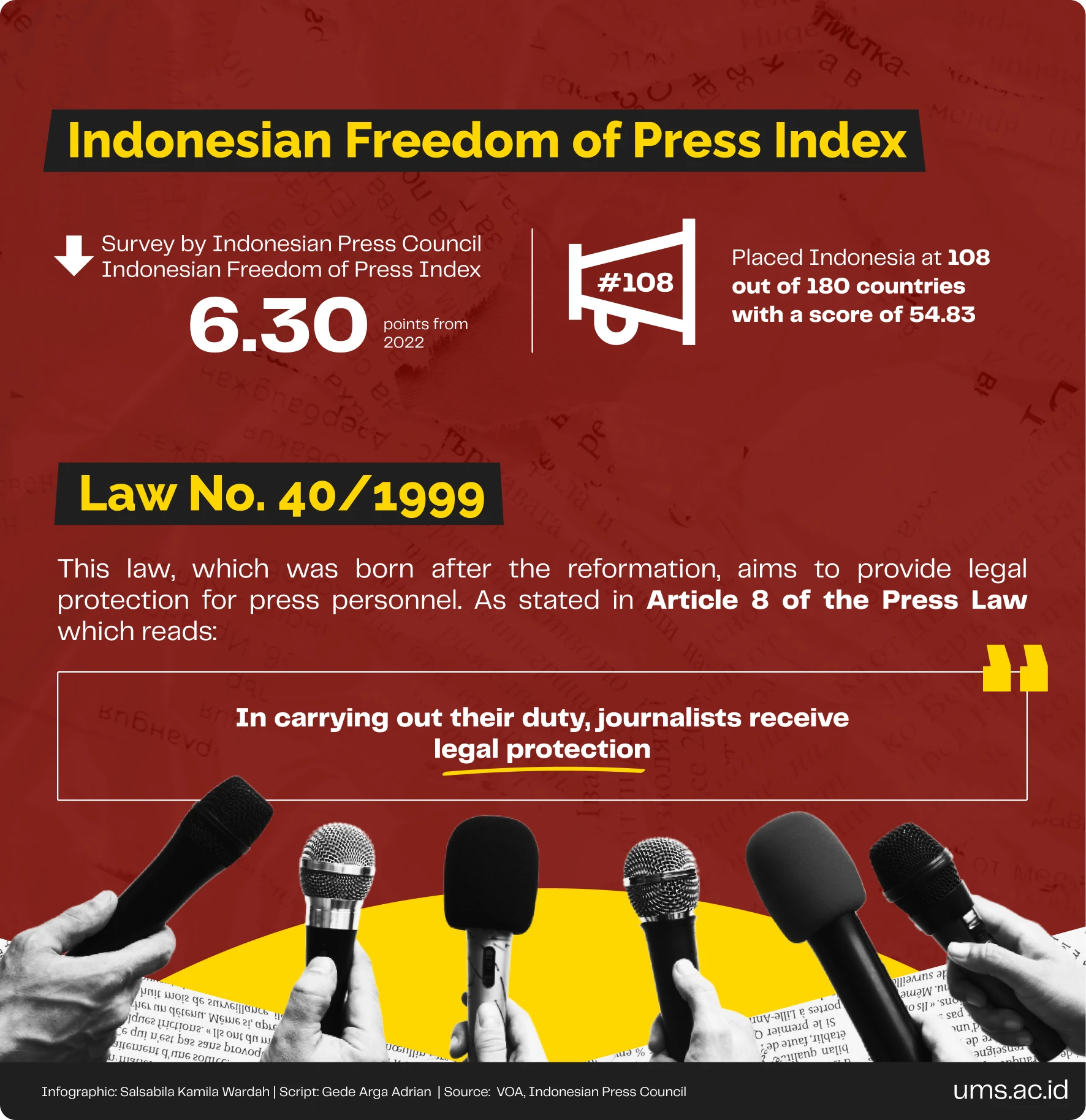
Additionally, the rise of online media has led to an increase in freelance journalists. Unfortunately, legal protection for freelance journalists is often overlooked. Budi highlighted that the current Press Law (Law No. 40/1999) only provides protection for journalists associated with press companies.
“I see that Law No. 40/1999 does not address the security of freelance journalists. Every profession comes with risks, including journalism. Freelance journalists require protection to ensure that the press, as the fourth pillar of democracy, can continue to stand tall and be sustained with the presence of robust journalism,” emphasized the Communication Sciences lecturers.
In his research, Budi highlighted that Article 8 of the Press Law only outlines for journalists to receive legal protection. However, those laws do not specify whether the protection is intended for print journalists, electronic media journalists, or online media journalists. The discussion on legal protection for journalists typically revolves around those who work in affiliation with press companies.
Budi argued that when examining Press Council Regulation No. 5/2008, it clarifies that legal protection is not solely provided by the state and society but also by press companies. However, the challenge arises from the fact that Article 8 of the Press Law does not explicitly state whether legal protection is exclusively granted to journalists working in press companies or whether it also extends to freelance journalists without affiliations to press companies.
Analyzing the mentioned example, Budi concluded in his research that legal protection for press personnel is exclusively granted to journalists affiliated with press companies.
Cases of criminalization of freelance journalists have become recurrent in Indonesia, primarily stemming from the absence of specific legal protection for freelance journalists. As a consequence, freelance journalists may face charges under laws like the ITE Law or other general laws.
In his research, Budi cited several cases of criminalization of freelance journalists, such as:
Budi expressed his concern, stating that the rampant criminalization of journalists indicates suboptimal performance in law enforcement. “I think this is how law enforcement is underperforming and failing to protect journalists,” he explained.
Notably, incidents of violence against journalists during coverage further highlight the authorities’ failure to adequately protect journalists.
“It’s possible that accidents or calamities befall journalists because they don’t receive adequate protection. For instance, during demonstrations, journalists may get injured because demonstrators and officers don’t recognize them as journalists, even if they're wearing press vests,” Budi explained.
Budi emphasized the importance of ensuring the safety of freelance journalists through the mechanisms outlined in the Press Law. He pointed out that the Press Law regulates the procedures if there are parties who feel aggrieved.
“The Press Law regulates that if there are errors in writing and so on, the media can use the right of reply. Then the mechanism for how the media treats corrections is also regulated. So people who feel aggrieved can go through the right of reply mechanism in the Press Law,” he explained.
The Press Law is unique in that it does not include articles imposing physical sanctions, such as criminalizing journalists or incarcerating them. Instead, it focuses on administrative sanctions applied to media outlets or journalists.
“If freelance journalists cannot be classified as journalists, they cannot be protected under Press Law, they may face charges under the ITE Law or other general laws. The Press Law is unique because it doesn’t include custodial sentences; instead, it imposes administrative sanctions, such as fines.” clarified Budi.
In his research, Budi proposed the amendment of Article 8 of the Press Law to include protection for freelance journalists. In the article, he emphasized the need for clarity regarding legal protection for journalists, whether affiliated with press companies or working as freelancers. This is particularly crucial in the era of Industry 4.0, where an increasing number of freelance journalists utilize online media for their work.
Furthermore, Budi recommended an immediate revision of the ITE Law, particularly addressing articles with multiple interpretations frequently utilized to criminalize journalists.
“Through this construction, I hope there is room for an additional article in the Press Law, which accommodates those who do not work for a press company to still receive legal protection. The fear is that if this is not included as one of the Press Law articles, journalists can be subject to other general laws such as the ITE Law,” Budi concluded.
National Press Day on February 9, 2024, should serve as a moment of reflection. Has the legal protection for Indonesian journalists been fully implemented?
Writer: Gede Arga Adrian
Editor: Al Habiib Josy Asheva
Translator: Farizal Luqman Majid
Bank Indonesia has held its benchmark rate at 5.75 percent, ending speculation of a hike to 6 percent that had circulated in recent weeks.
Nothing’s more special than reading curated news just for you.
Subscribe to the UMS Newsletter for free today.