
Bank Indonesia Holds Interest Rate at 5.75%, What Is the Impact?
24 July 2026
Bank Indonesia has held its benchmark rate at 5.75 percent, ending speculation of a hike to 6 percent that had circulated in recent weeks.



The Camellia sinensis L. tea plant species is widely cultivated in Indonesia, including in Kemuning Village, Karanganyar Regency, Central Java. Farmers grow this plant because it thrives in the cool mountainous climate of Mount Lawu. They typically harvest the tea leaves and supply them to various tea processing factories, providing the tea we consume as a beverage.
Tea has become an integral part of Indonesian gastronomy. For many, enjoying a cup of hot tea or iced tea feels essential after a meal. Tea is especially popular due to its antioxidant content, which helps combat free radicals, making it even more beloved by Indonesians.
We usually see tea leaves as a consumable product, often brewed in hot water as the common way to enjoy it. However, two researchers from the Faculty of Pharmacy at Universitas Muhammadiyah Surakarta (UMS), Setyo Nurwaini, S.Farm., M.Sc., and Wahyu Utami, S.Si., M.Si., Ph.D., have identified another potential for tea leaves to be developed further.

Two researchers from the Faculty of Pharmacy, Universitas Muhammadiyah Surakarta (UMS), Setyo Nurwaini (right) and Wahyu Utami (left) at the UMS Pharmaceutical Chemistry Laboratory, Friday (20/12/2024). Imam Safii/UMS Public Relations
They experimented with processing tea leaves into the main ingredient for making sunscreen. “We want to create a sunscreen product. Our focus is on utilizing abundant local resources, and one of them is tea,” said Setyo during an interview at the Pharmaceutical Chemistry Laboratory of UMS, Wednesday (18/12/2024).
Sunscreen, is a skincare product used to protect the skin from ultraviolet (UV) rays. According to Alodokter, sunscreen also helps prevent photoaging, dark spots, and sunburn.
Tea leaves contain beneficial and potentially valuable compounds. Setyo Nurwaini and Wahyu Utami noted that catechins found in tea leaves are part of the polyphenol group. These compounds protect plants from UV radiation and pathogen attacks.
Wahyu explained that the polyphenol group in tea leaves has the ability to absorb UV rays. This is the compound that prevents UV rays from reaching human skin in tea leaf-based sunscreen. “It serves as a preventive measure against sunburn and photoaging,” Wahyu added.
The experiment began with maceration, where dried and powdered tea leaves were soaked in a 96% ethanol solution. The goal was to extract the active compounds from the tea leaves. The mixture was stirred for three hours and left to settle for 18 hours.
The maceration results were then filtered and evaporated using a vacuum evaporator and a water bath at 60 degrees Celsius. This process yielded a thick tea leaf extract.
Setyo and Wahyu then formulated the tea leaf extract into sunscreen in cream form. Cream was chosen for its lightweight and comfortable texture on the skin, unlike the thicker lotion form.
Two phases were required to emulsify the sunscreen cream: the water phase and the oil phase. Ingredients mixed in the water phase included tea leaf extract, methylparaben, and polysorbate 80 (Tween 80). Three concentrations of tea leaf extract were used in the cream: 1%, 2%, and 4%.
For the oil phase, ingredients included paraffin oil, cera alba, glycerin, cetyl alcohol, span, stearic acid, propylparaben, perfume, and phosphate buffer with a pH of 7.4.
The researchers melted both the oil and water phases using a water bath heated to 75 degrees Celsius. The two phases were then mixed in a warm mortar and continuously stirred until a cream formulation was achieved.
According to Setyo, the process of making tea leaf sunscreen is relatively quick. However, the time-consuming step lies in extracting the compounds from tea leaves. “Making the extract takes a few days. Making the cream is easy,” she joked.

In one of the rooms at the Pharmaceutical Chemistry Laboratory at UMS, Setyo and Wahyu demonstrated the equipment used to test their tea leaf sunscreen. The cube-shaped gray device, called a spectrophotometer, measures the sun protection factor (SPF). “This is used to determine the SPF value,” Wahyu explained.
The spectrophotometer measures the absorption of UVB rays. The results showed that cream with 1% tea extract had an SPF value of less than 1, the cream with 2% extract had an SPF value of 2.03, and the cream with 4% extract had an SPF value of 2.41.
Setyo acknowledged that the SPF in the tea leaf sunscreen cream was relatively low. She explained that to achieve a higher SPF, the tea leaf extract composition in the sunscreen cream must be at least 10 to 15%. This percentage can increase depending on the desired SPF target. As an illustration, according to Alodokter, the standard SPF commonly used in Indonesia is at least 30.
They then compared their findings with research conducted by Iyan Sopyan from Universitas Padjadjaran, published in the International Journal of Applied Pharmaceutics in 2019. Unlike Setyo and Wahyu’s study, Iyan used black tea leaves that had undergone a fermentation process.
The formulation produced by Iyan was also not in the form of a cream but rather a lotion. His research tested a black tea extract concentration of 0.04%, which achieved an SPF level of 24.71.
Based on this comparison, Setyo and Wahyu saw significant potential for developing tea leaves as sunscreen material. However, they emphasized the importance of selecting the type of tea leaf processing and adjusting the concentration of tea leaf extract in the sunscreen. “The higher the tea leaf extract content, the higher the SPF,” Wahyu explained.
The tea leaf sunscreen was also tested for its antioxidant ability to combat free radicals. The two researchers compared the antioxidant capabilities of the tea leaf sunscreen with vitamin E. The results showed that sunscreen with 2% and 4% tea extract had higher antioxidant properties than the 1% concentration.
The antioxidant capability of tea leaf extract is close to vitamin E’s ability in combating free radicals. From three experiments conducted, tea leaf extract demonstrated an average antioxidant activity of 2.19 micrograms per milliliter, compared to vitamin E's average of 3.11 micrograms per milliliter.
These findings give tea leaf-based sunscreen dual benefits. “In addition to providing protective properties against sunlight due to its ability to absorb UV A and UV B rays, the tea leaf sunscreen also offers antioxidant benefits,” Wahyu added.
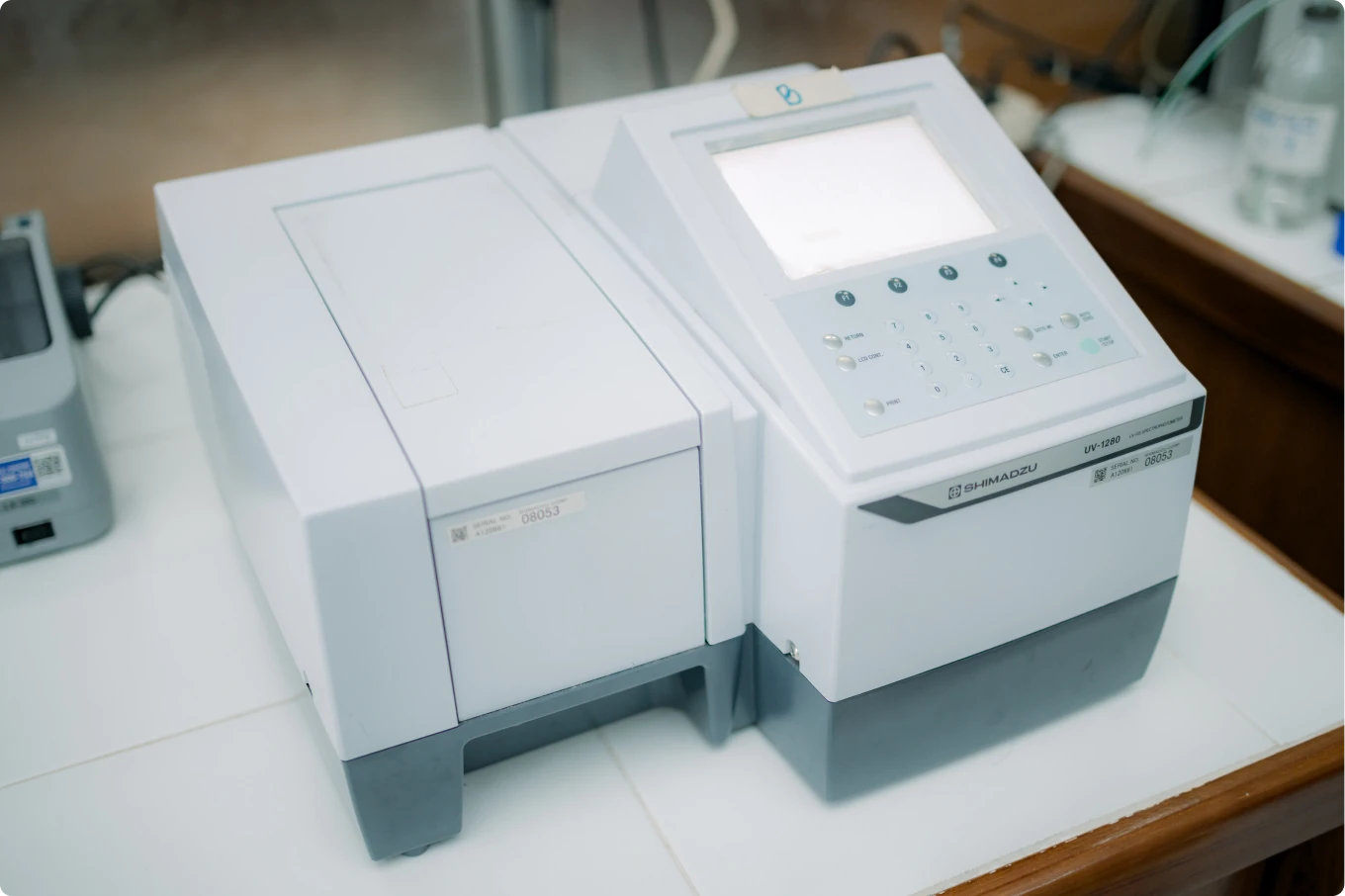
Spectrophotometer located in the Pharmaceutical Chemistry Laboratory, Faculty of Pharmacy UMS. Imam Safii/UMS Public Relations
Both researchers saw significant potential in utilizing tea leaf-based sunscreen. This is supported by the dual benefits of tea leaves, which can block UV rays and combat free radicals. “If the concentration can be increased, its SPF protection capability will also improve,” Setyo explained.
The market potential for sunscreen in Indonesia is relatively high. This is due to Indonesia's tropical climate, where sunlight shines throughout the year. It’s no surprise that sunscreen sales continue to climb.
According to CNBC Indonesia, sunscreen is one of the fastest-growing skincare products. Its sales value soared from Rp 530 billion in the second half of 2023 to Rp 914 billion in the first half of 2024, marking an increase of 72.27%.
When asked about plans for industrial-scale development, both Setyo and Wahyu said the process must still go through ethical research stages, or ethical clearance. “Our research proposal must first be submitted to the UMS Ethics Committee. It will be reviewed to ensure it adheres to research ethics,” Wahyu added.
The results of Setyo and Wahyu's research have now been published in the International Journal of Applied Pharmaceutics, which came out in early January 2021. The study has garnered attention from researchers worldwide.
One such researcher who contacted Setyo is Professor Vinood Patel from the University of Westminster, London, UK. Vinood is interested to include Setyo's study, titled Sunscreen from Tea, in his book. The study was later included in the book Tea in Health and Disease Prevention, which was published last September.
Writer: Gede Arga Adrian
Editor: Al Habiib Josy Asheva
Designer: Salsabila Kamila Wardah
Bank Indonesia has held its benchmark rate at 5.75 percent, ending speculation of a hike to 6 percent that had circulated in recent weeks.
Nothing’s more special than reading curated news just for you.
Subscribe to the UMS Newsletter for free today.