The Coffee Shop Boom
1 August 2026
Indonesia is one of the world's largest coffee-consuming nations, a thirst that keeps spawning new coffee shops. Sharpening the competition among them.



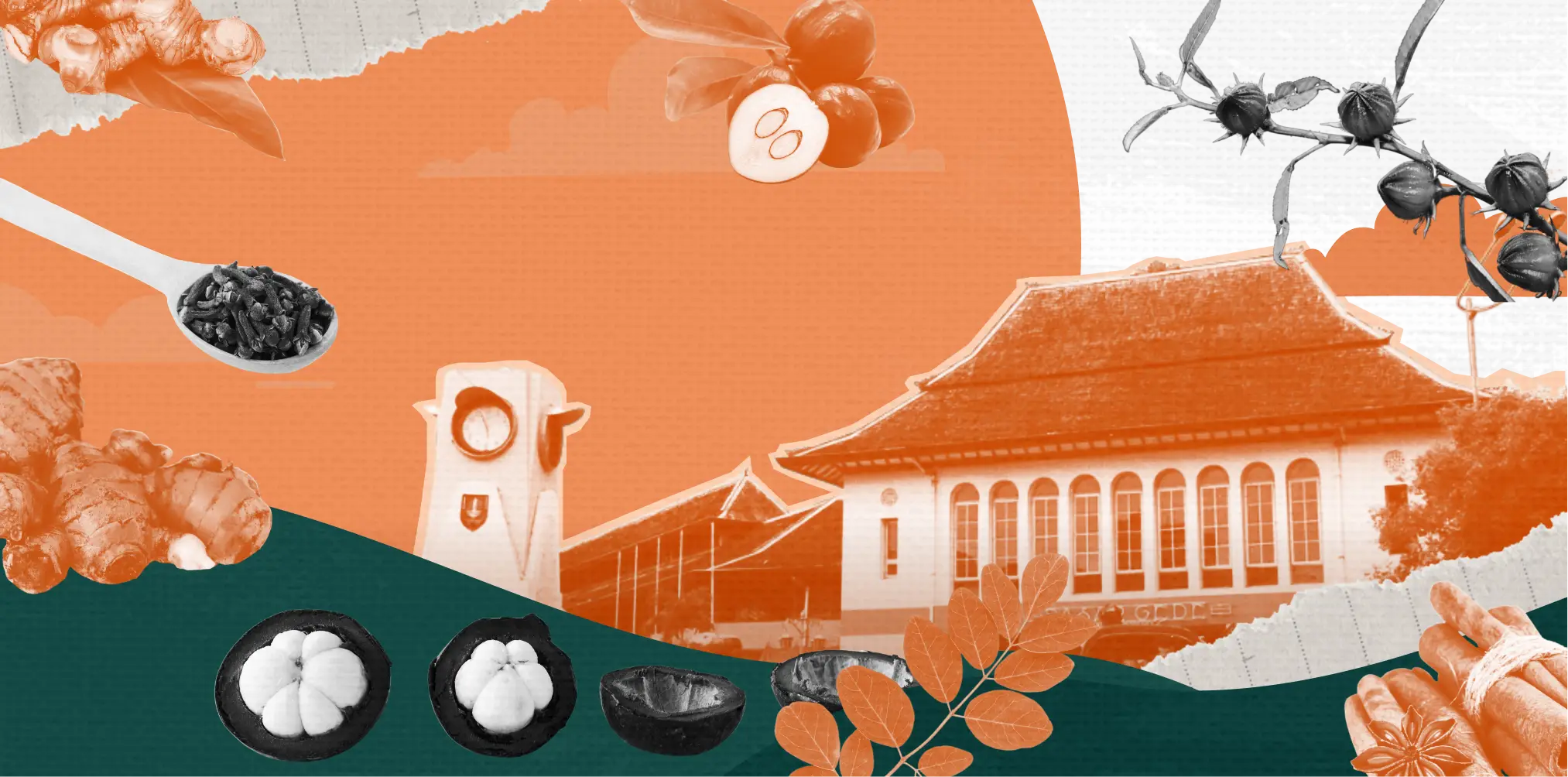
The fragrant aroma of spices fills the air, greeting every visitor passing through the northern corridor of Pasar Gede, Surakarta, Central Java. Peddlers line both sides of the passage, offering a variety of traditional herbs, from fennel, ginger, turmeric, lemongrass, galangal, sappanwood, to cinnamon.
Empon-empon are available in bulk or ready-to-consume sachets. One of the empon-empon peddlers, Widarti (70), also makes ready-to-consume blends. She sells various blends such as wedang rempah (spiced herbal drinks) like ginger-rosella tea, wedang uwuh, ginger-lemon tea, butterfly pea tea, diabetes-relief tea, to moringa tea.
“The one that’s currently viral and most popular is the wedang uwuh variety," said Widarti, who has been selling since 1975, on Thursday (12/9/2024). Widarti also stocks various types of spices, both local and imported. “One of the imported ones is this Arab cardamom,” she added, pointing to a package of murky white-greenish seeds.

Widarti (70) holds one of the merchandise that many tourists hunt at Pasar Gede, Thursday (12/9/2024). Gede Arga Adrian/UMS Public Relations
It is fair to say that the range of empon-empon available at Pasar Gede is incredibly complete. This is evident from the large plastic bags filled with towering piles of spices at the end of the market aisle. The market, designed by architect Thomas Karsten, has played a significant role in the spice trade in Surakarta. Many acknowledge Pasar Gede as the paradise of empon-empon.
According to Dr. Santhyami, M.Si., a plant ecologist from Universitas Muhammadiyah Surakarta (UMS), the presence of these medicinal plants is inseparable from cultural acculturation dating back to the royal era.
When Surakarta’s Kasunanan and Mangkunegaran principalities were still part of the Dutch East Indies’ Vorstenlanden, traders from all over the world, mainly from Arabs, China, and India, came to Surakarta.
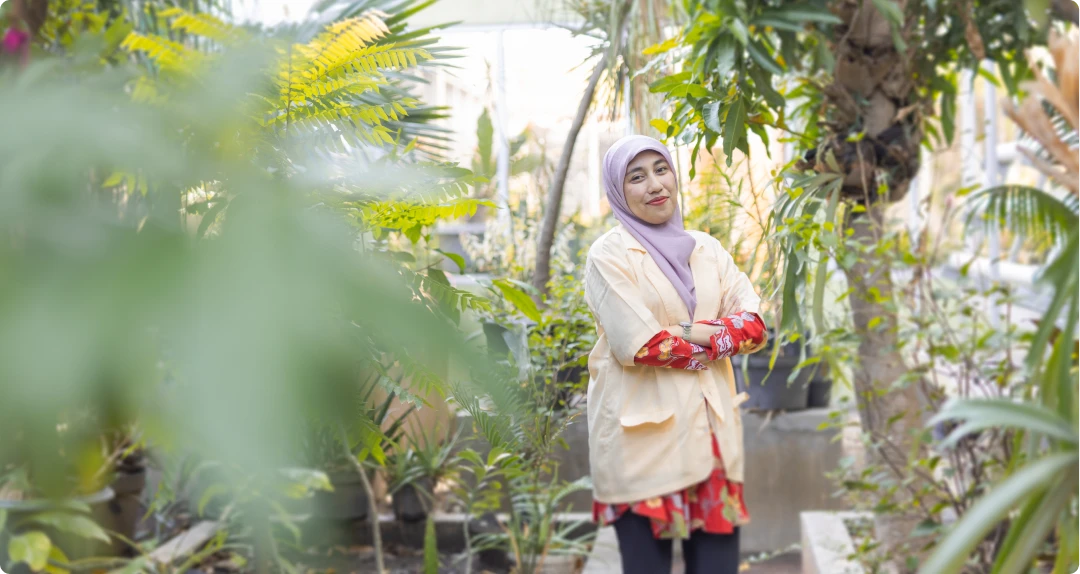
Dr. Santhyami, M.Si. Imam Safii/UMS Public Relations
“Pasar Gede, as a hub of trade connecting Java to the world, brought various medicinal plants introduced through the Maritime Silk Road,” said Santhy on Monday (9/9/2024).
Empon-empon has become an integral part of Surakarta’s culinary culture, especially in beverages like wedang, a traditional warm drink sold in hik (roadside stalls) to five-star restaurants to warm our body.
This culinary culture has deep ties with the peranakan Arabs and Chinese who settled in Surakarta. During the rainy season, traders often stayed in Surakarta for three to six months, and some eventually married locals, giving rise to the peranakan community.
While the majority of Surakarta’s population is of Javanese ethnicity, there is a significant minority of Chinese, Indian, and Arab descent. Arabs and Indians have lived around Pasar Kliwon since the 19th century, otherwise the Chinese community settled in Kampung Balong in Sudiroprajan, Jebres, Surakarta.
These ethnic divisions were reinforced by the colonial Dutch government’s wijkenstelsel policy, which segregated residential areas by ethnicity and race, limiting interactions between the local population and the peranakan.
“However, traditional markets, such as Pasar Gede, served as a bridge for various ethnic groups to interact and build meaningful social bonds,” added the UMS Biology Education lecturer.
This complex evolution led to various changes, including ecological transformations through the introduction and cultivation of new plant species, influencing the urban ethnobotanical practices of the area.
The tradition of using herbal plants as remedies passed down by the Peranakan community continues today. Now, the use of traditional remedies transcends ethnic and racial boundaries. “Many people have become familiar with and interested due to the interactions that take place in the market,” explained Santhy, a UMS Center for Environmental Studies researcher.
Santhy views Pasar Gede as a vital hub for exchanging knowledge about herbal plants. According to her, the market is not merely a center for trade but also a hub for introducing medicinal plants, cultivation, and sharing knowledge about their benefits.
“When I interviewed a seller, there was a customer looking for daun dewa (Gynura pseudochina). Since the seller didn’t sell or know much about the plant, they asked the customer about its benefits. Given its benefits the next day the seller immediately visited a grower and began stocking daun dewa at their stall,” Santhy recalled.
The introduction of new plants through small interactions between sellers and buyers has gradually influenced the diversity of plant species at Pasar Gede. Through her research, Exploring Urban Ethnobotany: A Case Study of Medicinal Plants Traded in Gede Hardjonagoro Market, Surakarta, Indonesia, Santhy has mapped the variety of medicinal plant species available at Pasar Gede.
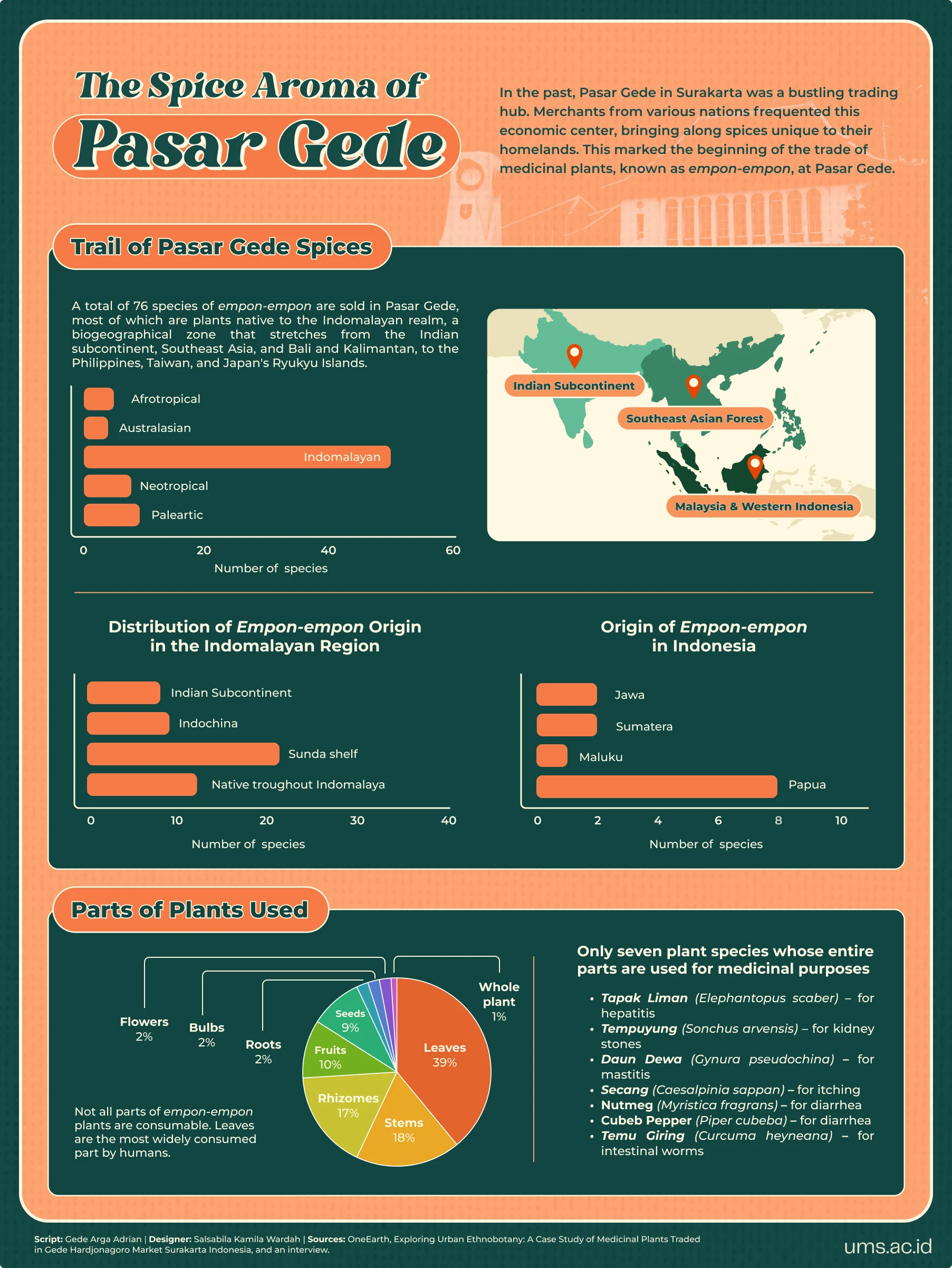
Her study, published in the Tropical Journal of Natural Product Research, identified about 76 species from 39 families being sold at Pasar Gede. Each species has its own healing properties for different ailments, such as diarrhea, diabetes, cough, flu, fever, and high blood pressure.
Some herbal plants that treat diarrhea include cinnamon, cubeb (Piper cubeba), and white turmeric. For diabetes, plants like bitter leaf (Andrographis paniculata), keji beling (Strobilanthes crispus), dandang gendis (Clinacanthus nutans), Bawang Dayak (Eleutherine bulbosa), and mahogany (Swietenia macrophylla) are recommended. Herbal plants for cough include temu kunci (Boesenbergia rotunda), kayu ules (wild cinnamon), and cardamom.
To treat flu, plants such as rasuk angin (blue trumpet vine) and ginger are used, while lempuyang and bangle (a variety of ginger) are common for treating fever. For hypertension, plants like rosella and kumis kucing (Java tea plant) are effective.
Santhy also calculated the proportion of plant parts used in traditional remedies. There are at least seven species where the entire plant is used for medicinal purposes, including tapak liman (Elephantopus scaber) for hepatitis, tempuyung (Sonchus arvensis) for kidney stones, daun dewa for mastitis, secang (Caesalpinia sappan) for itching, nutmeg (Myristica fragrans) and cubeb for diarrhea, and temu giring (Curcuma heynaena) for intestinal worms.
Not all parts of herbal plants are fully utilized. Leaves are the most commonly used part, making up 39 percent, followed by stems at 18 percent, rhizomes at 17 percent, fruits at 10 percent, and flowers at 9 percent.
Further, Santhy explored the origins of the 76 species sold at Pasar Gede. A total of 50 species originated from the Indomalaya region, 9 from the Palearctic, 8 from the Neotropics, 5 from the Afrotropical, and 4 from Australasia.
Indomalaya spans from the Indian subcontinent, Southeast Asia, and the islands of Borneo and Bali to southern China, Taiwan, the Philippines, to the Ryukyu Islands in Japan. Of the 50 species from this region, 21 come from the Indochina peninsula, 12 from the Indian subcontinent, and 9 from the Sunda shelf.
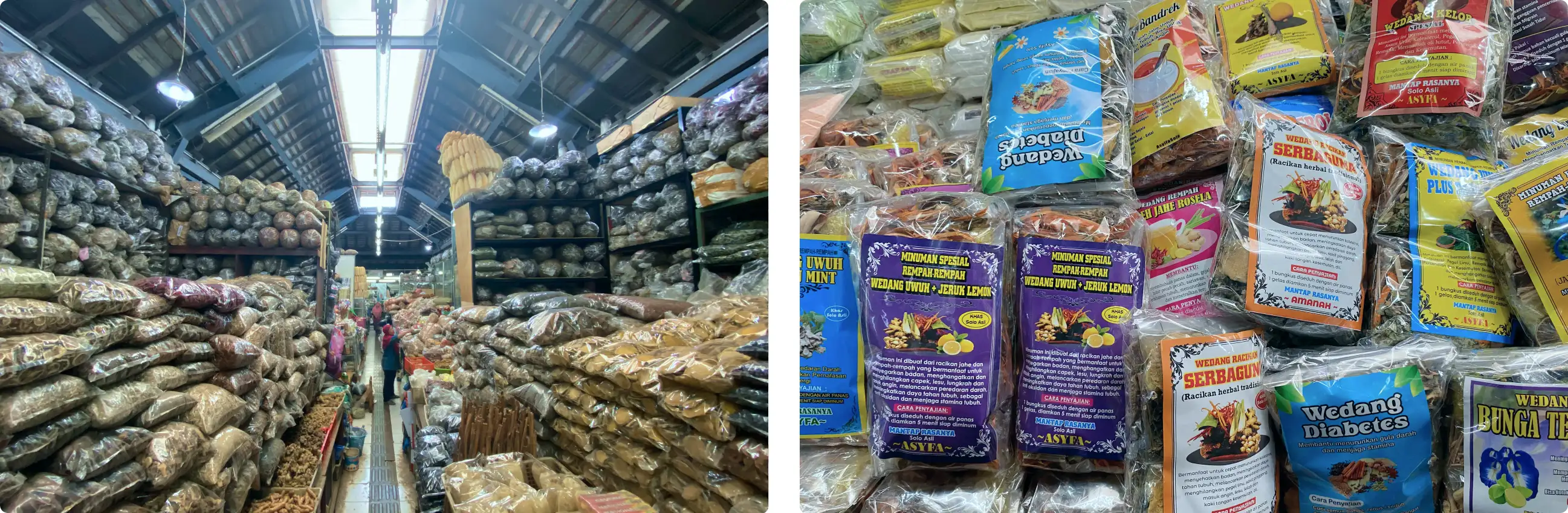
LEFT: Stacks of empon-empon at Pasar Gede. RIGHT: Various ready-to-brew spices that are sought after by tourists. Gede Arga Adrian/UMS Public Relations
The Bukittinggi-born woman mentioned that most of the medicinal plants at Pasar Gede are cultivated by local communities from the Lawu mountains, the Prambanan plains, and the agroforestry ecosystems of Gunung Sewu.
Local farmers carefully cultivate these medicinal plants, so they grow well and are suitable for sale in the market. However, some species of medicinal plants are sourced from the wild, such as temu giring (Curcuma heyneana), which are harvested from the mountains and then sold in the market.
Traders at Pasar Gede also source their goods from local farmers in the other parts of Central Java, such as Purworejo, Karanganyar, Wonogiri, Pati, Boyolali, and Sukoharjo. Meanwhile, areas in East Java that supply medicinal plants include Ngawi and Magetan.
Santhy happened to encounter a thread between the distribution of the medicinal plants and the former power of the Surakarta Kasunanan. Most of these medicinal plants come from the former territories of the Surakarta Kasunanan. This trade network has been established since ancient times.
At its height, the Surakarta Kasunanan was divided into several regions, including Mancanegara, the border areas ruled by minor nobles; Negara, the central region under the control of lower-ranking nobles; Negaragung or Kadipaten, a prosperous region governed by royal relatives; and Kutaraja, the kingdom’s capital controlled by the king.
“These supply areas correspond to the former borders of Negaragung and Negara, which were part of the Surakarta Kasunanan,” explained the lecturer, who once taught Biogeography at the Faculty of Geography at UMS.
The influence of the Surakarta Kasunanan also imparted to Pasar Gede the philosophy of Javanese urban spatial planning, known as catur gatra tunggal. This concept unites four elements: government authority, a space for interaction between the people and their leaders, religiosity, and the economy. This concept has endured to this day.
As the city has evolved, Pasar Gede has maintained its relevance as a center of knowledge on traditional medicine. The sellers of phytomedicine–the study of botany, and the use of medicinal plants–mostly women aged between 37 and 62, play a role in preserving cultural heritage. Their task is to ensure that knowledge of herbal medicines continues to be passed down to future generations.
“They don’t just sell. They also provide information on how to correctly process and dose the remedies to treat the customers’ ailments or complaints,” said Santhy.
Writer: Genis Dwi Gustati, Gede Arga Adrian
Editor: Al Habiib Josy Asheva
Translator: Farizal Luqman Majid
Designer: Salsabila Kamila Wardah
Indonesia is one of the world's largest coffee-consuming nations, a thirst that keeps spawning new coffee shops. Sharpening the competition among them.
Nothing’s more special than reading curated news just for you.
Subscribe to the UMS Newsletter for free today.