
The Scholar Behind UMS's Master's Program in IQT
27 July 2026
Prof. Andri Nirwana, S.TH., M.Ag., Ph.D., pioneered the Master of Al-Quran and Tafsir Studies as a first step in strengthening Quranic studies within Muhammadiyah.




Wartoyo’s expression turned somber as the judge delivered the verdict on Tuesday, May 22, 2012. The verdict, announced at the Wates District Court, partially granted the restitution claim of the plaintiff, PT Lancar Mukti Abadi, for the embezzlement of company funds committed by the defendant, Wartoyo, amounting to Rp59.000.000.
The approval of PT Lancar Mukti Abadi’s lawsuit is a prime example of the significance of enforcing restitution for crime victims. Dr. Muchamad Iksan, S.H., M.H., a legal expert from Universitas Muhammadiyah Surakarta (UMS), explained that restitution refers to a court-ordered requirement for a perpetrator to compensate a victim for losses or damages resulting from a wrongful act or offense. The compensation amount is established through a court ruling.
“Restitution differs from compensation. Restitution is paid by the perpetrator, whereas compensation is paid by the state,” Iksan clarified during our discussion on Thursday, April 26, 2024
The regulations concerning restitution are outlined in Law Number 31/2014 on Witness and Victim Protection. Article 7A, paragraph 1, states that victims have the right to restitution for loss of wealth or income, losses resulting from suffering directly related to the criminal offense, and/or reimbursement of medical and/or psychological treatment expenses.
“Victims who experience losses can apply for restitution through LPSK (Witness and Victim Protection Agency). If approved by LPSK, the victim will receive restitution from the perpetrator,” clarified the UMS Faculty of Law lecturer.
Research conducted by Iksan in 2023, titled “Fulfilling the Restitution Rights of Crime Victims: The Legal Practice in Indonesia,” revealed that the implementation of the law on restitution in Indonesia has not really met his expectation.
The research, published in the Academic Journal of Interdisciplinary Studies and indexed by Scopus Q2, identifies several factors contributing low number of restitution lawsuit, including:
This finding was further confirmed when victims pursued legal action through civil law. According to Iksan, in a civil case, victims must file a lawsuit to the district court. If victims cannot file a lawsuit on their own, they must seek assistance from a lawyer or legal expert.
The long road to justice is often complicated by LPSK verdicts, which are delayed due to the complexity of evaluating evidence to support the victim’s claim. It is well known that civil cases often take longer to resolve than criminal cases.
“I had a discussion with a prosecutor from the Surakarta District Attorney's Office. During his ten-year tenure, there had never been a case involving a restitution claim in Solo, despite the existence of written rules guaranteeing the fulfillment of victims’ restitution rights,” Iksan recalled. He expressed regret over the lack of public awareness about restitution, which is exacerbated by insufficient efforts by law enforcement to educate people. So, what process can people use to claim their rights?
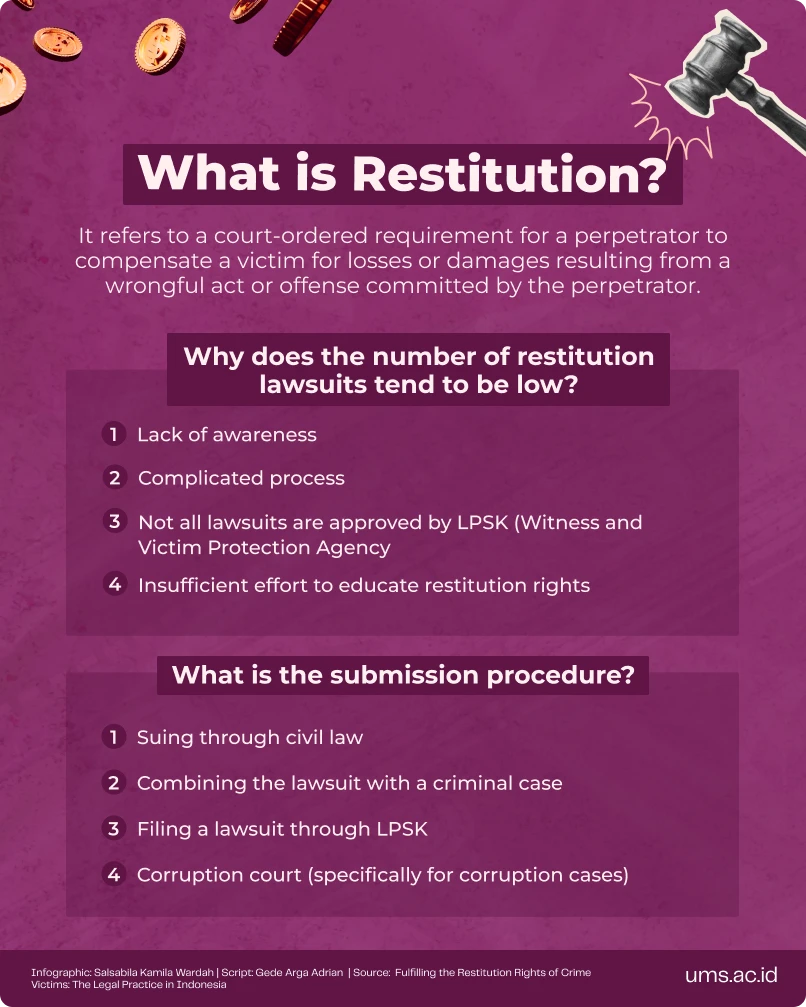
There are procedures victims can undergo to obtain restitution from the perpetrator of the crime. The first is by filing a civil lawsuit in the district court. However, this civil law has not been widely utilized by victims of criminal acts.
“Often, these civil lawsuits don’t balance out in terms of time, cost, and the results that victims later receive,” said the UMS Licensing Studies Center researcher. This is especially true for victims who have to handle their own civil lawsuits. Sometimes, they end up paying lawyers without getting anything significant.”
Secondly, victims can combine restitution claims with criminal cases. This mechanism is governed by Articles 98-101 of the Criminal Procedure Code. According to Iksan, this allows victims of criminal acts to “merge” a civil lawsuit with the trial process. This is applicable if the criminal offense results in losses.
Thirdly, victims can apply for restitution through the LPSK. According to Law No. 31/2014, witnesses and victims are entitled to restitution or compensation. They can file a lawsuit with LPSK for processing before a court decision is made.
Fourth, the last mechanism is the corruption court. In corruption cases, the state is the victim, so the perpetrator must pay restitution to the state.
Authorities should enforce restitution for victims of criminal cases. This includes prioritizing restorative aspects within the justice system in Indonesia. A robust justice system should aim to restore the losses suffered by victims.
In fraud cases, for example, Iksan noted that ideal justice would involve returning the money taken by the fraudster to the victim. Unfortunately, the justice system in Indonesia often cannot facilitate the return of losses suffered by victims.
“For example, if A cheats someone out of Rp100 million, and spends Rp75 million, leaving Rp25 million. With the criminal law mechanism, only the Rp25 million remaining would be returned. Meanwhile, the rest simply disappears,” he explained.
Another example is in the criminal case of the defendant Ali Harahap, who was negligent in driving a motorcycle and caused a traffic accidet. According to the decision of the Klaten District Court, Ali was sentenced to five months in prison, required to pay court costs of Rp2,000, and ordered to pay the remaining treatment costs (compensation) to the victim amounting to Rp11,000,000.
“So, restitution is a means to restore the losses experienced by victims,” he added.
According to Iksan, since KUHAP was enacted on December 31, 1981, legal protection has been oriented towards the offender. This is evidenced by the rights granted to perpetrators outlined in Articles 50-68 of the KUHAP. There are no clear rules guaranteeing the protection and proper fulfillment of victims. In fact, victims are the ones who are most disadvantaged, both materially and non-materially.
25 years later, awareness of protecting victims emerged. Protection for victims has become increasingly important since the state passed Law No. 13/2006 on Witness and Victim Protection, which has now been amended by Law No. 31/2014. Since then, the state has guaranteed the fulfillment of rights for victims, ranging from protection to restitution for losses experienced.
“Our current legal focus is balanced. While KUHAP protects the perpetrators, Law No. 31/2014 protects the victims,” Iksan said.
Writer: Gede Arga Adrian
Editor: Al Habiib Josy Asheva
Translator: Farizal Luqman Majid
Prof. Andri Nirwana, S.TH., M.Ag., Ph.D., pioneered the Master of Al-Quran and Tafsir Studies as a first step in strengthening Quranic studies within Muhammadiyah.

A UMS pencak silat athlete successfully claimed gold at the 10th Asian Pencak Silat Championship 2026.

The Klanceng Edufarm startup is planning international expansion after being named national champion at the 2026 Studentpreneur Bootcamp organized by the Muhammadiyah Center for Entrepreneurship and Business Incubator.

Nothing’s more special than reading curated news just for you.
Subscribe to the UMS Newsletter for free today.