
Bank Indonesia Holds Interest Rate at 5.75%, What Is the Impact?
24 July 2026
Bank Indonesia has held its benchmark rate at 5.75 percent, ending speculation of a hike to 6 percent that had circulated in recent weeks.



Marriage is commonly associated with building a household with a legally recognized partner until death do them part. However, amid this romantic ideal, some unconventional practices taint the sanctity of marriage. In certain regions of Indonesia, particularly on the island of Java, some individuals engage in “contract marriage.” But what exactly is this?
Contract marriage refers to a union established for a predetermined period. This practice first emerged in Indonesia in the 1980s in the Cisarua District, Bogor Regency, West Java. Its pioneers were migrants from the Middle East who practiced nikah mut'ah, the Arabic term for contract marriage.
Over time, contract marriage has spread to several regions in Indonesia, driven by various motives. According to researcher Marisa Kurnianingsih, S.H., M.H., M.Kn., from Universitas Muhammadiyah Surakarta (UMS), there are two common motives behind this practice: financial gain and sexual gratification. “Sometimes, both motives are present simultaneously,” Marisa stated on Tuesday (4/2/2025).
The agreements in contract marriages vary. Some specify the duration of the marriage during the ijab (marriage contract), while others follow a standard ijab qabul (marriage vow) but end under specific conditions. For instance, the marriage may dissolve after the woman gives birth or when the husband returns to his home country. “There is no formal divorce declaration (ikrar talak),” she explained.
Marisa, who explored contract marriage as part of her dissertation research, has investigated this phenomenon across several regencies in three provinces on the island of Java: West Java, Central Java, and East Java.
The cheerful-looking researcher was left deeply unsettled when she visited a regency on the northern coast of West Java in mid-2024. There, she encountered a teenage girl who was forced into a contract marriage with a man in his twenties.
Economic hardship left the girl's parents with no options. Lured by the promise of a sack of rice and a monthly payment of one million rupiah from a man in a neighboring village, they agreed to marry off their daughter, who had just turned 14.
“It’s as if they sold their own child just to receive a sack of rice and one million rupiah per month,” Marisa said in dismay. “In my opinion, that amount is far too little for a human being.”
Marisa encountered a different situation in East Java. There, she discovered a local religious leader who actively pressured women into contract marriages. This revelation left her even more shocked.
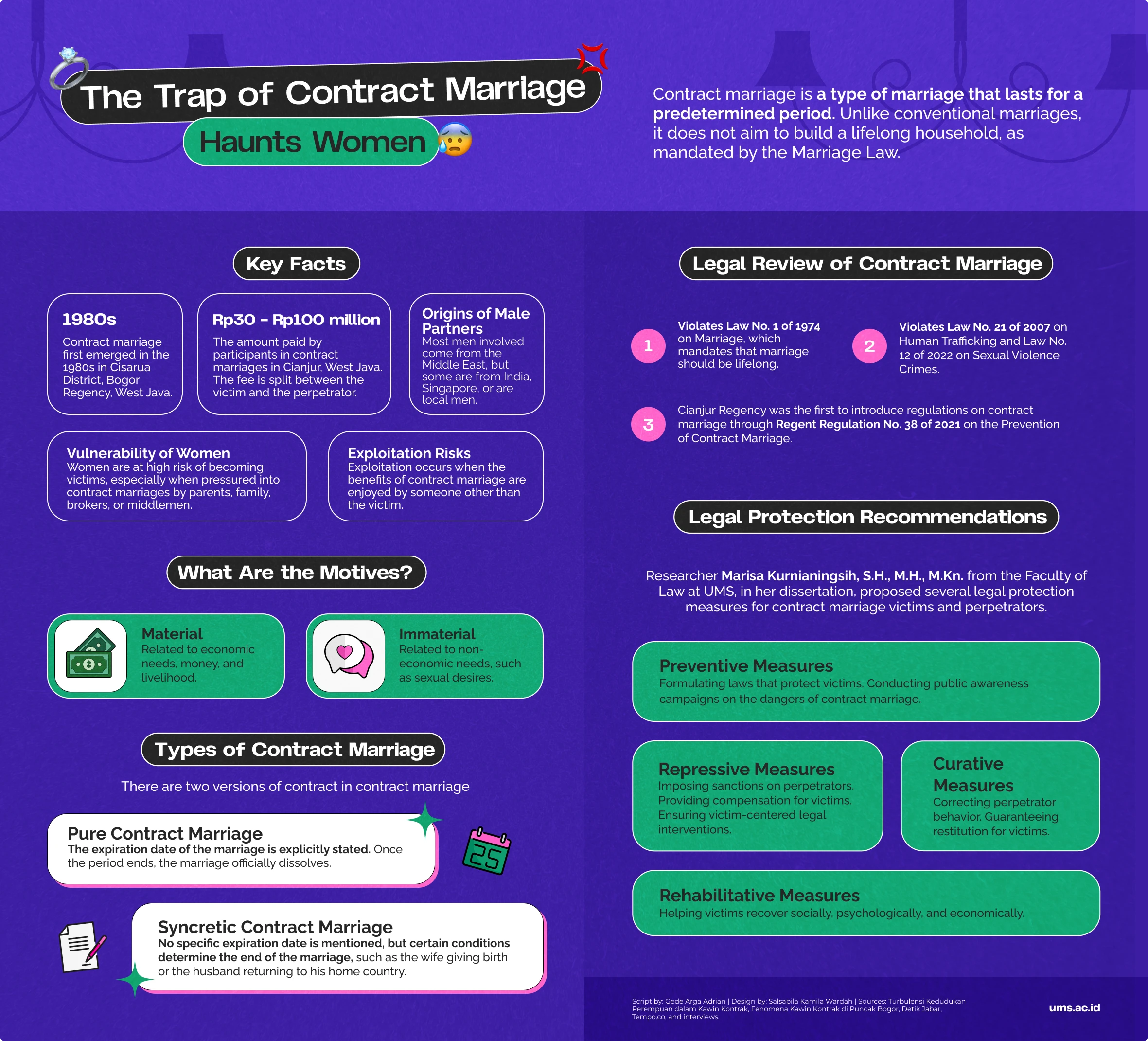
Marisa’s journey across three provinces led her to meet 17 individuals involved in contract marriages, both perpetrators and victims. Out of this number, six women experienced sexual exploitation, with the benefiting party being the husband. Ten women suffered both economic and sexual exploitation, with the advantages going to the husband, brokers, middlemen, or even their own families.
In contract marriages, women can act as either perpetrators or victims. “It can be both,” explained the lecturer from the Faculty of Law at UMS.
However, the majority of women in contract marriages are victims. This is because they are often coerced into these arrangements by others, such as their parents, families, or brokers.
This situation turns contract marriage into a breeding ground for exploitation, especially when there are financial incentives involved.
On the other hand, women can also be classified as perpetrators if they willingly engage in contract marriages for their own benefit. The financial gains they receive are then used to support their livelihoods
“If the benefits go solely to the individual (perpetrator), then it leans more toward prostitution,” she explained.
So, how does the government respond? Some district governments acknowledge the presence of contract marriage in their regions, while others try to cover up its existence.
These differing attitudes shape how local governments address the issue. District governments that acknowledge contract marriage tend to implement preventive policies to curb its occurrence. They also keep records of individuals involved in contract marriages.
For example, Cianjur Regency, West Java, known as a major supplier of women for contract marriages in Cisarua, has issued Regent Regulation No. 38 of 2021 on the Prevention of Contract Marriage.
On the other hand, local governments that choose to cover up contract marriages often turn a blind eye to the reality on the ground. There are no concrete records of the number of perpetrators or victims, making preventive action difficult.
"If they choose to hide it, it makes you wonder, does the government even consider this their responsibility?" questioned Marisa. "This issue needs to be acknowledged as a serious problem."
Contract marriage violates Law No. 1 of 1974 on Marriage, which defines marriage as a lifelong union. A marriage with a fixed duration directly contradicts this principle.
The exploitation within contract marriage violates the Law on the Eradication of Human Trafficking Crimes and the Law on Sexual Violence Crimes. This is especially true when contract marriage is arranged or coerced by third parties, such as parents or brokers.
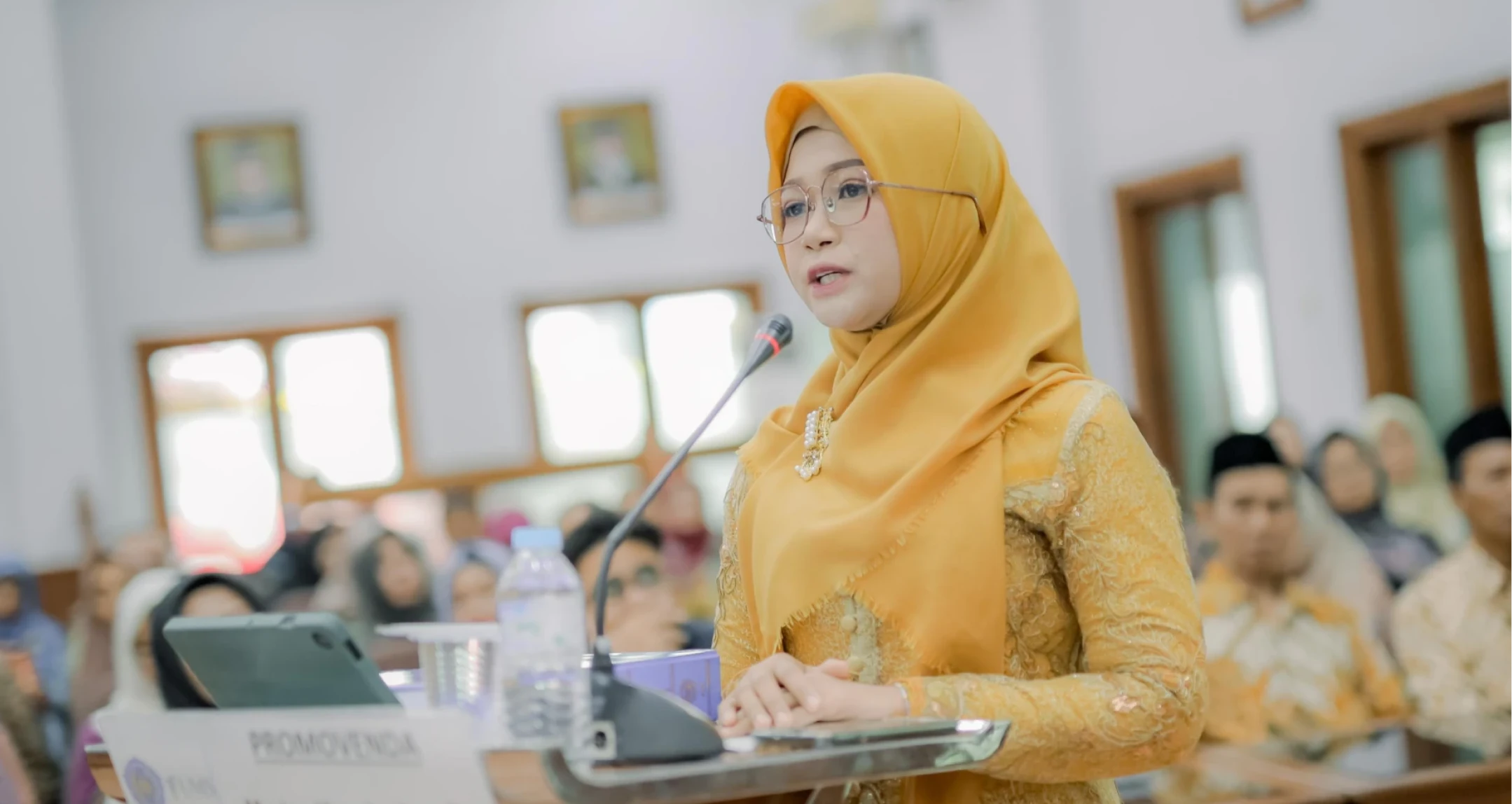
Marisa Kurnianingsih, S.H., M.H., M.Kn. presenting her dissertation on contract marriage, last Tuesday (21/1/2025). UMS Public Relations/Imam Safii
In her dissertation, Marisa emphasized the importance of preventive measures, recommending the formulation of victim-centered legal regulations. These regulations should be accompanied by widespread public awareness campaigns at the community level.
To create a deterrent effect, Marisa suggested that the government impose strict sanctions on perpetrators of contract marriage. Meanwhile, victims should receive legal protection and compensation for any losses suffered due to contract marriage.
A corrective approach is also necessary to change the behavior of perpetrators. “If perpetrators do not receive education and rehabilitation, they may engage in contract marriage again in the future,” Marisa explained.
Additionally, Marisa advocated for rehabilitative measures to help victims recover. These efforts should focus on psychological, social, and religious aspects. “Victims also have the right to receive restitution from the perpetrators of contract marriage,” she added.
Marisa successfully completed her dissertation, titled: “The Turbulence of Women's Position in Contract Marriage (A Proposed Concept of Legal Protection for Victims of Exploitation Based on Theo-Anthropocentric Values).”
Before an audience of examiners, promoters, and the rector of UMS, Marisa presented her dissertation and the solutions she proposed. The open doctoral defense was held at the Mohammad Djazman Auditorium, UMS, on Tuesday (21/1/2025).
After the session, UMS Rector Prof. Dr. Sofyan Anif, M.Si., praised Marisa’s research. He highlighted that theo-anthropological legal protection is a crucial foundation for transforming marriage laws in Indonesia.
"This serves as an important recommendation for the Ministry of Religious Affairs, society, and the legal community. These elements (Marisa’s proposals) must be taken into serious consideration," Sofyan Anif stated.
Writer: Gede Arga Adrian
Translator: Farizal Luqman Majid
Editor: Al Habiib Josy Asheva
Designer: Salsabila Kamila Wardah
Bank Indonesia has held its benchmark rate at 5.75 percent, ending speculation of a hike to 6 percent that had circulated in recent weeks.
Nothing’s more special than reading curated news just for you.
Subscribe to the UMS Newsletter for free today.