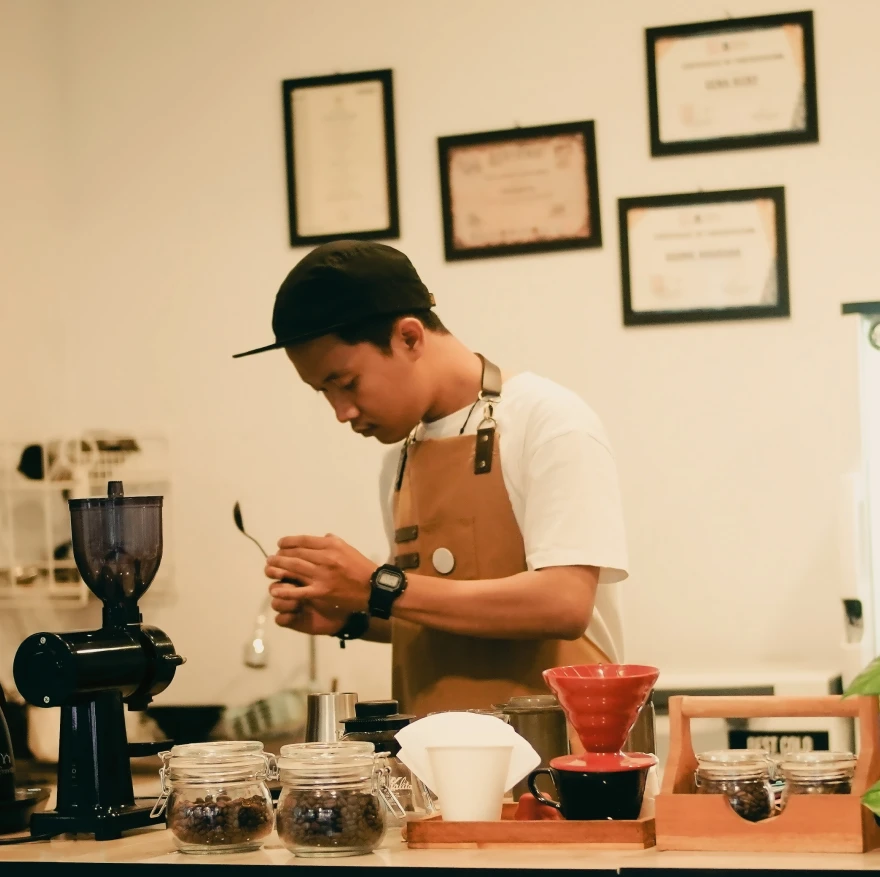
The Coffee Shop Boom
1 August 2026
Indonesia is one of the world's largest coffee-consuming nations, a thirst that keeps spawning new coffee shops. Sharpening the competition among them.



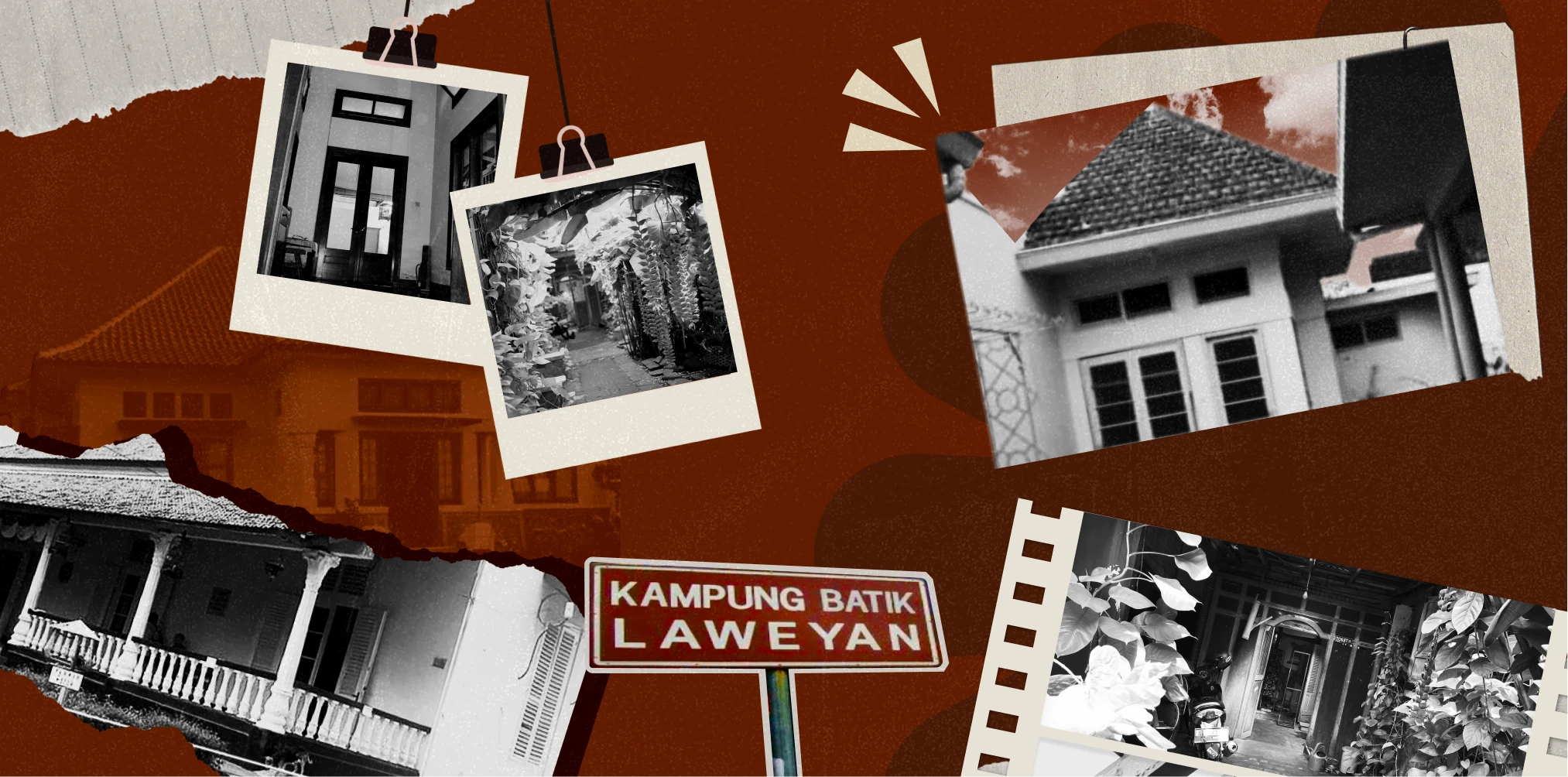
At the corner of Jalan Sayangan Kulon in Laweyan, Surakarta, Central Java, an Indische-style house is ready to welcome visitors. Two men are opening the gate. At the entrance, a sign reads Batik Mahkota Laweyan.
The road leading to the house is quite narrow, barely wide enough for one car, with walls on either side. The road, paved with concrete bricks, is typically used by pedestrians, cyclists, and motorbike riders.
Despite its narrowness, the road retains its natural charm, with creeping plants along the upper side of Jalan Sayangan Kulon, stretching from the house’s gate westward and offering a refreshing shade for visitors
Not long, Dr. Nur Rahmawati Syamsiyah, S.T., M.T., an Architecture lecturer from Universitas Muhammadiyah Surakarta (UMS), appeared in the distance, her smile beaming as she greeted us. Nur Rahma then introduced us to the owner of the old house.
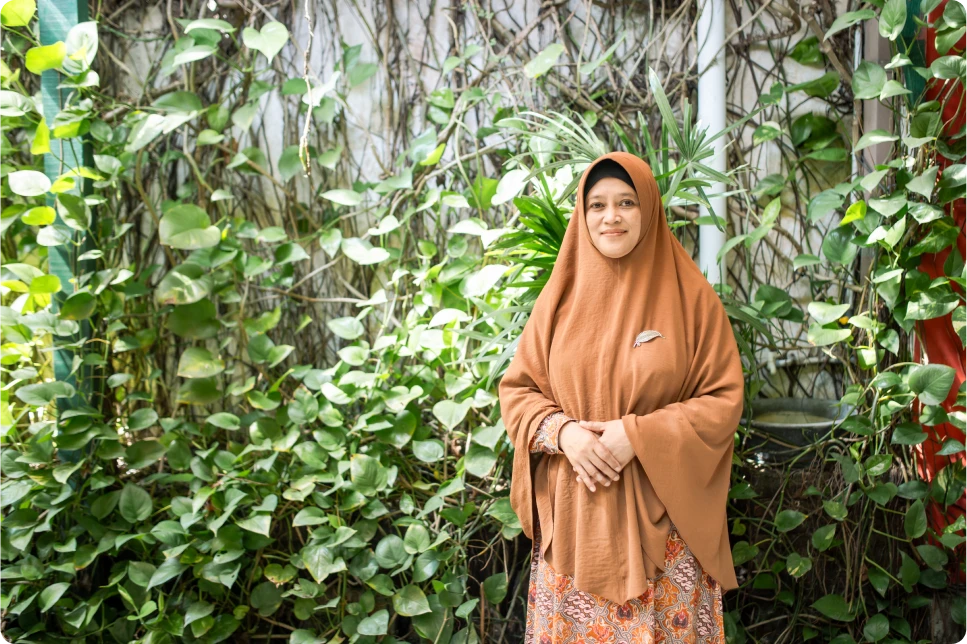
Dr. Nur Rahmawati Syamsiyah, S.T., M.T. Imam Safii/UMS Public Relation.
Lush, cool, and verdant, these were the three words that immediately came to mind as we stepped into the yard. Various climbing plants adorned the house's courtyard walls, from pothos vines to butterfly pea flowers, and even heliconia blooms. The house’s veranda appeared serene, adding more tranquility and calmness. Rows of batik clothes lined up along the windows.
Amidst the greenery, we began discussing the Indische-style architecture of the old house. Indische Buildings combine architectural styles from Europe, Java, and elements of Indian influence. The Indische Style flourished in the Dutch East Indies from the late 19th century to the early 20th century
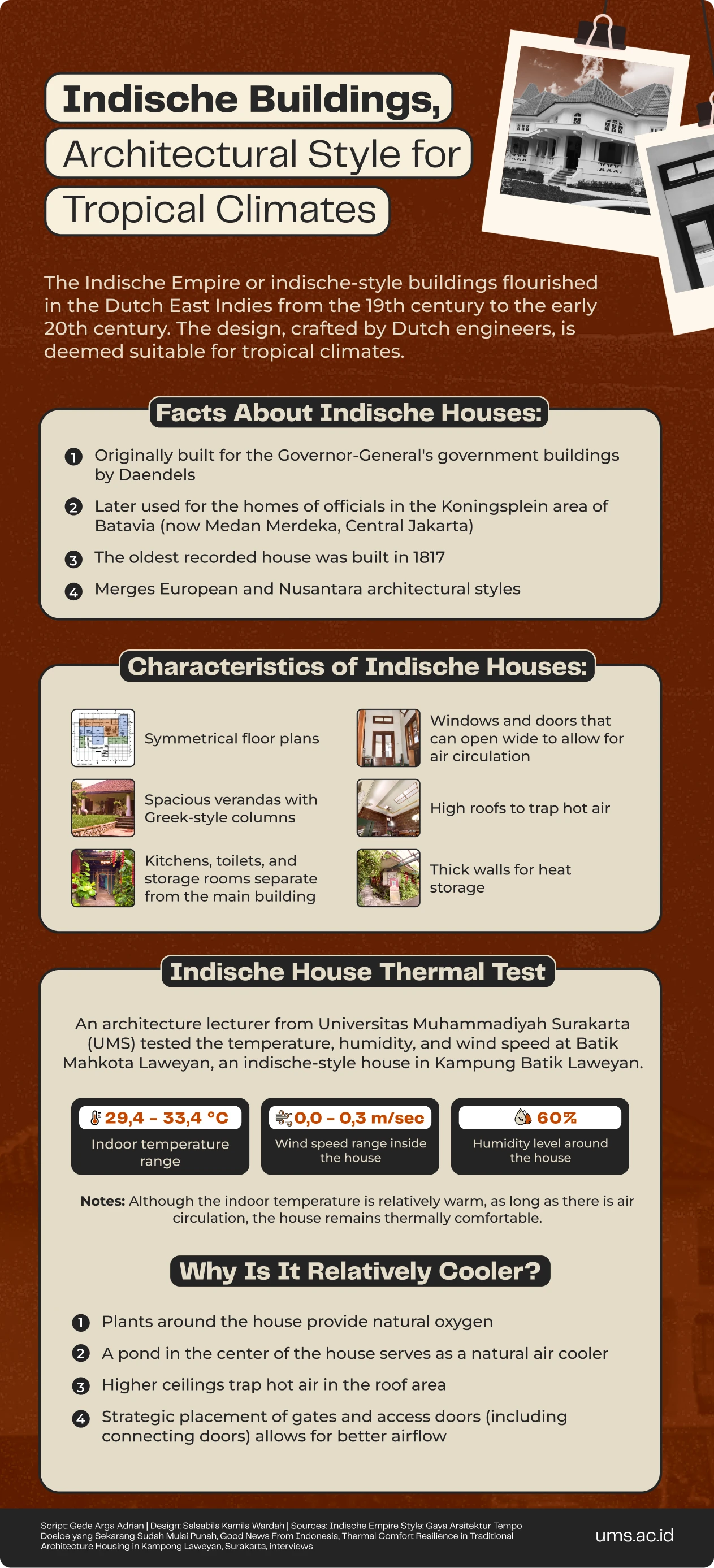
There are many Indische-style buildings in Kampung Batik Laweyan. Typical features of these houses include thick walls, terrazzo floors, large ventilation, and high roof structures.
We arrived at a corner of the house usually used for coloring batik fabric. The room’s lighting was enhanced by both lamps and glass ceiling, allowing sunlight to filter into the space.
We walked down a narrow corridor leading to the Al-Qur'an batik gallery. As we entered the gallery space, the exposed construction of rafters, battens, and tiles was immediately visible. Inside the joglo-roofed gallery, there was a giant piece of fabric, approximately four meters tall, tied to two teakwood pillars. The fabric displayed Surah Al-Fatihah, created using the batik technique. Around the walls hung smaller pieces of fabric adorned with other verses from the Al-Qur’an.
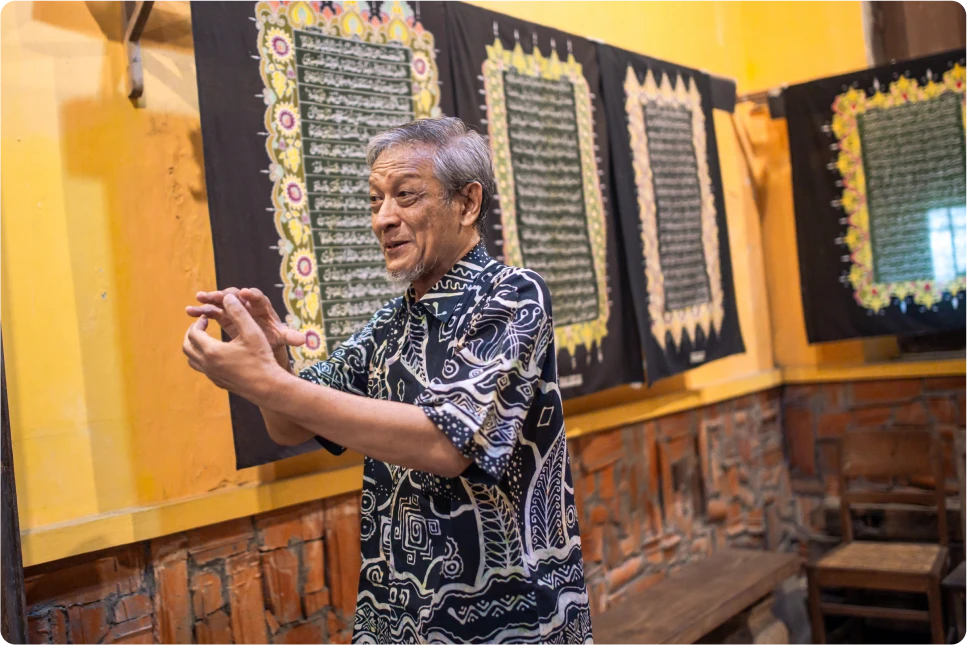
The owner of Batik Mahkota Laweyan, Ir. Alpha Febela Priyatmono, S.T., M.T. Imam Safii/UMS Public Relation.
As we were deep in conversation, a middle-aged man in a black batik shirt appeared. He was Ir. Alpha Febela Priyatmono, S.T., M.T., an Architecture lecturer at UMS and the owner of the house and Batik Mahkota Laweyan.
In the past, Alpha’s home wasn’t yet a brick building. “It was still a wooden structure,” Alpha shared on Monday (30/9/2024). It wasn’t until the 1950s that the current Indische-style house was constructed.
There was no air conditioning in the rooms we visited, and the yard, though planted with some vegetation, was not particularly spacious. Most of the area was used for buildings, giving the house a dense, multi-functional feel, as it served as a residence, a batik gallery, and a batik production site. It’s no surprise that the house was bustling with activity, from batik shop employees to local and international tourists.
Despite the compact layout, the house remained cool and comfortable during our tour. This coolness is something Nur Rahma had experienced as well. “How does a house this dense maintain good air circulation?” she had wondered. Her curiosity led her to research the building’s thermal conditions.
Nur Rahma conducted a study on the thermal comfort of the house in November 2023. In an interview on Friday (27/9/2024), she explained that three indicators were measured: temperature, humidity, and wind speed. These factors were measured four times a day, morning, noon, afternoon, and night, over the course of a week.
She found that high temperatures are manageable as long as there is air movement. “There are gaps above the roof and ceiling that allow air to flow freely,” she explained.
The wind speed inside the house ranges from 0.0 to 0.8 meters per second, which, according to Indonesia's national standards (SNI 03-6572-2001), falls within a comfortable range. The humidity level is a comfortable 60%.
Several factors contribute to the comfort of the Indische-style houses. One is the raised ceiling in the middle section, which is about 20 centimeters higher than the rest. This allows hot air and moisture to gather there and eventually escape through the roof tiles, keeping the interior cool and dry.
The house’s location at the end of a narrow street also aids airflow, with wind entering through the gate and flowing through every corner of the house. Indeed, standing at the gate, we could feel a distinct breeze.
Additionally, most houses in Laweyan have connecting doors that link neighboring houses, which also serve as ventilation for better air circulation.
Although further research is needed, Nur Rahma suspected that the house's structure plays a key role in its thermal comfort. Typically, Indische-style houses have thick walls and limasan roofs.
The thick walls store heat and delay its transfer from outside to inside by about seven to eight hours. As a result, the house remains cool in the morning and early afternoon, even when it’s hot outside. By late afternoon, the interior begins to warm up, creating a continuous exchange of air.
Alpha, the homeowner, has also made modifications, such as adding climbing plants and a fishpond in the center of the house. The creeping plants, which trail from the street to the courtyard walls, are part of his simple motivation: every leaf produces free oxygen for humans to breathe.
This oxygen cools the surrounding air. For instance, the area around the fishpond had a temperature of 29.4°C. As the yard cools down, the air flows into the house, pushing warm air upwards towards the roof.
Nur Rahma’s research, titled "Thermal Comfort Resilience in Traditional Architecture Housing in Kampong Laweyan Surakarta," was presented at The 10th International Conference on Engineering, Technology, and Industrial Application (ICETIA 2023) and was published in the E3S Web of Conferences journal.
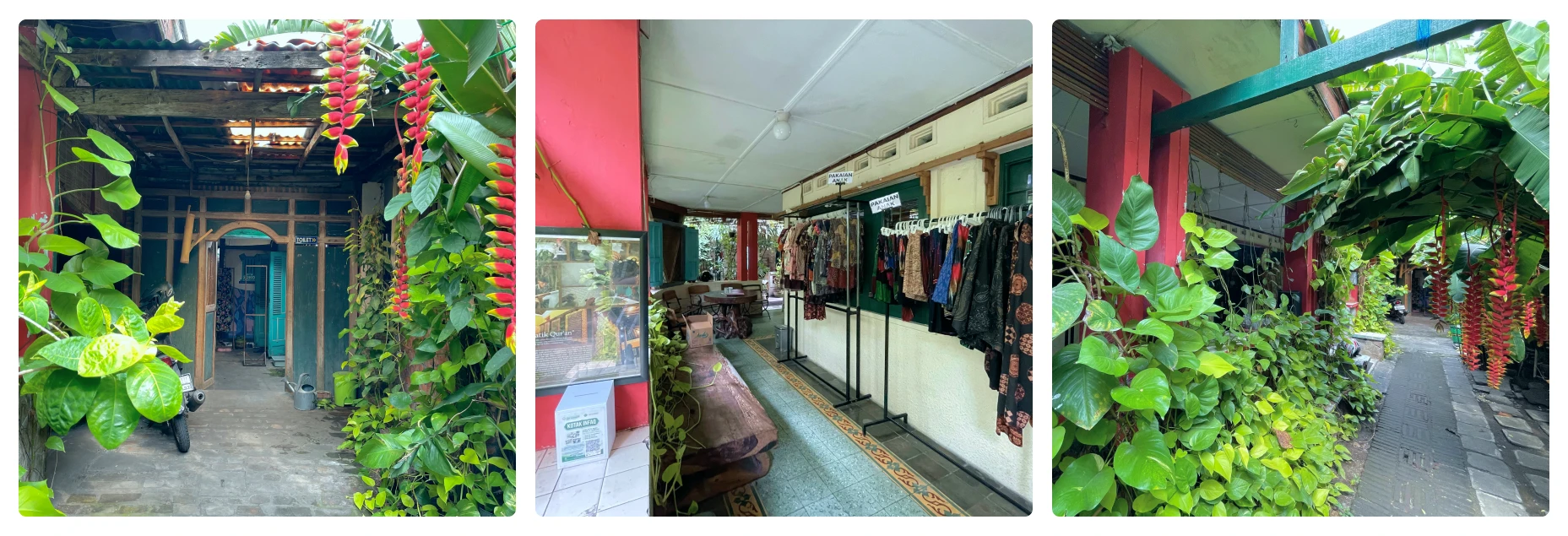
LEFT: A connecting door that links the owner’s house to the neighboring building. CENTER: The house’s extended veranda. RIGHT: The garden in the yard serves as a source of oxygen. Gede Arga Adrian/UMS Public Relation.
The rising temperatures due to climate change are becoming increasingly noticeable, and this shift is also affecting seasonal patterns. As a result, the rainy season feels shorter compared to the dry season. It is widely felt that the effects of climate change are even striking inside houses.
Research conducted by Nur Rahma proves that traditional houses are more resilient to climate change. “The significant changes in climate do not have a major impact on the comfort of houses in Kampung Batik Laweyan,” she explained.
The Indische architectural style is one such design well-suited for Indonesia. This style takes into account various aspects, from the tropical climate to Indonesian culture. For example, the high roofs are designed to keep the house cool during the hot midday weather.
Unfortunately, Indische-style buildings and other traditional architectural designs are gradually disappearing. Nur Rahma regretted that many architects tend to follow market trends. “Architects should be involved in educating the public about local wisdom,” she stressed.
On the other hand, owners of traditional houses also face challenges. Alpha Febela revealed that homeowners must think twice before renovating their houses, as most old houses in the Laweyan area have been designated as cultural heritage buildings (BCB). These buildings cannot be altered carelessly.
Law No. 11 of 2010 on Cultural Heritage allows for the restoration of cultural heritage buildings, but it requires attention to the originality of materials, form, layout, style, and construction techniques. The condition of the BCB after restoration must be as close as possible to its original state, with minimal changes. The techniques, methods, and materials used in the restoration must not cause any damage.
“Actually, this area (Laweyan) is already designated as a cultural heritage site. That's why you can't just tear things down,” he said.
Writer: Gede Arga Adrian, Genis Dwi Gustati
Editor: Al Habiib Josy Asheva
Translator: Farizal Luqman Majid
Designer: Salsabila Kamila Wardah
Indonesia is one of the world's largest coffee-consuming nations, a thirst that keeps spawning new coffee shops. Sharpening the competition among them.
Nothing’s more special than reading curated news just for you.
Subscribe to the UMS Newsletter for free today.