
Bank Indonesia Holds Interest Rate at 5.75%, What Is the Impact?
24 July 2026
Bank Indonesia has held its benchmark rate at 5.75 percent, ending speculation of a hike to 6 percent that had circulated in recent weeks.



Suicide cases among adolescents need to be a cause for concern. According to a statement from the National Research and Innovation Agency (BRIN) cited on Thursday (16/1/2025), the number of suicide cases in Indonesia from 2012 to 2023 reached 2,112 cases. Among these, 985 cases occurred in adolescents, accounting for approximately 46.63% of the total cases.
Looking back, the World Health Organization (WHO) in 2017 reported that 3.9% of 8,899 Indonesian adolescents had attempted suicide. These attempts were made at least once within the 12 months preceding the survey.
Five years later, Indonesia's Ministry of Health revealed that Indonesia ranked fifth in Southeast Asia with 3.7 deaths per 100,000 population due to suicide. Thailand held the highest rank with 12.9 deaths per 100,000 population.
A public health expert from Universitas Muhammadiyah Surakarta (UMS), Ayu Khoirotul Umaroh, S.K.M., M.K.M., explained that suicidal behavior is not limited to cases of death caused by suicide.
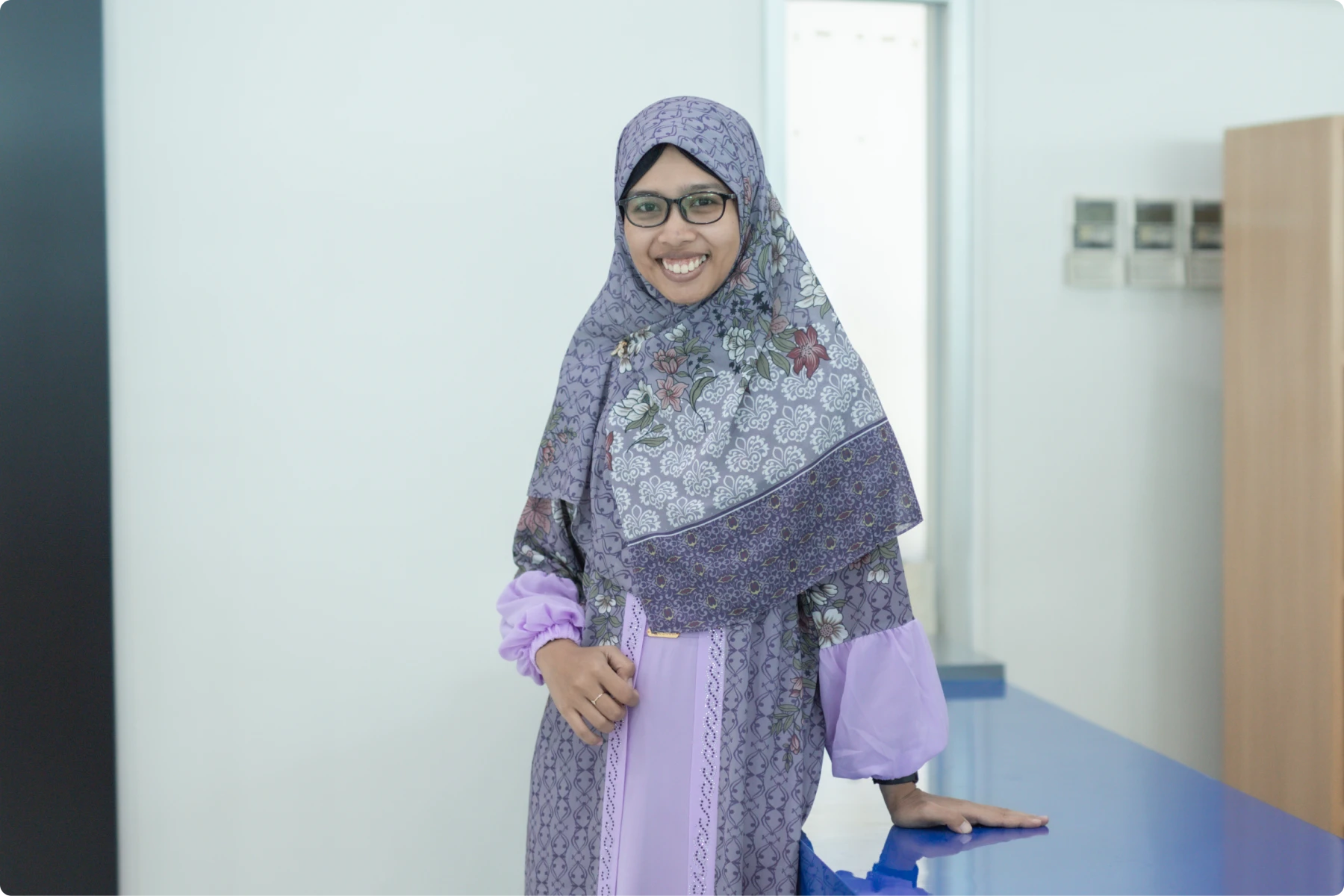
UMS public health expert , Ayu Khoirotul Umaroh, S.K.M., M.K.M. Imam Safii/UMS PR
"Suicide has three stages," said Ayu in a virtual interview on Wednesday (15/1/2025). These stages begin with suicidal ideation or suicidal thought, planning to commit suicide, and taking suicidal actions.
Ayu conducted a research analysis on data released by the Global School-based Health Survey (GSHS). The GSHS survey was conducted at 75 schools in Indonesia to understand health problems and risky behaviors among adolescents.
The GSHS survey respondents were focused on adolescents who had experienced suicidal thought within the 12 months prior to the survey. Several indicators suspected to influence suicidal tendencies include hunger, physical assault, physical altercations, bullying, loneliness, worry, lack of close friends, problems with others, peer support, parental support, and parental attention.
In a study titled “Are Social Supports Associated With Suicidal Ideation Based on Gender Differences Among Adolescents in Indonesia?”, Ayu and her peer Purwo Setiyo Nugroho, found at least two factors influencing suicidal tendencies among adolescents: peer support and parental support.
Ayu, who is also a lecturer in Public Health at UMS, compared the conditions of peer support and parental support between male and female adolescents. It turns out that these two factors are related to the gender of the adolescents.
Previous studies indicated that suicidal tendencies tend to arise more frequently in female adolescents. However, Ayu’s analysis showed that male adolescents are more prone to suicide than their female counterparts. “Initially, the suspicion leaned towards females, but the results showed it was males,” Ayu explained.
Ayu's analysis revealed that male adolescents are 4.23 times more likely to have suicidal tendencies if they lack peer support, 2.48 times more likely if they lack parental support, and 3.27 times more likely if they are not open with their parents.
This finding unsettled Ayu, prompting her to delve deeper into research on suicide cases to analyze why male adolescents tend to be more vulnerable.
Ayu suspects that changes in testosterone levels in male adolescents could be the primary culprit. Testosterone is a hormone that triggers androgenic traits in males during puberty.
She compared her findings with research conducted by University of California Los Angeles researcher Tiffany Ho in 2022. Tiffany suggested that the hormone testosterone may be a contributing factor in male suicides.
This hypothesis is supported by research from Texas State University researcher Billy C. Roland, who found higher levels of testosterone in the remains of suicide victims compared to those who died from other causes. “Testosterone has a strong influence, from the emergence of suicidal thoughts to the act itself,” Ayu explained.
The second reason is the prevalence of traditional masculinity within society. This principle dictates that men must always be strong, resilient, and never show sadness in public. Ayu stated that research conducted by Muhammad Fadhil Fikri Ramdani from the Universitas Negeri Surabaya found that Indonesia is still grappling with this form of masculinity.
Furthermore, masculinity is not just about hiding sadness from the public. It also impacts the relatively small social circles of adolescent boys, as emotional closeness is not properly developed. This causes boys facing problems to internalize their feelings. “They keep it to themselves. It's like they don't have a best friend,” she said.
This issue relates to the role of peer support in connection with suicidal urges. The tendency to not confide in others, to be reserved, and to appear fine actually indicates weak peer support. According to Ayu, when this occurs, boys tend to seek solutions on their own.
“These solutions can be positive or negative. If it's negative, it can lead to suicide ideation," she continued.
She also based her analysis on research by Sarah McKenzie from the University of Otago, which states that parental behavior that trivializes children's emotions prevents them from expressing their feelings. This trivialization can manifest in phrases like, “It's just that,” or “Don't be a crybaby.” As a result, parents fail to understand their children's problems and dismiss their anxieties.
Ayu believed that parents should try to find out why their children are sad. Parents should also understand what kind of help or support their children need. “If there's no parental support, who can these adolescent boys turn to?” she emphasized.
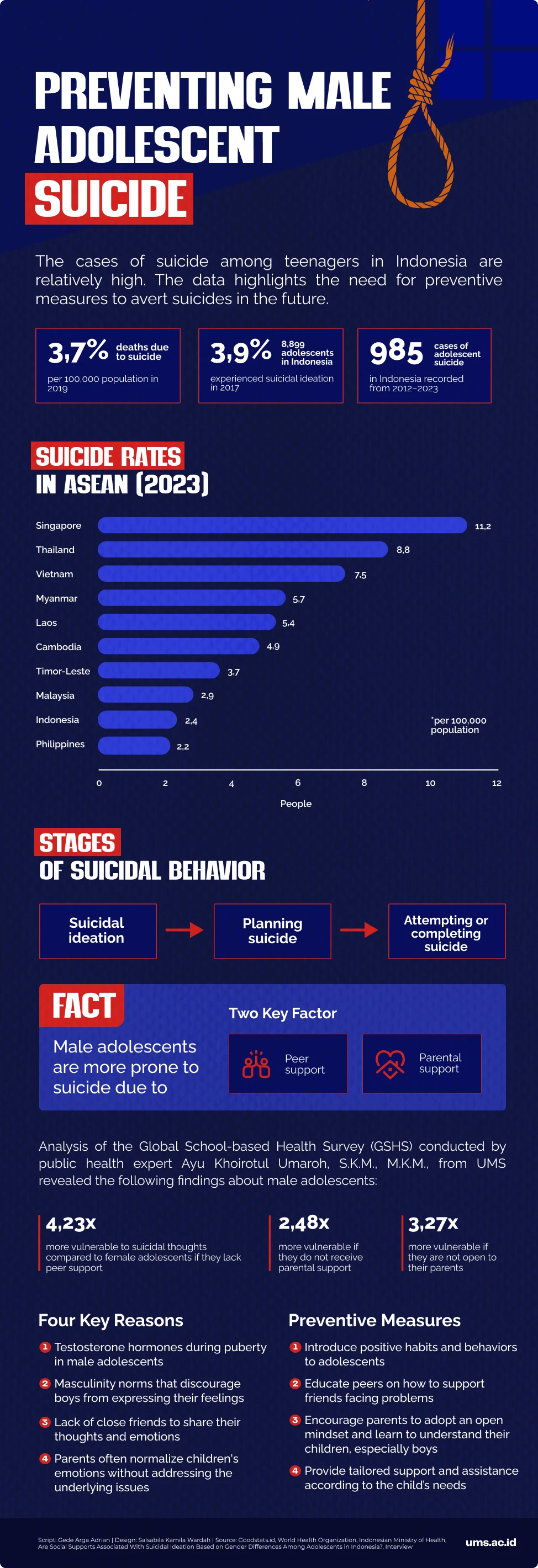
Reducing suicide rates is an absolute necessity. The 3.9% figure cited by WHO must not be taken lightly. “That 3.9% represents real people,” Ayu emphasized.
Ayu highlighted that adolescents need to learn how to provide support to their peers who are facing challenges. Changing adolescent behavior takes time, she noted, and teachers should introduce the concept of peer support gradually. “It’s important to first cultivate positive habits, rather than immediately expecting adolescents to support one another,” she explained.
Parents also need to stay open-minded and adapt to modern times, learning to understand what their children truly need. They must respond appropriately when they face difficulties, instead of imposing their own will, which could cause adolescents to lose their sense of identity and direction.
At the same time, parents need to establish clear boundaries for their children to follow. However, without a close relationship, children may find it difficult to adhere to these boundaries. Understanding how to approach their children is key to parenting success.
Reducing stigma surrounding male adolescents is a crucial first step in protecting them from suicidal tendencies. If this stigma persists, the prevalence of suicidal thoughts among male adolescents will likely remain unaddressed. “Even a single case of suicide is already a crisis,” Ayu concluded.
Writer: Gede Arga Adrian
Translator: Farizal Luqman Majid
Editor: Al Habiib Josy Asheva
Designer: Salsabila Kamila Wardah
Bank Indonesia has held its benchmark rate at 5.75 percent, ending speculation of a hike to 6 percent that had circulated in recent weeks.
Nothing’s more special than reading curated news just for you.
Subscribe to the UMS Newsletter for free today.