
How Sheep Manure Turns into Nutrient Rich Fertilizer
16 July 2026
Sheep dunged nutrient-rich organic fertilizer for plants, made with the help of maggots. Built on community empowerment and a zero-waste principle.




Driven by their concerns about the growing problem of industrial waste and its lack of effective utilization, two students Adin Nur Rohman (Industrial Engineering) and Arief Surya Adhi (Accounting), designed an IoT-based waste treatment plant that earned a silver award at the Japan Design, Idea, and Invention Expo (JDIE) 2024. The event was held at the Tokyo Ariake Garden Convention Center on July 6-7.
The Japan Design, Idea, and Invention Expo is a competition organized by the World Invention Intellectual Property Associations (WIIPA) and Chizal Corporation. This prestigious event serves as a platform for inventors and innovators from around the world to showcase their designs, mockups, prototypes, and commercial-ready products to global investors. The expo comprised 343 teams from 25 countries.
The two esteemed associations also partnered with the Indonesian Invention and Innovation Promotion Association (INNOPA) for the selection process. The team chosen through this collaboration went on to represent Indonesia at the JDIE event in Japan.
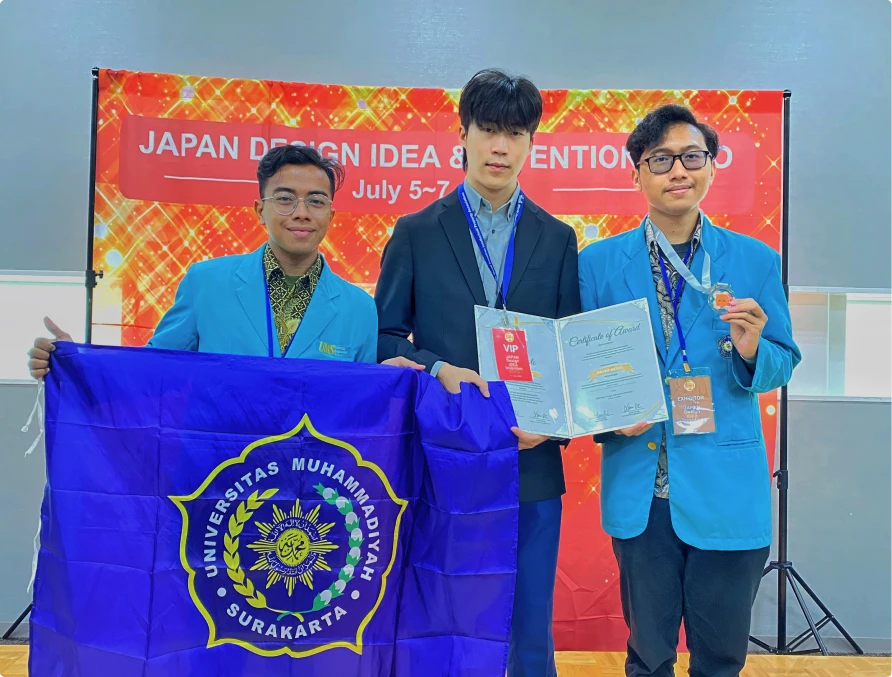
Arief (left) and Adin (right) won a silver medal at the Japan Design, Idea, and Invention Expo 2024, Tokyo (7/7/2024).
During our interview, Adin shared that his innovation with Arief is titled “Smart Green Industry Renewable Energy: Processing Industrial Waste into Renewable and Environmentally Friendly Energy Based on the Internet of Things (IoT) in Support of Zero Emissions.”
The problem of industrial waste in Indonesia, in Adin's view, is an issue that requires serious attention.
“The growing industrial waste in Indonesia has raised our concerns. Many factories simply store waste without adding any value or benefit to the environment,” Adin said.
Adin sees industrial waste as a valuable resource that remains underused. They believe that with the proper processing methods, waste can be transformed into raw materials for new products or alternative energy sources.
The SGIRE Waste Tank UMS team, led by Adin, focuses on transforming industrial waste into a renewable energy source using IoT technology.
“We designed a waste treatment plant which complies with zero emissions and zero waste using IoT technology. While it’s still a prototype, we’ve carefully considered every element of the design,” Adin explained.
Their design features a three-dimensional model of a structured green industrial area, including elements such as a renewable energy building, a waste tank area, water purification and hydrogen production facilities, an electricity power center, and a waste processing center. Each tank is designed to contribute to the production of renewable energy, including biogas, biodiesel, biofuel, and more.
“There is a waste monitoring system integrated with IoT technology. This system makes it easier for operators to track the capacity of waste stored in the tanks and monitor the progress of the waste processing,” the Solo-born student added.
The monitoring system will send notifications or signals to officers when the waste has been fully processed, ensuring that the treatment runs smoothly without requiring intense manual supervision.
The design features large interconnected tanks for filtering and processing waste into renewable energy. The system will be installed within the factory premises, with all tanks connected through metal pipes and pressurized compressors.
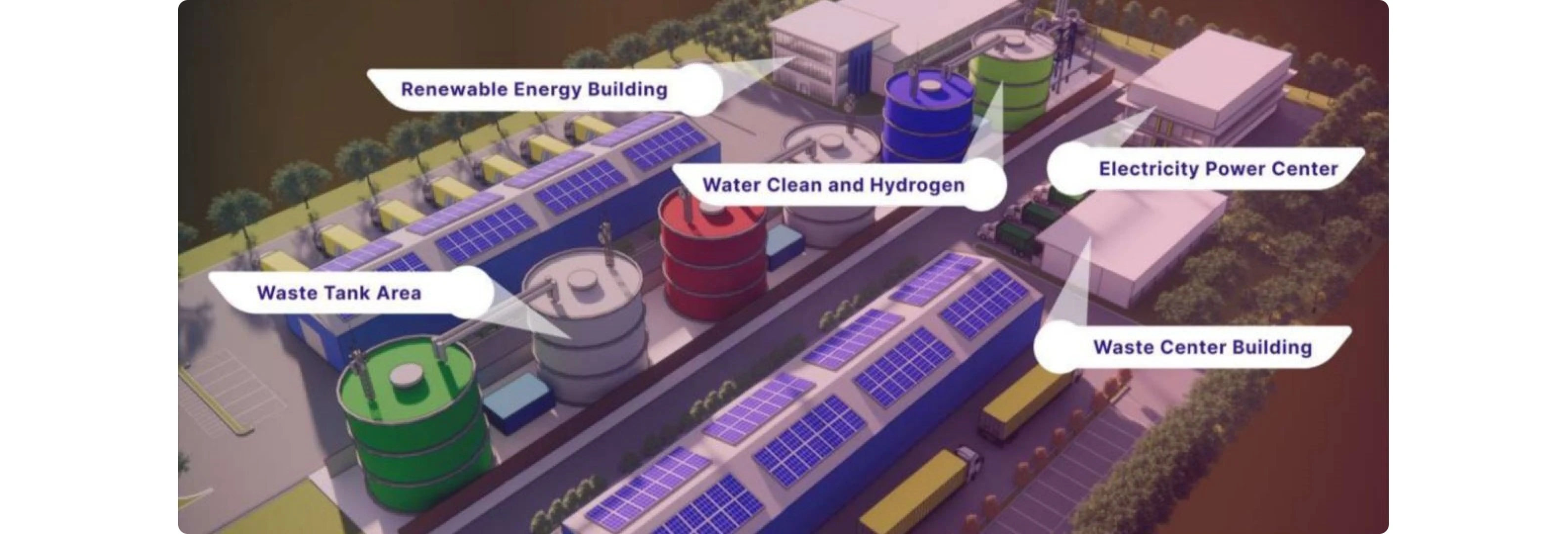
Adin and Arief's three-dimensional design of SGIRE
“Each tank serves a specific function in the process. The entire system is also supported by solar panels installed on the factory roof, providing additional electrical energy. Any residual byproducts, such as water and hydrogen, are treated to ensure the water is sterilized and safe for consumption,” Adin explained.
Functions of Each Tank
Adin and Arief’s design is versatile, benefiting both factories that produce solid waste and those that generate liquid waste. They incorporated the concept with a Waste Water Treatment Plant (WWTP) system, enabling optimal treatment of liquid waste before its conversion into renewable energy.
“It is suitable for all manufacturing industries where both liquid and solid waste are no longer usable or challenging to process,” he added, highlighting the benefits of the SGIRE system.
Arief mentioned that it took him and Adin 10 months to develop SGIRE.
"From the initial idea to the completion of the design model, the process spanned from October 2023 to July 2024," explained the UMS Accounting student.
The students don't dismiss the necessity of external support. The implementation can proceed if backed by external parties. This includes backing from the Ministry of Public Works and Housing (PUPR), the Ministry of Environment and Forestry (KLHK), and other private contractors to facilitate funding and the construction of necessary infrastructure.
“This project, if proceeded, will require funds of up to trillions of rupiah. Indonesia has great potential to develop renewable energy, but we need strong support to compete with the dominance of fossil fuels,” he estimated.
Some developed countries in Europe and America have successfully implemented a good waste management system, while Indonesia is still in the early stages of implementation.
The dominance of non-renewable energy sources like coal poses a significant challenge to the development of renewable energy in the country. However, with the government’s commitment to achieving net zero emissions (NZE) by 2060, there is hope that innovations such as those developed by Adin and Arief will receive the attention and support they deserve.
“We partially assemble the design in Indonesia, while the finalization is done in Japan. Previously, we also showed this innovation at the 36th National Student Scientific Week (PIMNAS) 2023 at Universitas Padjadjaran, Jatinangor,” said the UMS Industrial Engineering student.
Although they did not win a medal at the 36th PIMNAS, Adin and his teammates were grateful for the opportunity to present their innovations. They saw it as a chance to promote sustainable energy in Indonesia and introduce their ideas to a broader audience.
As the silver medalists from the world stage competition, Adin and Arief are now keep working on their innovation for industrial-scale use.
“We want to find industrial partners and investors to help bring this idea to life. We plan to continue our research and submit proposals to various institutions for additional funding and technical guidance,” Adin said.
Adin and Arief hope to present SGIRE at academic and industry forums to attract more interest in sustainable energy solutions. They aim for their innovation to gain wider acceptance and adoption by society.
“In addition to seeking partners, our main focus is on simplifying the complex system to reduce costs while still ensuring high-quality waste treatment," he said thoughtfully.
The development of the SGIRE design model greatly benefited from the guidance of Raden Danang Aryo Putro Satriyono, S.T., M.T., who served as the project supervisor. He acknowledged that SGIRE faces significant challenges, particularly the substantial investment required, which could impede its realization.
"The real challenge is convincing large industries to invest in implementing the SGIRE system. Significant funding is needed for surveys, design, licensing, construction, and project feasibility testing," explained Danang, an Industrial Engineering lecturer.
Another obstacle for SGIRE is the technical complexity involved in integrating IoT systems with waste treatment technology. Danang pointed out that if the project is realized, it will require intensive and regular maintenance.
"Although prototypes have been developed, the project's readiness is still in its early stages. Moving forward, we need funding from the university for further development, and in the long term, we are targeting external funding for broader implementation," he concluded.
Writer: Genis Dwi Gustati
Editor: Al Habiib Josy Asheva
Translator: Farizal Luqman Majid
Sheep dunged nutrient-rich organic fertilizer for plants, made with the help of maggots. Built on community empowerment and a zero-waste principle.
Nothing’s more special than reading curated news just for you.
Subscribe to the UMS Newsletter for free today.