
How Sheep Manure Turns into Nutrient Rich Fertilizer
16 July 2026
Sheep dunged nutrient-rich organic fertilizer for plants, made with the help of maggots. Built on community empowerment and a zero-waste principle.



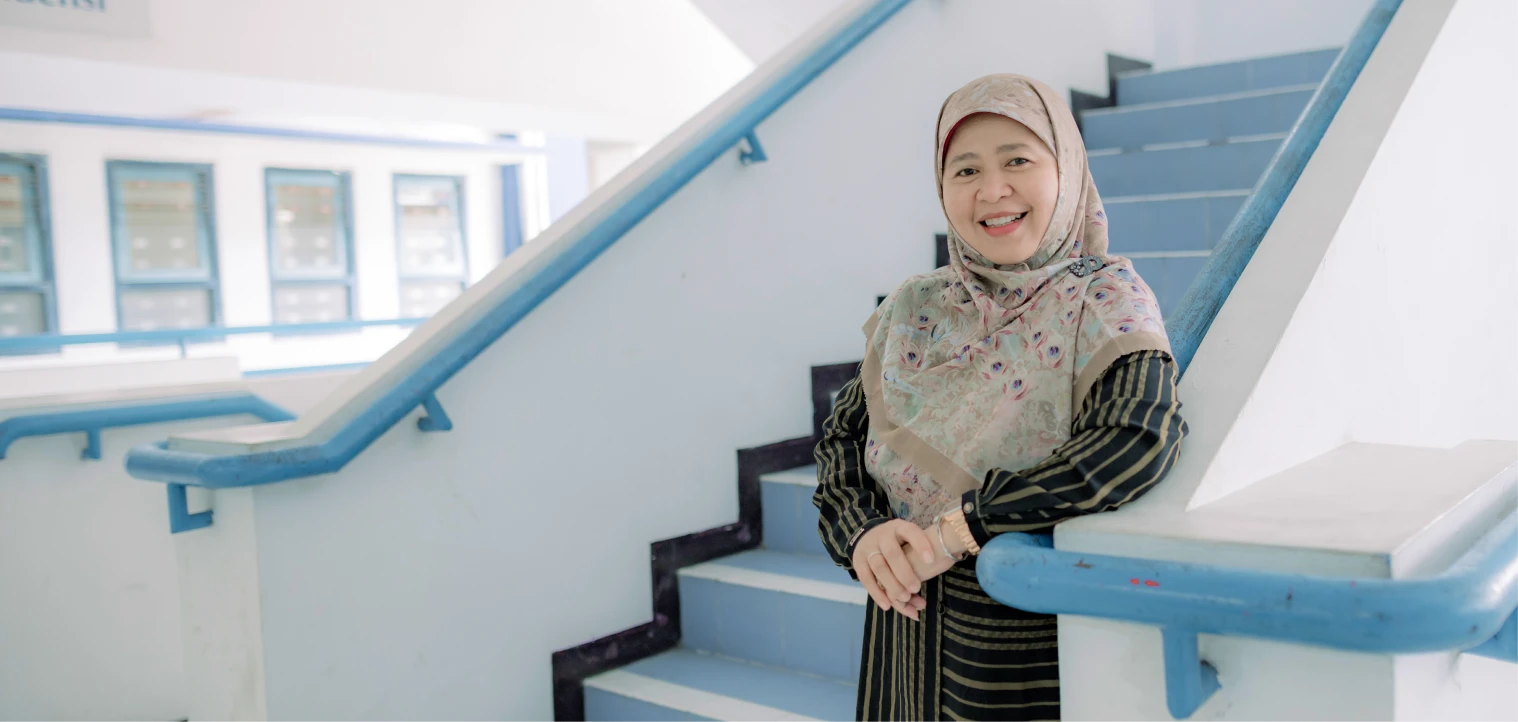
Studying Psychology at Universitas Muhammadiyah Surakarta (UMS) was never Eny Purwandari’s own dream. It was her parents’ request that pushed her to choose that major.
Eny still vividly remembers how she cried after registering for college. “I cried when I registered. I took the bus to register, and I cried the whole way. I was told to go alone and wasn’t accompanied by my parents,” Eny recalled when met in her office in early December.
Her tears at that time were not without reason. Growing up as a high-achieving student who frequently ranked first at her school, Eny was determined to pursue higher education in medicine. However, fate did not align with that ambition. “When I was not accepted (at that time), I felt devastated,” she recalled.
Before Eny had even completed her first semester of college, an incident occurred that changed her perspective on the field of psychology. She received news that her friend, let’s call her Mawar, not her real name, was ill and often called out Eny’s name. Mawar’s parents then visited Eny’s home in Sragen, Central Java.
At that time, Eny was studying at UMS and only learned about Mawar’s parents’ visit when she returned to Sragen. She then went to visit Mawar. Eny arrived and was greeted by Mawar, but something in their conversation sounded strange to her. “Look, the Prophet Muhammad is talking with us,” Eny said, imitating Mawar’s words.
The incident shocked Eny. She did not know what was happening, as it was only the beginning of her college life. She then returned to UMS and consulted one of her lecturers. It turned out that what Mawar was experiencing was schizophrenia.
From that moment, she began to understand the importance of psychology for others. Eny then actively provided support as a friend to Mawar and her family. She also actively offered counseling to Mawar’s parents and encouraged them to have Mawar examined at a mental hospital.
“That was my turning point. From then on, I finally studied seriously,” she said firmly. Slowly but surely, Eny’s support as a friend helped restore Mawar’s mental well-being.
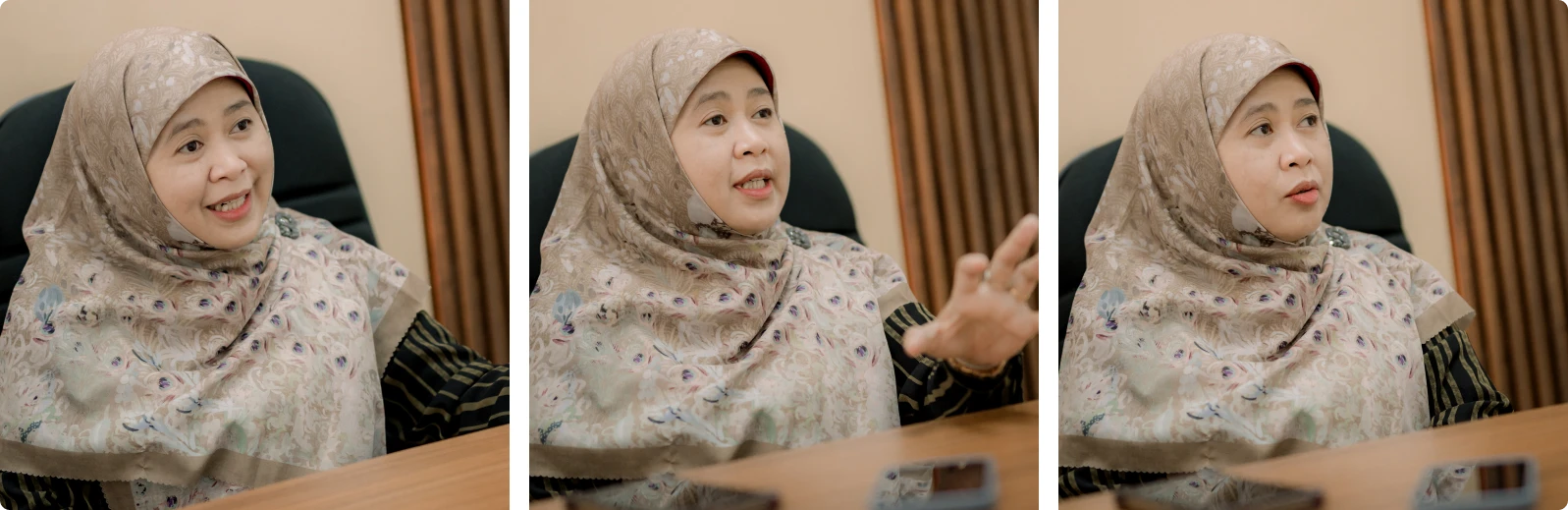
The woman born in Sragen on 15 Juli 1975 once received an offer from her father to pursue a career as a civil servant at the Department of Social Affairs (now the Ministry of Social Affairs). Eny declined, choosing to chart her own path instead. “I’ll find my own way,” she firmly told her father at the time.
A graduate of the UMS Psychology program in 1998, Eny later applied for lecturer positions at two universities, namely Universitas Islam Indonesia and UMS. Fate eventually opened the way for Eny to pursue her academic career as a lecturer at UMS.
Her decision was eventually met with her father’s full approval. “My father is very democratic, although there are moments when he needs to be authoritative,” she recalled
In between her teaching routine, the mother of three made time to continue her studies, pursuing both her master’s and doctoral degrees in Clinical Psychology at Universitas Gadjah Mada.
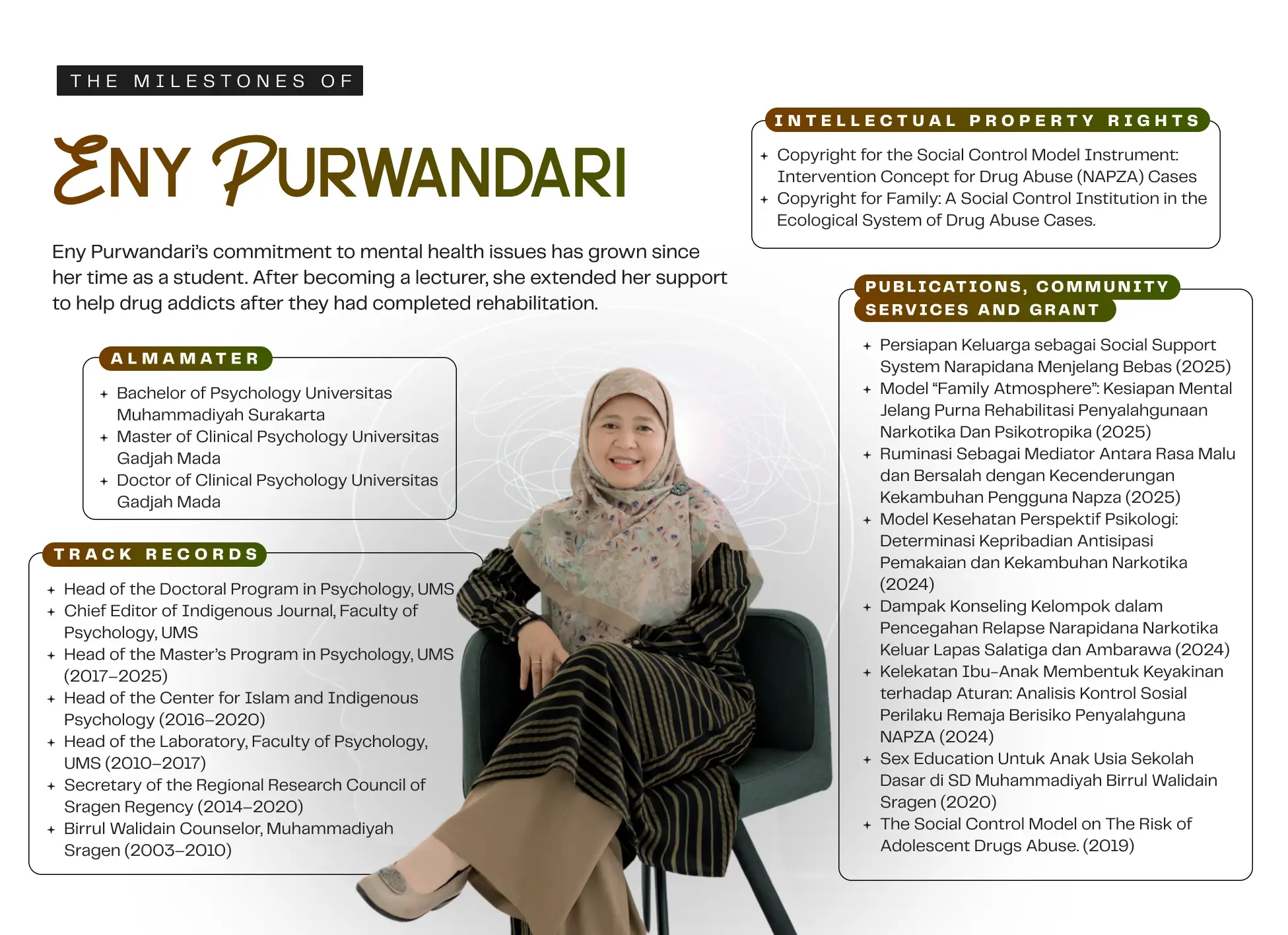
Eny has also held a number of strategic positions within the Faculty of Psychology at UMS, including Head of the Laboratory, Head of the Center for Islam and Indigenous Psychology, Chief Editor of the Indigenous Psychology Journal, Head of the Master’s of Psychology Program, and Head of the Doctor of Psychology Program.
Outside of that, Eny has been active as a counselor at Birrul Walidain Sragen and as part of the psychology team at the Elderly Day Care through the Elderly School program of ‘Aisyiyah under the Regional Leadership of ‘Aisyiyah, Surakarta City. She has also served as a member of the expert council of the Birrul Walidain Committee of Muhammadiyah Sragen, as well as the Regional Research Council of Sragen Regency.
Eny’s life journey has not been entirely smooth. A harsh reality emerged during her early years as a new lecturer, when cases of narcotics abuse erupted like an explosion, wreaking havoc within her close environment.
However, Eny refused to give up. Instead, this reality strengthened her resolve. “There is a responsibility for me to help and do something, even if it means stumbling along the way,” she explained.
Since then, the mother of three has firmly focused her attention on research into the complexities of narcotics, psychotropic substances, and other addictive substances. She became increasingly confident in this path when she realized how many families shared similar experiences. Helping addicts recover became both a calling of her heart and a moral responsibility.
Accompanying drug addicts in their recovery process certainly presents its own challenges. Eny therefore involved a number of lecturers, students, and alumni as professional collaborators in these activities. Together with her team, she employed various strategies to gather information about addicts through their families and peers.
Gaining the trust of drug addicts also required extra effort so that they would be willing to open up to Eny and her team. Fear of imprisonment clearly haunted them. “In the informed consent, we clearly state that it is solely for research purposes,” Eny explained.
Eny discovered that parents of drug users often had no knowledge at all of their children’s involvement with illegal substances. Schools, too, were unaware that their students had been drawn into the narcotics circle.
The major challenges she faced did not dampen Eny’s motivation. Instead, she redefined the focus of her research and community service. This time, she chose to concentrate on preventive measures to deter drug use and post-rehabilitation efforts to ensure that recovering addicts do not relapse.
Eny actively consolidated efforts with the National Narcotics Agency and the Ministry of Immigration and Corrections to implement rehabilitation programs. She has also been actively involved in providing assistance to drug-related inmates in several correctional facilities across the Solo Raya region.
The UMS Outstanding Lecturer Award winner in 2008 observed that inmates often experience depression as they approach their release from prison. The main contributing factors are loneliness, social acceptance after release, and economic challenges. For this reason, she also involved inmates’ families to provide psychological reinforcement. “What they need is the comfort of family,” she said firmly.
Eny’s commitment to helping drug addicts has earned her recognition through intellectual property rights. The two registered works are titled “Social Control Model Instrument: An Intervention Concept for Drug Abuse Cases” and “Family: A Social Control Institution in the Ecological System of Drug Abuse Cases.”
The trials of life and Eny’s dedication have led her to achieve the title of the 60th Professor of UMS in the field of Mental Health Psychology in June. Eny hoped that this achievement will continue to bring benefits to the wider community. “I hope this title will truly prepare me to enter the classroom of life, because the best people are those who can bring benefits to others,” she concluded.
Writer: Gede Arga Adrian
Translator: Farizal Luqman Majid
Editor: Al Habiib Josy Asheva
Sheep dunged nutrient-rich organic fertilizer for plants, made with the help of maggots. Built on community empowerment and a zero-waste principle.
Nothing’s more special than reading curated news just for you.
Subscribe to the UMS Newsletter for free today.