How Sheep Manure Turns into Nutrient Rich Fertilizer
16 July 2026
Sheep dunged nutrient-rich organic fertilizer for plants, made with the help of maggots. Built on community empowerment and a zero-waste principle.



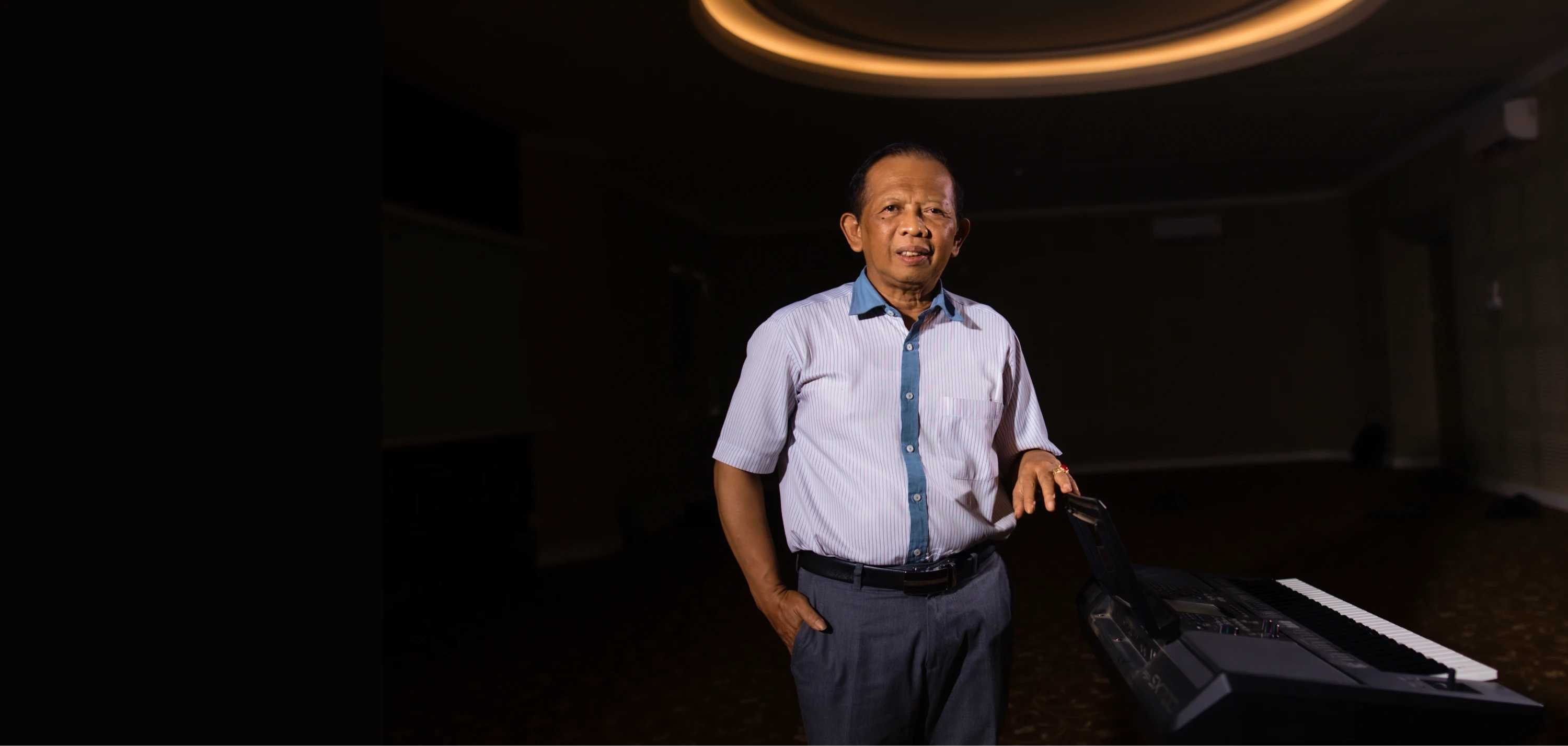
One day in the 1970s, a young boy was having a heartfelt conversation with his father after a Quran recitation session. The boy gazed intently into his father’s eyes as his father imparted wisdom.
“Teaching is a form of devotion to Allah, my son. If you become a teacher, your knowledge will continue to benefit others, even after we’re no longer here,” the father said, as Ahmad Muhibbin later recounted.
That evening, on the porch of their modest home, Muhibbin’s father spoke at length about the importance of knowledge and the responsibilities of being the eldest child. Young Muhibbin lowered his gaze, trying to absorb the weight of his father’s words. While he didn’t fully understand then, he felt the aspirations his father had placed upon him.
“If you want to be a person of benefit, become a teacher. Once you graduate from the teaching school, you can start teaching right away and help your siblings continue their education,” his father added.
“Yes, father,” the boy replied softly.
Sitting across from us now, Ahmad Muhibbin exuded a warm and approachable demeanor, making it easy for us to delve into his past.
“That’s how it all started. It was the beginning of my journey to becoming a lecturer,” said the lecturer, now also serving as the Head of Master of Education Administration at Universitas Muhammadiyah Surakarta (UMS).
Muhibbin admitted that despite their modest life, his father was a pragmatic thinker. Believing education to be a pathway out of poverty, his father encouraged him to enroll in the Teacher Training School (SPG). In the New Order era, SPG was equivalent to high school, and its graduates could begin teaching immediately.
“Graduating from SPG meant I could start working and financially support my younger siblings' education,” Muhibbin said, mimicking his father’s tone.
After graduating from SPG, Muhibbin aspired to pursue higher education. He chose the Moral Pancasila and Citizenship Education (PMP-KN) program at Universitas Sebelas Maret (UNS).
“Back then, students with good grades were called in and motivated by their teachers to continue to university, even though graduating from SPG already provided a chance to become a teacher,” recalled the eldest of six siblings.
After discussing with his parents, Muhibbin finally earned their blessing to pursue a bachelor’s degree. Yet, who would have thought that during this new chapter, he would uncover a newfound passion for music.
At UNS, Muhibbin encountered a lecturer who integrated music into the study of cultural values within Pancasila. Through this course, he learned foundational music theories, including writing sheet music, composing, and arranging songs.
“Although not in-depth, the lessons offered me a fresh perspective on music as a learning medium. Music, it turns out, is not only enjoyable but also unifying,” he explained.
Muhibbin taught himself to play the guitar and keyboard.
“My first guitar was bought from a friend in need of money. At first, I only wanted to help, but then I thought, why not learn to play it?” he quipped. He trained his fingers to transition between chords, plucking strings to create simple melodies guided by music guidebooks, as the internet was not as widespread back then.
His campus life became more vibrant as he mingled with peers from various musical genres, from keroncong and dangdut to metal. These friendships enriched his understanding of music and deepened his passion for the art.
“I’m not picky about music preferences. I enjoy all genres,” said Muhibbin who recently became Professor of FKIP UMS.
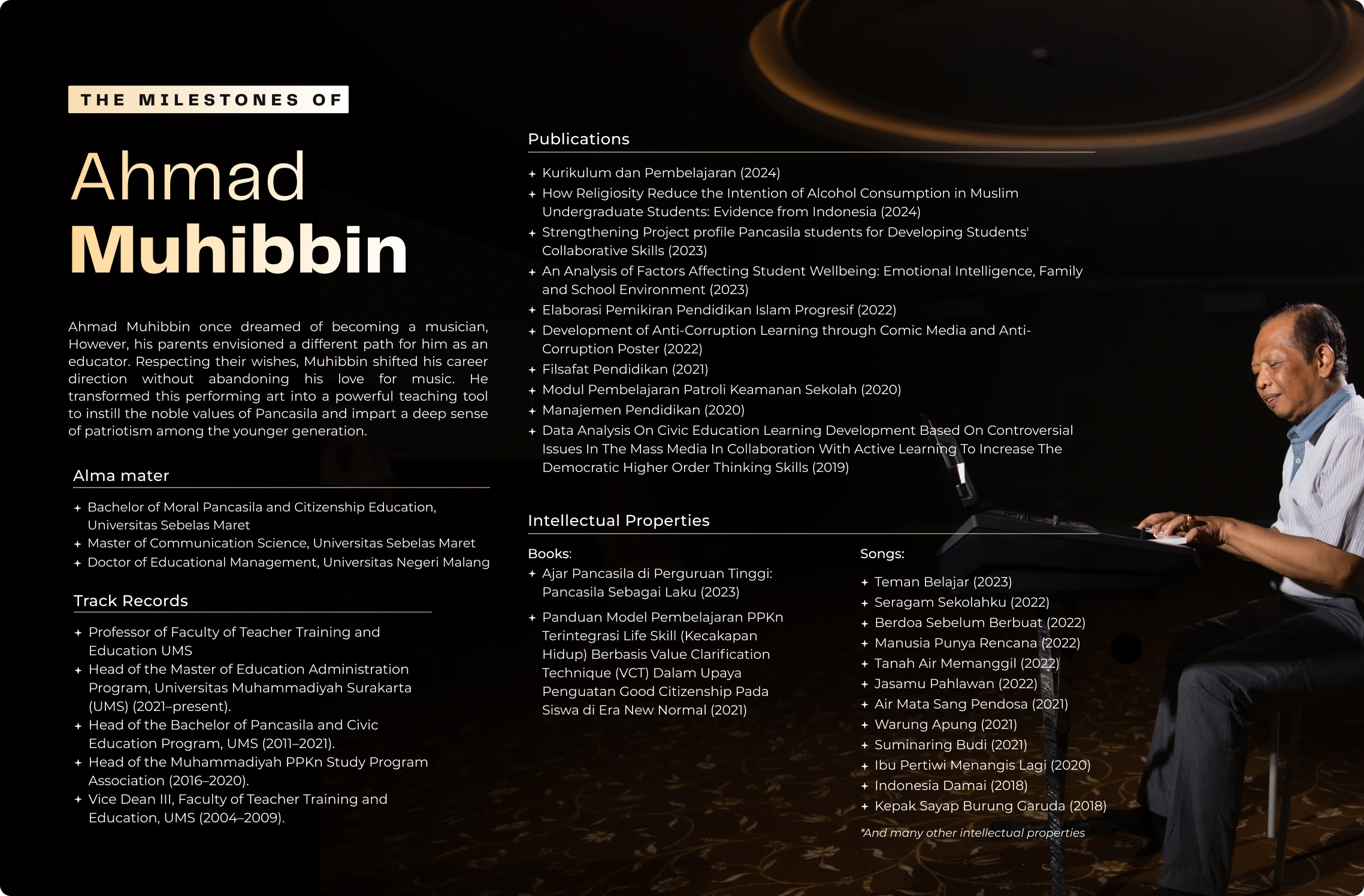
Despite his newfound hobby, Muhibbin remained steadfast in his responsibility as an aspiring educator.
“I once dreamt of becoming a musician, but I knew my parents preferred me to be an educator. They always reminded me to focus on education but never forbade me from indulging in music, as long as my purpose remained meaningful,” he shared.
Several years after earning his bachelor's degree, Ahmad Muhibbin began his career as a lecturer at Universitas Muhammadiyah Surakarta (UMS) in 1994, teaching in the Social Studies of the Faculty of Teacher Training and Education.
After dedicating a few years to UMS, Muhibbin embarked on a new chapter in his academic journey. In 2003, he received a recommendation to pursue a master’s degree in Communication Studies. Reflecting on this significant decision, he remarked, “I saw it as an opportunity to deepen my knowledge and skills, especially in addressing the evolving dynamics of the education sector.”
By 2005, Muhibbin had completed his master’s studies and returned to UMS with a broader perspective. His expertise and dedication earned him a pivotal role in the university’s academic development.
In 2006, the Communication Sciences program was officially established at UMS, with Muhibbin as one of its key pioneers and drivers. This milestone marked a significant contribution by Muhibbin to advancing higher education at UMS.
“At that time, I was also entrusted to teach PPKn courses in the Communication Sciences program at UMS, as PPkn is a general education course required across all study programs,” he explained.
Everything ran smoothly and as expected. Year after year, Muhibbin’s journey as an educator and a driving force in academia gained increasing recognition. By 2011, he was appointed as the Head of the Pancasila and Civics Education (PPKn) Program at UMS.
Amidst his busy role as program head, Muhibbin remained committed to lifelong learning. During this period, he pursued his doctoral studies at Universitas Negeri Malang (UNM), specializing in Educational Administration.
After completing his doctorate, Muhibbin reflected deeply. He questioned why his musical knowledge had not been utilized to enrich the learning process. He realized that in an era of rapidly advancing technology, PPKn was often perceived as dull and uninspiring by students.
The course was often perceived merely as theoretical, without truly resonating with students or leaving a lasting impression.
“In 2017, I began to think, why am I not utilizing something valuable that I already possess to enhance my students' learning experience? I finally gathered them together (the students), and to my surprise, they showed a great interest in learning about culture through music. That’s when the idea of proposing an elective course in the Pancasila and Civics Education program, Cipta Lagu Berkarakter (Value-based Song Creation), came to mind. I became the instructor for the course,” he recalled.
Today, the PPKn UMS music lab, though modest in size, is equipped with soundproofing and various musical instruments, including guitars, a bass, a mini electric drum kit, and a keyboard that he often brings himself to accompany students in their singing sessions.
“The output of this course is original song creation. I teach the students how to compose songs, but without sheet music since they aren’t music students. Usually, I create the music using the keyboard, and then they get creative with the lyrics,” he explained, noting that this method effectively breaks the monotony of learning pure theory.
Through his song-writing activities, Dr. Ahmad Muhibbin has emerged as one of the most productive academics in terms of intellectual creations. To date, he has secured 47 Intellectual Property Rights (HKI) for his works. His creations largely focus on songs with themes of nationalism that inspire a sense of unity and patriotism, alongside Javanese songs and religious music.
“Many of my religious song ideas are inspired by childhood memories,” Muhibbin explained. “As for the Javanese songs, they feel natural to me because I am a Javanese. Meanwhile, the nationalist-themed songs stem from my daily experiences as a Pancasila and Civics Education lecturer.”
Occasionally, his songs address contemporary social issues. One example is Indonesia Damai (Peaceful Indonesia), which was born out of his discomfort with the polarizing terms “kampret” and “cebong” used during the lead-up to the 2019 Presidential Election.
These terms had become tools for societal dispute, triggering polarization that threatened the unity and peace of the nation. Through Indonesia Damai, Muhibbin sought to remind people of the importance of unity and collaboration, which are foundational to a harmonious and forward-thinking nation.
“Simply put, music is not just entertainment. It is a medium for character-building and moral messaging. Music is a universal language that unites, remains memorable, and is easy to digest. That’s why I ensure my lyrics are easy to listen to,” he said.
As an educator, Muhibbin remains committed to inspiring others. His songs not only teach students about character development but also invite them to internalize the profound values embedded in Indonesia's culture.
“Teaching and educating are acts of devotion I dedicate to the younger generation, ensuring they stay grounded in understanding, embracing, and upholding the values that unify us as a nation,” he concluded firmly.
Writer: Genis Dwi Gustati
Translator: Farizal Luqman Majid
Editor: Al Habiib Josy Asheva
Sheep dunged nutrient-rich organic fertilizer for plants, made with the help of maggots. Built on community empowerment and a zero-waste principle.
Nothing’s more special than reading curated news just for you.
Subscribe to the UMS Newsletter for free today.