
How Sheep Manure Turns into Nutrient Rich Fertilizer
16 July 2026
Sheep dunged nutrient-rich organic fertilizer for plants, made with the help of maggots. Built on community empowerment and a zero-waste principle.



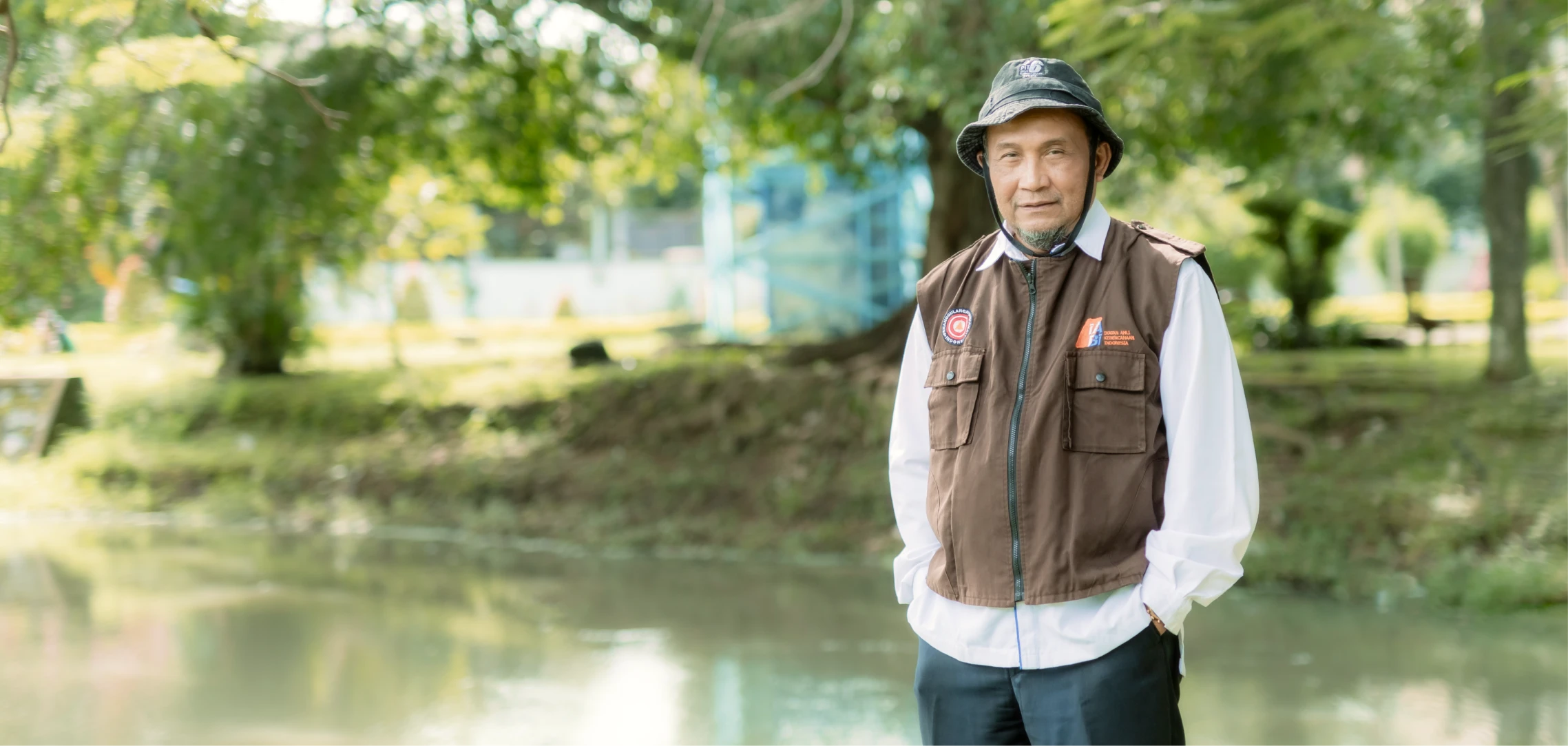
The early hours of the morning have always held a special significance for Kuswaji Dwi Priyono. Under the dark sky, occasionally lit by stars, he would wake up without an alarm to assist his parents.
Kuswaji’s parents, he shared, were clothing merchants who moved from one market to another weekly. It was a necessity for them to begin their day long before dawn.
“My mother used to say I was the easiest child to wake up in the morning,” Kuswaji chuckled, recounting his mother’s words during an interview at the Community Service and Muhammadiyah Organization Development Institute (LPMPP), on the 5th floor of the Siti Walidah Main Building at Universitas Muhammadiyah Surakarta (UMS), Monday (13/1/2025).
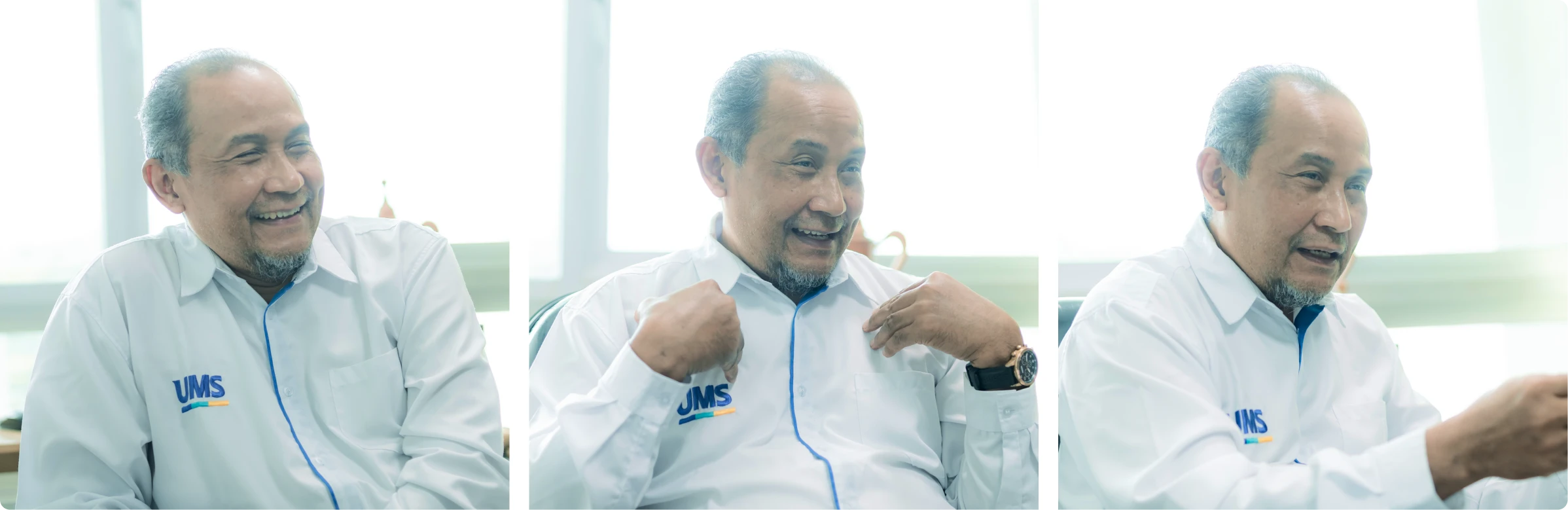
Prof. Dr. Kuswaji Dwi Priyono, M.Si. Imam Safi’i/UMS PR
“I remember everything vividly. Going to Ponjong Market was 7 km from home. Paing Regedeg Market was about 17 km, Jepitu Market around 20 km, and Baran Market in Rongkop was 19 km, among others,” he recalled.
Amid the arid landscape of Semanu, the second of five siblings grew up with discipline as a way of life. Simplicity and hard work were essential foundations for striving for a better future.
“I can say that the discipline instilled back then became one of the pillars that kept me going. My parents were determined for their children to live better and more decent lives than they did,” said Kuswaji, who was recently inaugurated as a Professor of Geography at the Faculty of Geography, UMS.
Before turning 12, Kuswaji already displayed a keen interest in nature. His love for the outdoors grew even stronger when he joined the Scouts extracurricular program.
“I always looked forward to camping activities and treasure hunts. It felt like a small adventure,” he recalled. During camping trips, he learned to read Morse code, understand wind directions, and many other exciting things.
Kuswaji’s teenage years were not solely filled with nature adventures. Upon entering high school, he joined the Indonesian Islamic Students organization (PII).
According to Kuswaji, PII was one of the hardline Islamic organizations of its time, as it also instilled militancy in its members.
“Although I was part of PII, my family was deeply rooted in Muhammadiyah. That kept me grounded, as Muhammadiyah instills the values of Islam as a blessing for all ('rahmatan lil ‘alamin'),” he explained. The combination of these two influences shaped Kuswaji into a person who is both firm and empathetic toward humanity and nature.
Kuswaji candidly shared that he initially wanted to pursue agriculture after graduating from high school. However, fate led him to his second choice: the Faculty of Geography at Universitas Gadjah Mada (UGM).
“I was fascinated by how soil and landscapes are formed. Geography offers a broad perspective on the relationship between humans and nature,” he said.
He chose to major in Geomorphology, where he delved into the dynamics of soil and the Earth’s surface and how the factors influencing them affect human life.
His studies in geomorphology led Kuswaji to a variety of field experiences. One of his most unforgettable moments was working on a soil resource survey project in North Sumatra after earning his Doctorandus (Drs.) and Bachelor of Science (B.Sc.) degrees.
The project was led by a Dutch soil expert, with Kuswaji as part of the team responsible for field surveys, analyzing soil profiles, and studying soil development in various locations based on instructions.
“We mapped the potential and limitations of land for various uses. It was an incredibly enjoyable first career experience, especially since it was my first time traveling far from home and flying on an airplane,” he joked.
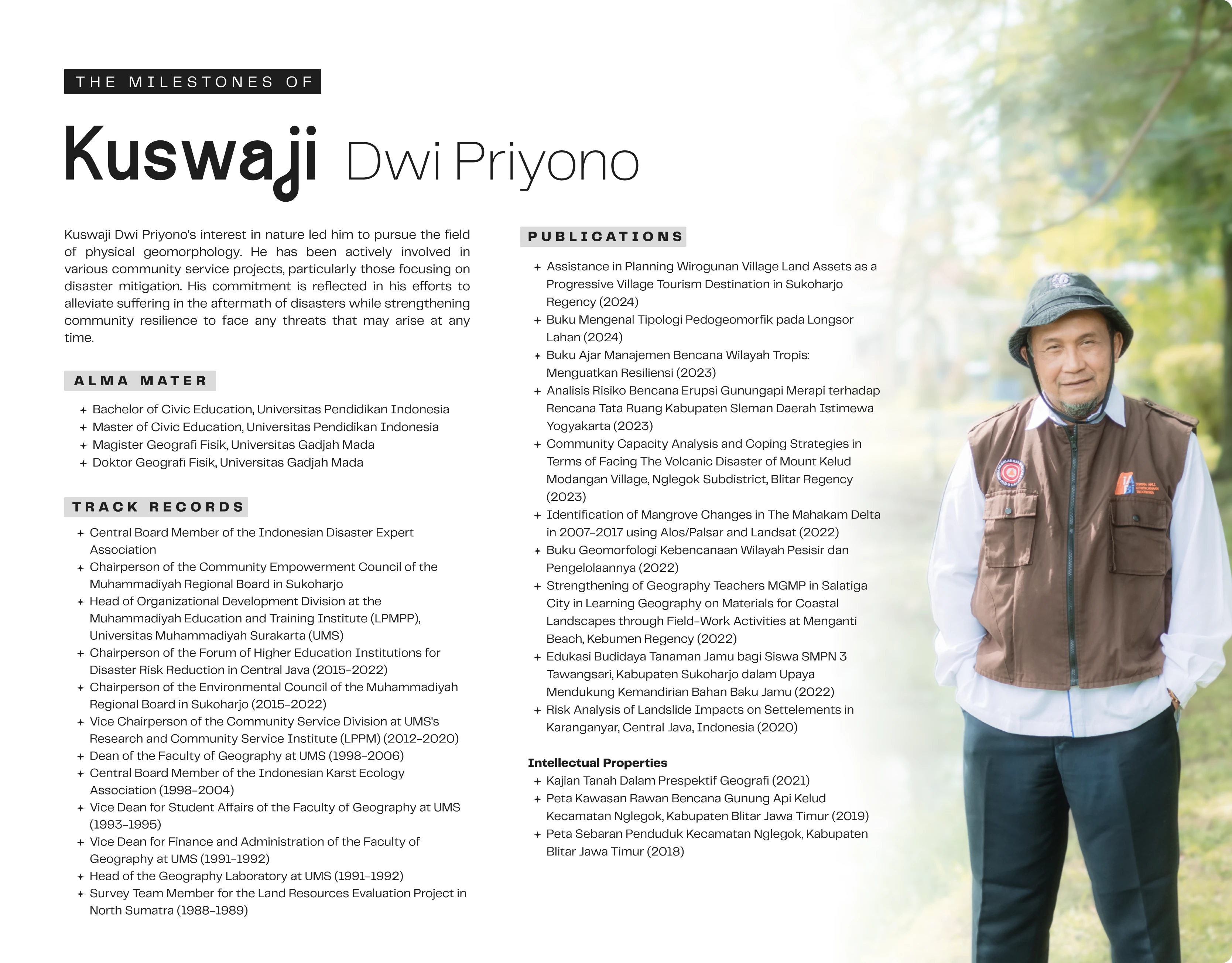
Kuswaji’s passion for geomorphology deepened as he pursued his master's and doctoral studies at the same university. “Since my focus was in that area, I also studied disaster mitigation. I thought it would be meaningful to share my knowledge with Indonesia, a country plagued by all kinds of disasters, from volcanoes to floods,” he reflected at the time.
In 1991, Kuswaji began his service at Universitas Muhammadiyah Surakarta (UMS) as a young lecturer in the Faculty of Geography. In the following years, he was entrusted with managing laboratories and eventually became dean for two terms. He also actively encouraged impactful community service.
“Among the various community service projects with UMS, the most memorable was the effort to provide clean water in Gunung Sewu, an area often plagued by prolonged droughts,” Kuswaji recalled. During extreme dry seasons, residents of Gunung Sewu had to sell their livestock to purchase water.
The scorching heat in the karst region of Gunung Sewu, specifically in Pucung Village, Wonogiri, was intense. Cracked limestone soil was part of the daily scenery for the residents, he recounted.
Together with his team, Kuswaji conducted speleological surveys to uncover hidden underground water sources beneath the karst layers.
Using caving equipment, they eventually discovered an underground river flow. “After the survey, we identified the potential for an underground river in the area, but the challenging terrain made it seldom utilized,” he explained.
Reaching the water source was no easy feat. Kuswaji and his team had to descend through a vertical cave shaft 17 meters deep in Goa Suruh.
“The stable water flow, about 2 liters per second, offered a glimmer of hope for the people of Pucung in 2009,” he elaborated.
The project in Gunung Sewu turned out to be a lengthy endeavor due to limited funding from the Ministry of Research and Technology (Kemenristek).
“In the end, we also received support from the Indonesian Islamic Da'wah Council (Dewan Dakwah Islamiyah Indonesia), and UMS pitched in as well,” he continued.
When sufficient funds were finally secured, Kuswaji and his team began constructing a small dam, installing a submersible pump, and designing a distribution system. After years of hard work, water began flowing to residents' homes in early 2013.
“The water price, which previously reached Rp50,000 per cubic meter, drastically dropped to Rp3,500 per cubic meter after the project,” he stated plainly.
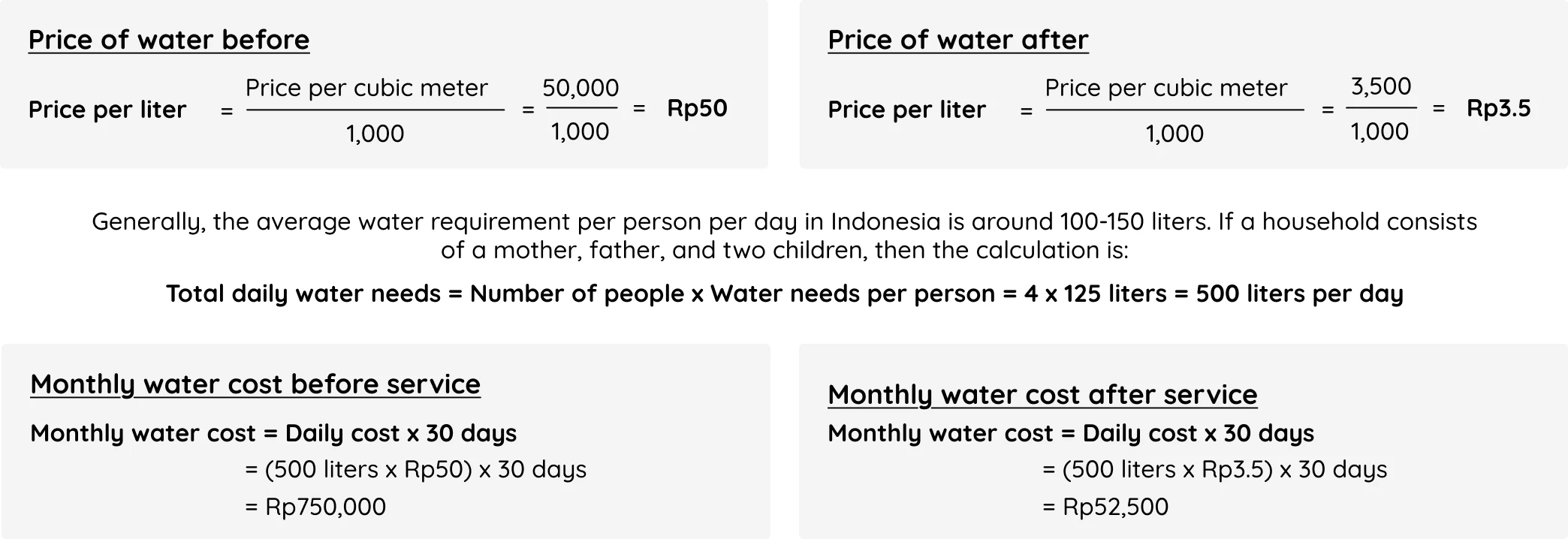
Estimated monthly water costs per Liter
He and his team successfully developed a collective awareness among the community. Today, if a pipe is damaged or the water distribution system requires repair, the residents of Pucung Village voluntarily organize fundraising efforts.
Kuswaji’s dedication to community service continues. This year marks 13 years of his efforts in assisting various communities alongside LPMPP UMS.
“We strive to build grassroots awareness that disasters are challenges we can face together,” Kuswaji emphasized.
The relaxed figure sitting before us has been actively involved in various disaster-related organizations since the 1990s. He served as a central board member of the Indonesian Karst Ecology Association (Pekindo), a central board member of the Indonesian Geographers Association (IGI), and chaired the Central Java Forum of Higher Education Institutions for Disaster Risk Reduction (FPT-PRB).
Most recently, Kuswaji has taken on the role of central board member of the Indonesian Disaster Experts Association (IABI). He contributes to developing community-based disaster mitigation strategies. “Disasters are an inevitable reality for humanity, but we can minimize vulnerability and disaster risks through mitigation,” he asserted.
For Kuswaji, disaster mitigation is not solely about technical matters. It also encompasses education and leveraging local wisdom. This philosophy is reflected in several of his textbooks and maps of disaster-prone areas that he authored.
Involving the community in every step of mitigation is essential. “The community is the primary actor, not just a recipient of aid. They possess extraordinary potential if empowered,” he added.
Our conversation immediately brought to mind the memory of Kuswaji's inaugural speech as a Professor. On that occasion, he highlighted the theme of resilience, which he described as the ability of communities to endure and recover after being tested by disasters from the Almighty Creator.
“Resilience is the journey to understand disasters, learn from them, and grow stronger. That’s my current focus, strengthening resilience. We live in a land of a thousand disasters, so there must also be a thousand solutions,” Kuswaji emphasized.
This approach has been realized through Kuswaji's long journey alongside communities. He has witnessed firsthand how the strength of communities can serve as the main pillar in facing disaster challenges.
Writer: Genis Dwi Gustati
Translator: Farizal Luqman Majid
Editor: Al Habiib Josy Asheva
Sheep dunged nutrient-rich organic fertilizer for plants, made with the help of maggots. Built on community empowerment and a zero-waste principle.
Nothing’s more special than reading curated news just for you.
Subscribe to the UMS Newsletter for free today.