
How Sheep Manure Turns into Nutrient Rich Fertilizer
16 July 2026
Sheep dunged nutrient-rich organic fertilizer for plants, made with the help of maggots. Built on community empowerment and a zero-waste principle.



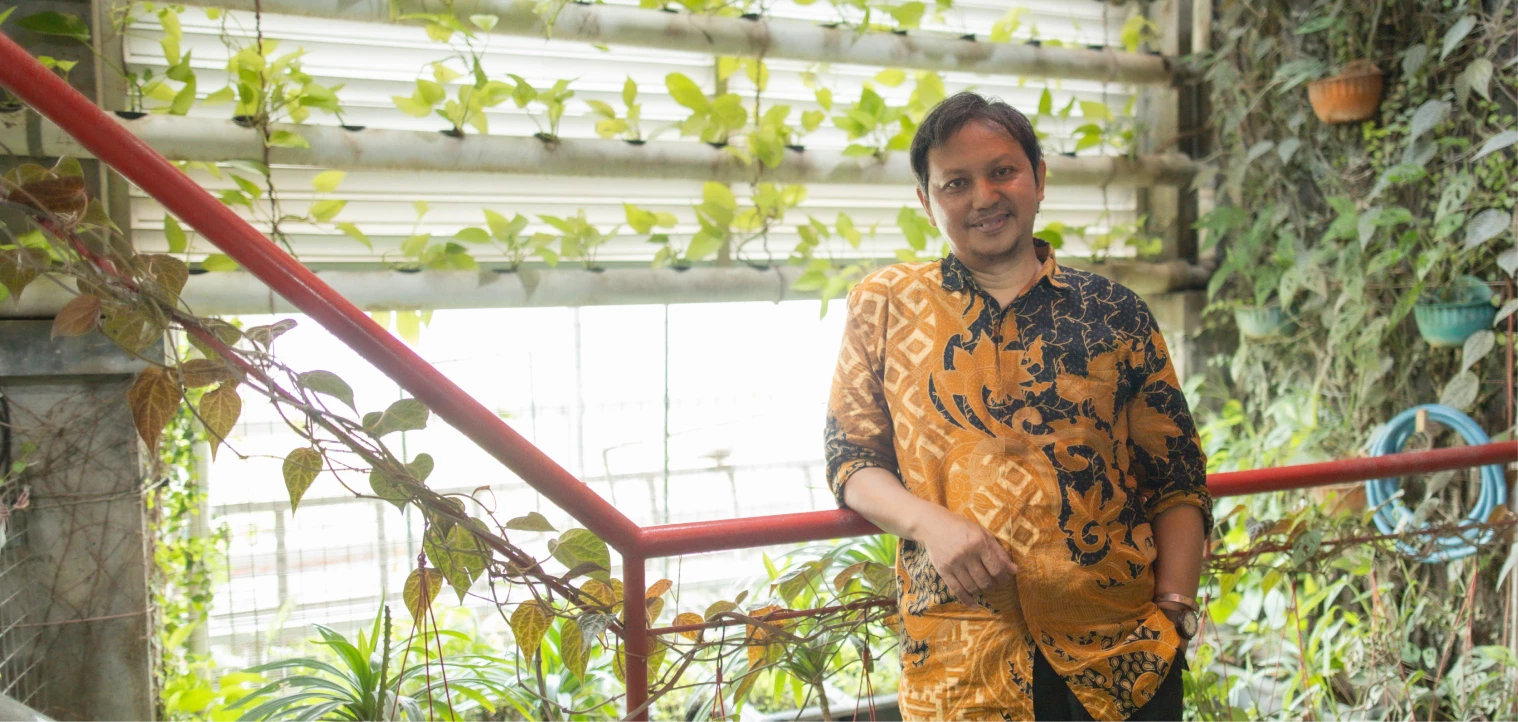
Qomarun’s yard isn’t large, but it is lush enough to relax while enjoying the gentle breeze. Nestled among other houses on Jalan Duwet III, Surakarta, Qomarun’s home appears verdant. The three-story building is draped in various types of climbing plants.
Qomarun uses the ground floor of his house as an architectural studio, complete with a library, garage, and a fish pond beneath it. The other rooms are located starting from the second floor. There's also an aviary installation at the front of the house, which Qomarun fills with various species of birds.
Qomarun’s house is easy to recognize due to the dense vegetation surrounding it. The homeowner installed plants to create a lush, green ambiance. “These are betel vine plants,” Qomarun said, pointing to a corner of the wall.
Indeed, during his doctoral studies, the man who now teaches in the Architecture Program at Universitas Muhammadiyah Surakarta (UMS) fell in love with green architecture. He was moved after hearing increasing reports of global warming, particularly since the early 2000s.
Qomarun’s residence became his first experiment in developing the concept of a green home. He named it Rumah MAPAN, an acronym for “mandiri pangan dan energi” (self-sufficient in food and energy). Although the house was built in 2008, the MAPAN concept was gradually implemented starting in 2014.
Read more: A Green House in a Narrow Alley
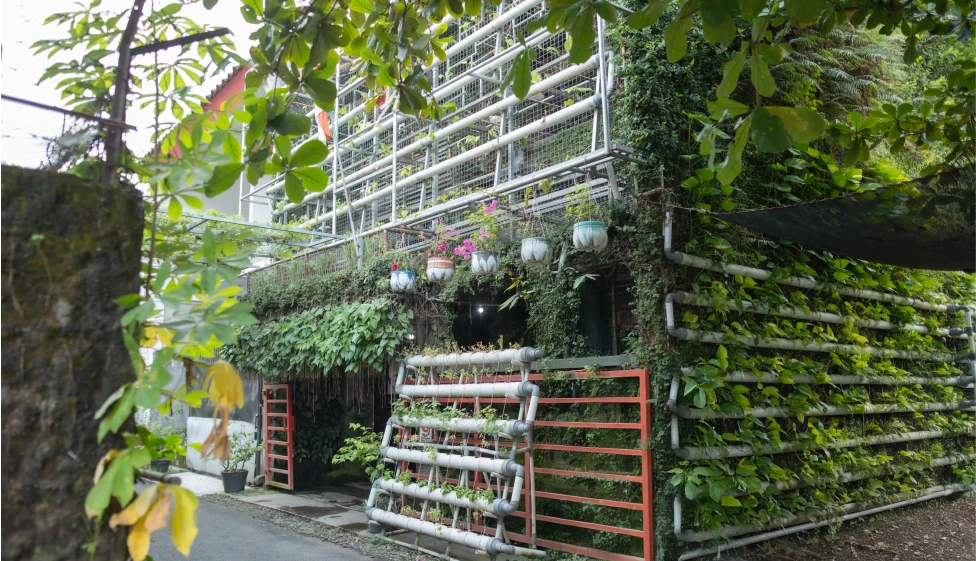
MAPAN House owned by Qomarun looks lush in Karangasem, Laweyan, Surakarta, May 15, 2025. Aquaponic installations are mounted on the side and front walls of the house. Imam Safii/UMS Public Relations
The "growing house" concept was chosen in building the home, with each floor covering an area of 42 square meters. This concept accommodates the gradual expansion of the house to meet changing spatial needs over time.
“As the name suggests, a growing house is built one floor at a time. It’s not like a regular house that’s constructed all at once,” he explained.
Several installations were added to complete the MAPAN House, including 1,600-watt peak (wp) solar panels, an aquaponic planting system, an aviary, a vertical garden, and a freshwater fish pond.
Such an installation was chosen to avoid wasting the natural resources. For instance, dirty water from the fish pond, which contains fish excretions, is pumped upward using solar-powered pumps to an aquaponic plant system. The plants absorb the minerals from the fish waste, purifying the water. The clean water is then returned to the pond using gravity.
Meanwhile, the solar panels convert sunlight into electrical energy. The panels, which cost around Rp24 million, can produce between 400 to 600 watts of electricity, enough to power the pond water pump, dispenser, and lights on the ground floor.
As a result, electricity consumption decreased. Before installing solar panels, Qomarun spent IDR 1.6 million per month on electricity. After the installation, the cost dropped to IDR 1 million per month. “It’s a decent drop, about six hundred thousand rupiahs,” he said.
In addition to being energy self-sufficient, the MAPAN House also strives for food self-sufficiency. The fish pond Qomarun built is stocked with three types of edible fish: catfish, pangasius, and gourami. The harvest from these three fish types has reached up to one ton per year.
Vegetables from the aquaponic system, such as mustard greens, water spinach, and bok choy, are harvested every three months. Meanwhile, cassava and sweet potatoes are grown using polybag techniques in the green strip in front of the house.
The effort to popularize green architecture continues. In 2022, Qomarun received a grant of IDR 300 million through the Kedaireka scheme from the Ministry of Education, Culture, Research, and Technology.
The grant was used to implement the MAPAN House concept in five homes in the Karangasem area of Laweyan, Surakarta, Central Java. These five houses belong to members of the Surakarta Urban Farmers Network Community, or Jaritaniku, and are still maintained to this day.
The MAPAN House successfully qualified as a participant in the 2021 IAI Awards organized by the Indonesian Institute of Architects. It met the four key criteria of the Greenship Home V.0.1 standard, EASY, which stands for energy, water, waste, and diversify. As a result, the MAPAN House was awarded the Platinum category.
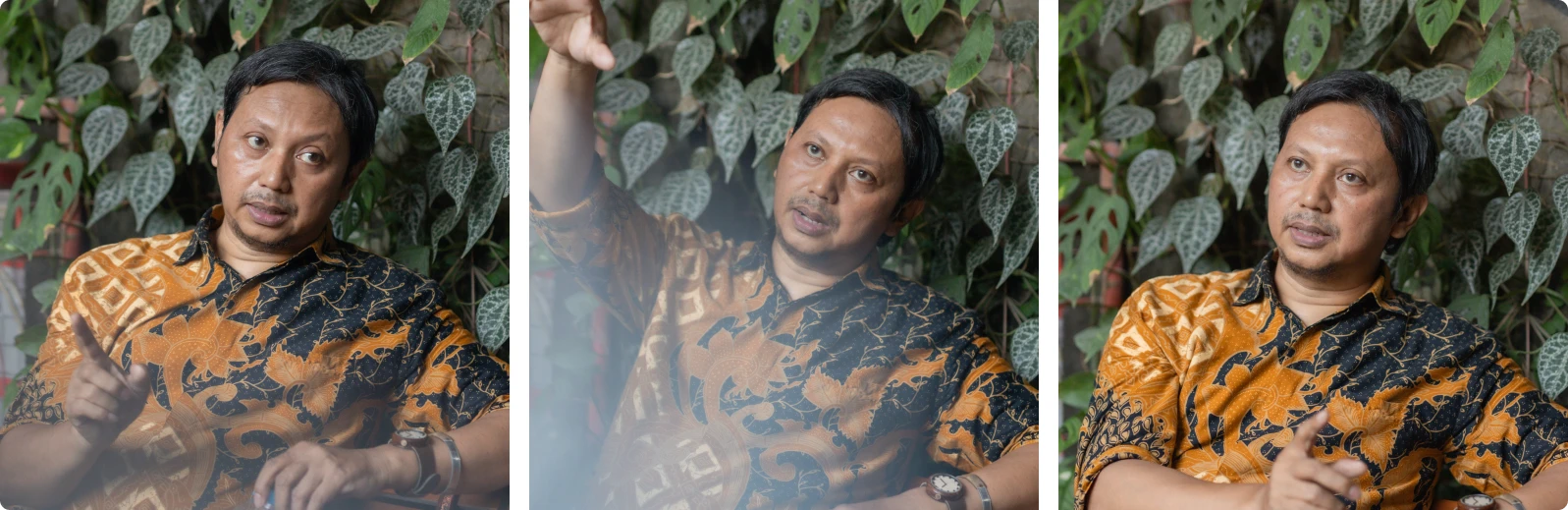
Dr. Ir. Qomarun, M.M. Imam Safii/UMS PR
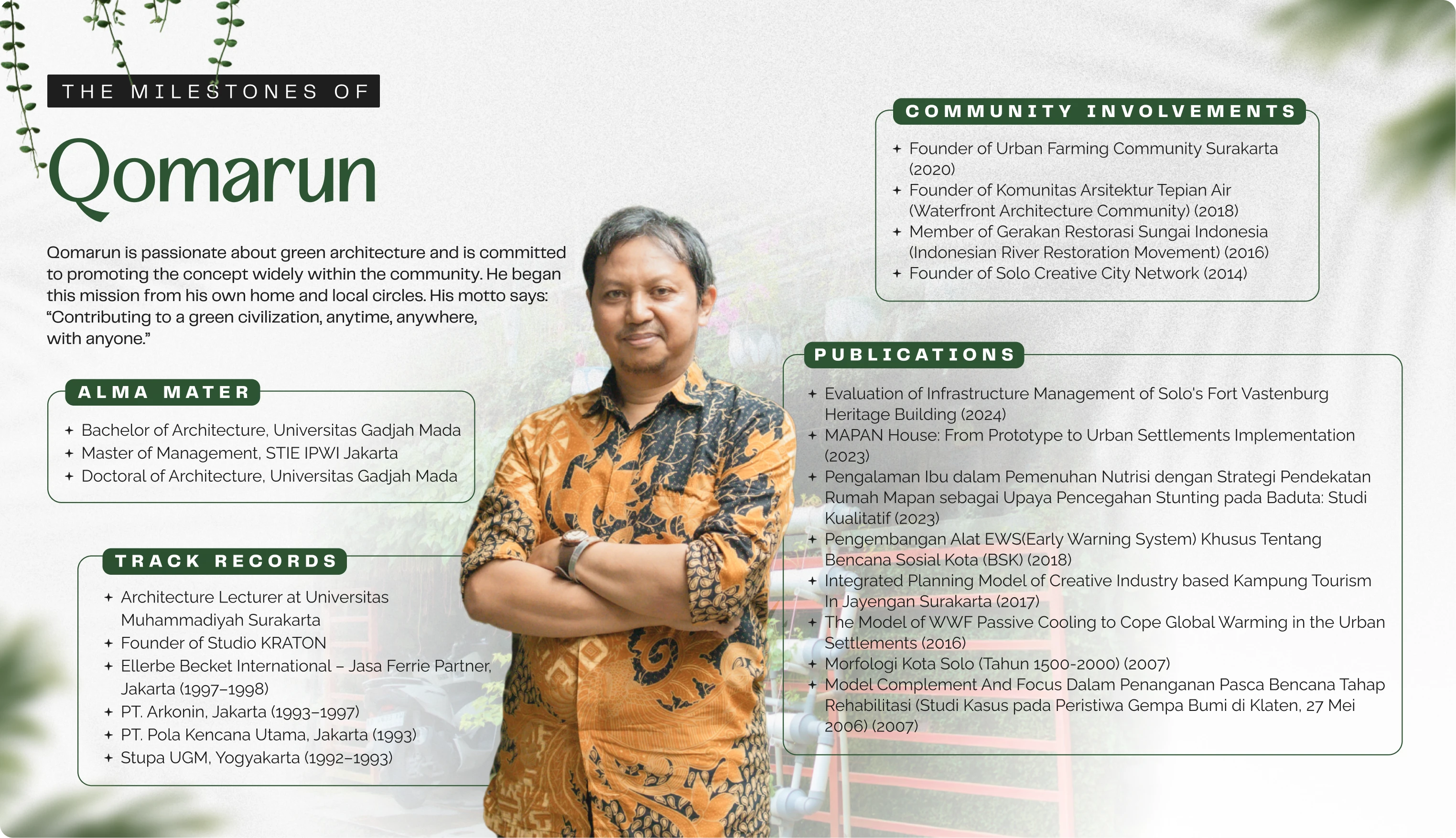
Qomarun believes that architecture is a field that blends both art and technical knowledge. This idea is not mere talk. The blood of art has flowed through Qomarun since he was young. Born in Sukoharjo, Central Java, on September 9, 1969, Qomarun said he inherited his artistic side from his father.
“My father, while working as a civil servant, still loved to paint. What I remember most is him painting wayang (traditional shadow puppets). He could recall every detail by heart,” he reminisced.
Even though science subjects like physics and mathematics were his favorites during his teenage years, he never abandoned his love for arts. In fact, Qomarun once won a cartoon drawing competition during his time at Sukoharjo State Senior High School.
After graduating from high school, Qomarun continued his studies in the Architecture Department at Universitas Gadjah Mada (UGM), earning his bachelor's degree in 1993. Right after graduation, he started his professional career by joining the Tourism Studio (Stupa) at UGM.
Stupa UGM focused on urban architecture and regional tourism planning. However, it didn’t fully suit him. “I wanted to be an architect who designs buildings,” he said.
Qomarun then continued his career at PT Pola Kencana Utama in Jakarta in 1993. Less than a year later, he moved to PT Arkonin, a subsidiary of PT Pembangunan Jaya that specializes in construction consultancy. It was at Arkonin that Qomarun's architectural career really took off.
Indonesia in the 1990s was in a period of rapid development. It’s no surprise that Qomarun often worked on new building projects in Jakarta. “Back then, the economy was very supportive. Many malls, hotels, and new housing developments emerged during that time,” he explained.
One of Qomarun’s most memorable experiences was being involved in the construction of the Jakarta Stock Exchange building (now known as the Indonesia Stock Exchange/IDX) and the Jakarta Financial Tower in the Sudirman Central Business District (SCBD), Jakarta, in 1995.
The project was designed by American architecture firm Brennan Beer Gorman. It brought together three local architectural consultants: Encona Engineering, Atelier 6, and Arkonin.
“These three consultants formed the JSEB-JFT Consortium. The basic design was done by Brennan Beer Gorman, while the JSEB-JFT Consortium handled the follow-up architectural work,” he added.
While building his career, Qomarun also stayed committed to his education. He completed his master’s degree in management at the Sekolah Tinggi Ilmu Ekonomi IPWI Jakarta in 1997. Later, he earned his doctoral degree in architecture from UGM in 2014.
When the storm of the 1997–1998 monetary crisis hit, Qomarun decided to pivot his career and became a lecturer in Architecture at UMS. In the early days of his academic career, he still frequently traveled back and forth to Jakarta to finish his ongoing projects.
Despite entering academia, Qomarun never abandoned his passion for architecture. Entering the new millennium, he established Studio KRATON, an acronym for Kreasi Arsitektur dan Kota Madani.
“Studio KRATON prioritizes green architecture. Every design I create must pass the platinum green level, meaning it must be energy-efficient,” he explained.
At one point, the Mayor of Surakarta for the 2012–2021 period, FX. Hadi Rudyatmo, gathered several creative individuals in the city of Bengawan into a forum. The thick-mustached man said, “Why don’t you make me an international event,” Qomarun recalled Rudy’s words.
Qomarun and several representatives in the forum proposed forming an official community. Thus, the Solo Creative City Network (SCCN) was established in 2014.
Qomarun explained that SCCN was established through the initiative of seven individuals, including himself. The founding members are UMS Architecture lecturer Ir. Alpha Febela Priyatmono, M.T., Rumah Rempah founder Paulus Mintarga, Fresh Blood Indonesia founder Irfan Sutikno, lecturer at the Indonesian Institute of the Arts Surakarta Prof. Dr. Dharsono, M.Sn. (the late), Dr. Dhian Lestari Hastuti, S.Sn., M.Sn., and Omah Sinten owner Slamet Raharjo.
“SCCN is essentially made up of artists from various fields. There are architects, interior designers, puppeteers, dancers, even culinary artists. In total, there are 16 subsectors,” he explained.
From their collaboration, came the biennial event Bamboo Biennale, which has been held since 2014. The event showcases bamboo art and involves both local and foreign bamboo experts, architects, craftsmen, bamboo activists, and musicians.
Two years later, Qomarun joined the Gerakan Restorasi Sungai Indonesia, initiated by UGM lecturer Prof. Dr.-Ing. Ir. Agus Maryono. This movement aims to restore the strategic function of rivers, as a water supply source, flood and drought control, means of transportation, microclimate regulator, ecosystem health supporter, green corridor, and even as a tool for education.
In 2018, Qomarun collaborated with Architecture students at UMS to establish the Komunitas Tepian Air (KOTA), or Waterfront Community. This community focuses on waterfront architecture, aligning with one of the courses in the UMS Architecture program, Waterfront Design.
In line with his research on Rumah MAPAN, Qomarun also founded the Urban Farming Community Surakarta (UFCS), a group that promotes food and energy self-sufficiency starting from the household level.
Qomarun’s active involvement in these various communities reflects his persistent efforts to set a greener Earth. He believed the presence of green buildings is crucial to sustaining life on the planet. These efforts also represent Qomarun’s commitment to supporting the Net Zero Emission 2060 initiative, which is now being actively promoted.
“If a building is already far from being green, there will be two options in 2060: demolish it or renovate it into a green building,” he concluded.
Writer: Gede Arga Adrian
Translator: Farizal Luqman Majid
Editor: Al Habiib Josy Asheva
Sheep dunged nutrient-rich organic fertilizer for plants, made with the help of maggots. Built on community empowerment and a zero-waste principle.
Nothing’s more special than reading curated news just for you.
Subscribe to the UMS Newsletter for free today.