
Bank Indonesia Holds Interest Rate at 5.75%, What Is the Impact?
24 July 2026
Bank Indonesia has held its benchmark rate at 5.75 percent, ending speculation of a hike to 6 percent that had circulated in recent weeks.


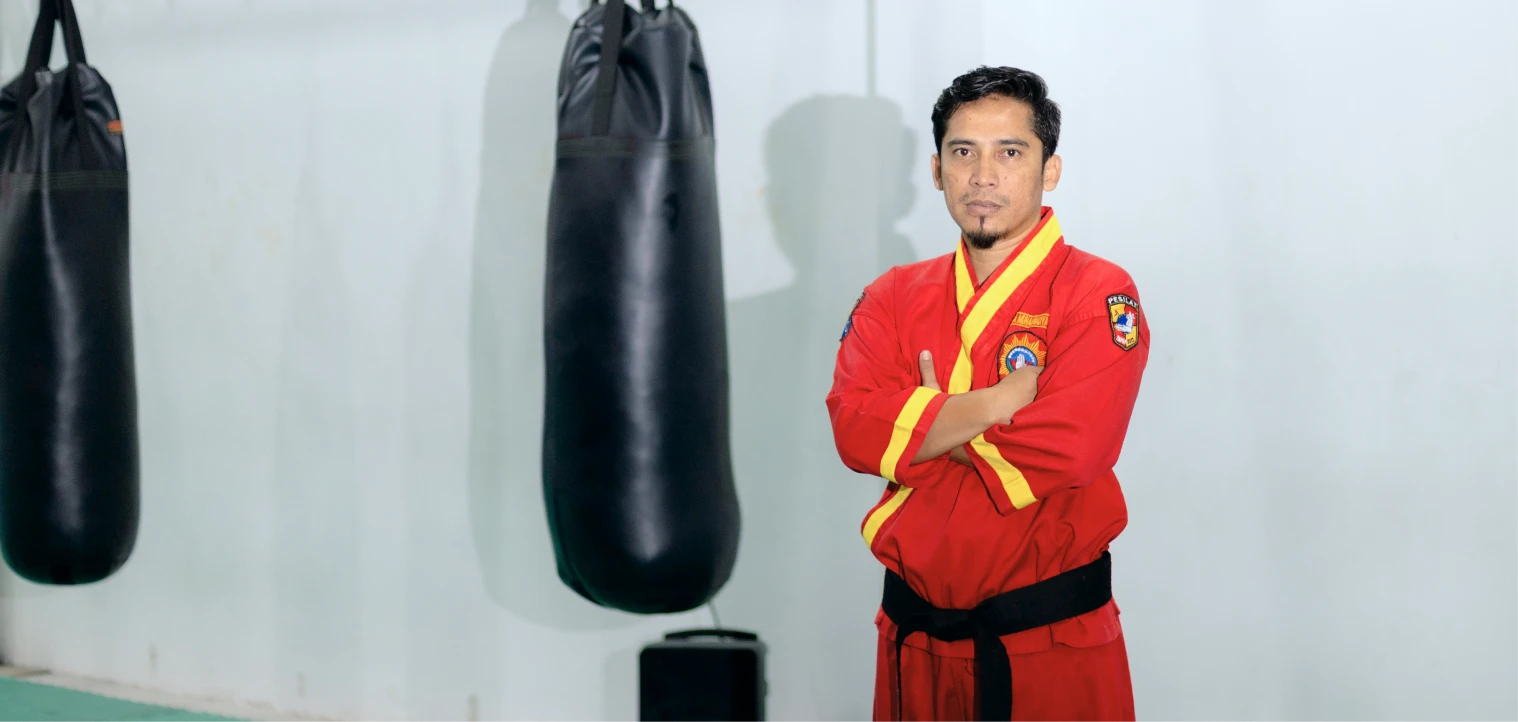
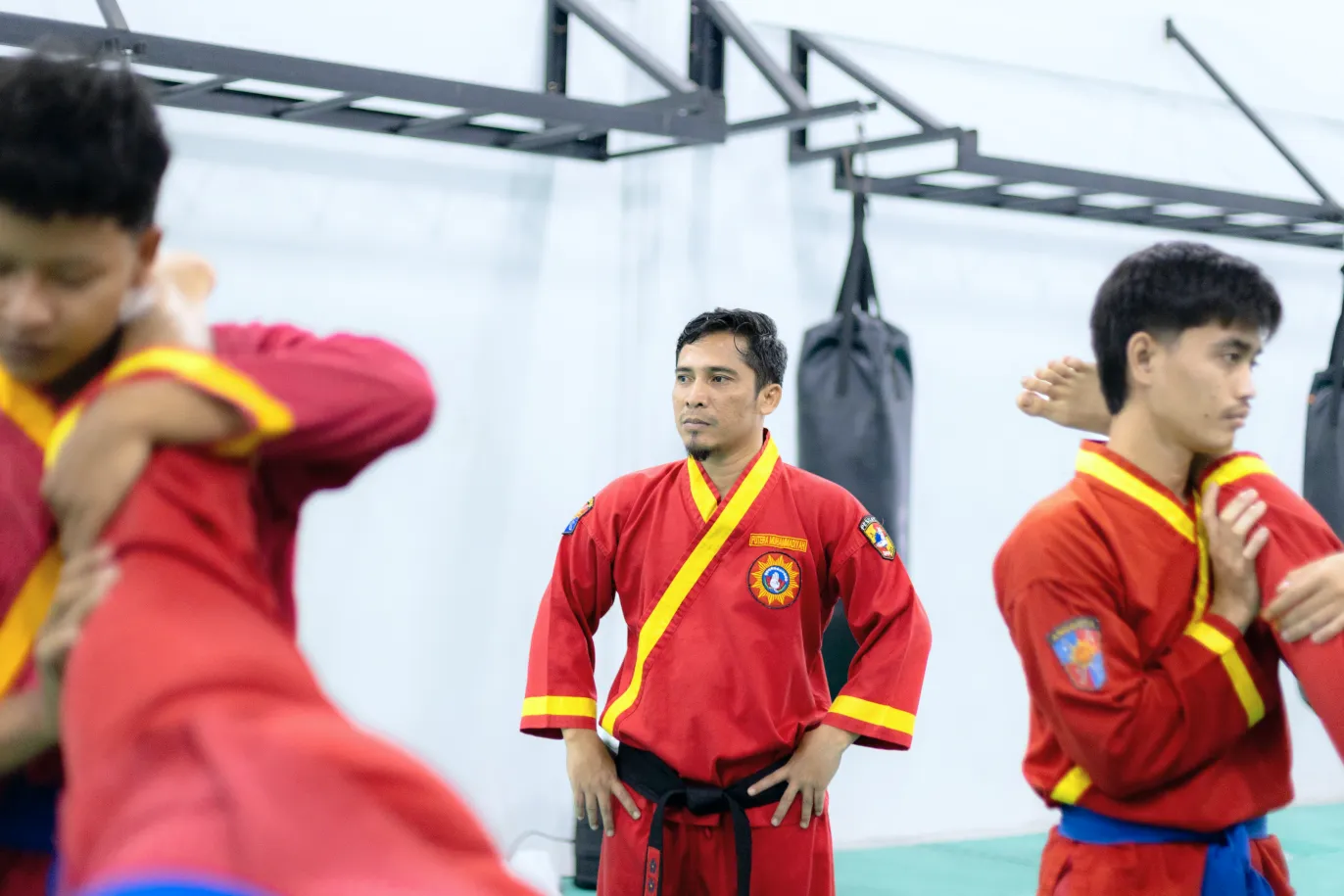
In front of Tapak Suci members at Universitas Muhammadiyah Surakarta (UMS), Nur Subekti guided a regular training session. The session coincided with Hari Bertapak Suci, which is held every Thursday at the UMS Sport and Martial Art Center.
The man, affectionately known as Bekti, shared that in addition to training Tapak Suci members at UMS, he also coaches several pencak silat athletes preparing to compete in national championships. The training process, he explained, uses the high-intensity interval training (HIIT) method.
HIIT is a training method characterized by very high intensity, short rest intervals, and repeated cycles. The UMS Sport Education lecturer has been developing the HIIT method specifically for pencak silat since 2020. This specialized training model was designed to improve the performance of athletes in the sparring category.
At the time, Bekti faced the Covid-19 pandemic, which made training difficult due to mobility restrictions. "It was hard for us to train outside. Access to athletes was also limited, and I was required to prepare them to compete at the national level," Bekti recalled when we visited the Hari Bertapak Suci session at the end of February.
Bekti then redesigned the HIIT method by utilizing athletes' body weight combined with high intensity. He named it Bodyweight Exercise and Technique Intensive (BEX-TI). He also involved several silat practitioners and academics in developing the training model.
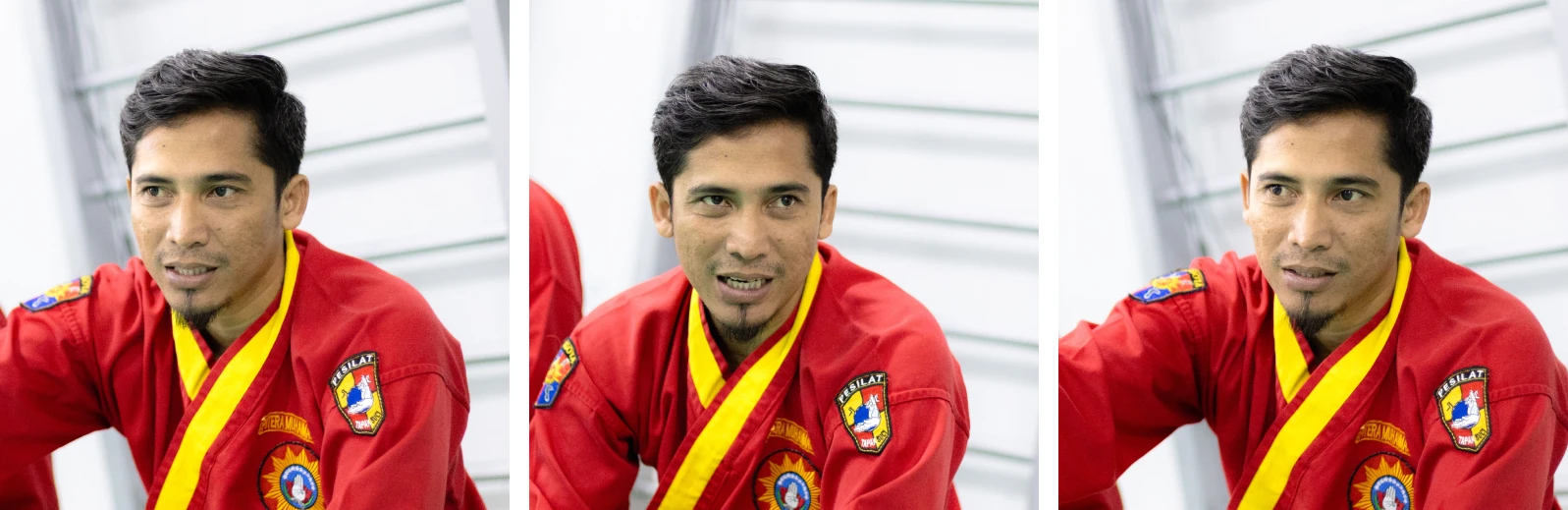
BEX-TI adjusts the ratio between training intensity and rest intervals. In the initial stage, athletes train with lower intensity and longer rest intervals. Over time, the training intensity increases while rest intervals become shorter.
"Sometimes I push that ratio. The intensity is high and rest is short to push the athlete's limits. But the repetitions are relatively few," added the Vice Dean III of the Faculty of Teacher Training and Education at UMS.
Bekti explained that the method was developed based on an analysis of the specific demands of pencak silat matches. He calculated the time required for delivering punches and kicks, the duration of matches, and rest intervals.
He also calculated time that is not officially counted under match regulations. "Normally, the net duration of a match is two minutes. There are moments not counted, even though they matter. When the referee says stop, the clock stops. That means there is remaining time, and that is included in my analysis," Bekti explained.
Bekti first applied the BEX-TI method to train his athletes ahead of Pekan Olahraga Nasional (PON) XX in 2021. The results were promising: two of his athletes, Anas Rais Arni Royhan and Dela Kusumawati, won bronze medals.
This success encouraged Bekti to implement the BEX-TI method again in subsequent competitions. This time, Ginting Baharudin Putra emerged as a champion. He won a gold medal at Pekan Olahraga Mahasiswa Nasional (Pomnas) XVIII 2022, a silver medal at Pekan Olahraga Nasional (PON) XXI 2024, and a gold medal at the ASEAN University Games 2024.
Bekti later proposed BEX-TI as the subject of his dissertation while pursuing his doctoral degree in Sports Science at Universitas Sebelas Maret (UNS). In 2025, he successfully completed his doctoral studies. He also introduced BEX-TI to Malaysia during a visit to the Department of Physical Education and Sports Science at Universiti Teknologi Malaysia.
Read more: UMS Introduces BEX-TI Pencak Silat Training Innovation to Malaysia
Nur Subekti first became acquainted with Tapak Suci when he was a student at State Junior High School 2 Baturetno, Wonogiri, Central Java. His English teacher, who was also the Tapak Suci extracurricular coach, Ari Prasmono, introduced Bekti to Muhammadiyah's martial art.
At the time, Ari saw that Bekti had talent in martial arts. Under Ari's guidance, Bekti quickly progressed and participated in various pencak silat competitions, ranging from inter-school and sub-district levels to district championships.
His perseverance in martial arts continued into high school. Ari specifically introduced Bekti to several prominent Tapak Suci coaches in Solo, Central Java. "Mr. Ari had connections with coaches in Solo," Bekti recalled.
Through those connections, the alumni of SMK Pancasila 3 Baturetno, Wonogiri, won first place in the Central Java Regional Student Championship. This achievement earned him the opportunity to train at the Central Java Student Training Center (PPLP).
Learning from senior athletes at PPLP Central Java motivated Bekti to pursue higher education. "At first, after vocational school, I wanted to work. But after winning the championship and moving to Solo, seeing my seniors there, I eventually decided to continue to university," said the man born in Ogan Komering Ulu Regency, South Sumatra, on October 2, 1987.
His achievements soared further during his studies in Physical Education, Health, and Recreation at Universitas Sebelas Maret. In 2009, Bekti won a gold medal in the Men's Class A category at the National Pencak Silat Circuit. His contribution helped lead the Central Java contingent to become the overall champion.
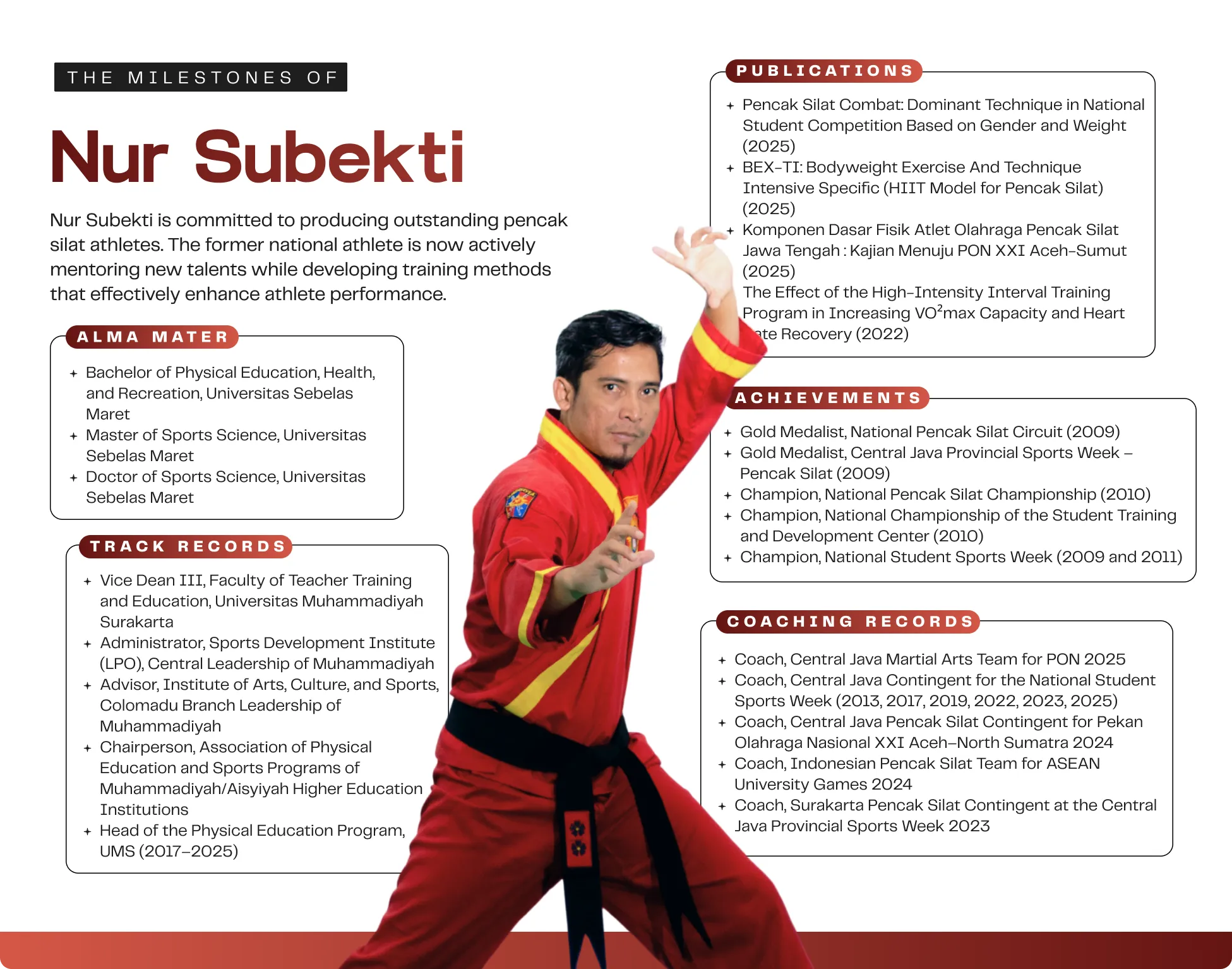
Nur Subekti, a Javanese man born in Sumatra, decided to retire as an athlete in 2012. He made the decision in order to pursue his master's studies in Sports Sciences at Universitas Sebelas Maret (UNS).
However, his dedication to pencak silat did not end there. Bekti began a new career as a pencak silat coach. His goal was massive: to produce the next generation of Central Java athletes.
Initially, Bekti coached high school athletes. A year later, in 2013, he began training university students. "In 2013, I handled the Central Java team for Pomnas (National Student Sports Week)," Bekti said.
His coaching career took a big leap from that point. Bekti went on to train several Central Java pencak silat athletes to compete in multiple editions of the National Sports Week. In 2024, he accompanied the Central Java pencak silat contingent at Pekan Olahraga Nasional (PON) XXI in Aceh–North Sumatra.
Read more: Mahasiswa POR UMS Sabet Medali Emas PON XXI
Bekti's athletes have also won medals at the international level. One of them is Ginting Baharudin Putra, a Physical Education student at Universitas Muhammadiyah Surakarta (UMS), who secured a gold medal at the ASEAN University Games 2024.
The man who now holds the title of pendekar in Tapak Suci is active in several Muhammadiyah autonomous organizations. At the branch level, he once served as Chair of the Arts, Culture, and Sports Institute of the Muhammadiyah Colomadu Branch.
At the central level, Bekti was entrusted as a member of the Achievement Development Division of the Muhammadiyah Central Board's Sports Development Institute for the 2022–2027 term.
Bekti also helped pioneer the establishment of the Physical Education Program at UMS in 2017. He explained that the program was initially intended to support cadre development within Tapak Suci Muhammadiyah. It is therefore unsurprising that he was appointed Head of the Physical Education Program for the 2017–2021 and 2021–2025 terms.
In UMS, Bekti actively trains members of the Tapak Suci student organization. He also frequently conducts intensive training sessions for UMS pencak silat athletes preparing for various championships. "If you train with me, it will be tougher and more disciplined," he joked.
The BEX-TI method he developed is often used to prepare UMS pencak silat athletes ahead of competitions. It has proven effective, as several of his athletes have achieved success at both national and international levels.
He believed that every person has potential that can be honed to achieve excellence. That mission is what he carries as a coach, to maximize the potential of his athletes. For Bekti, his students must surpass their teacher. "If my athletes' achievements are still below mine, then I have failed," he asserted.
Writer: Gede Arga Adrian
Translator: Farizal Luqman Majid
Editor: Al Habiib Josy Asheva
Bank Indonesia has held its benchmark rate at 5.75 percent, ending speculation of a hike to 6 percent that had circulated in recent weeks.
Nothing’s more special than reading curated news just for you.
Subscribe to the UMS Newsletter for free today.