How Sheep Manure Turns into Nutrient Rich Fertilizer
16 July 2026
Sheep dunged nutrient-rich organic fertilizer for plants, made with the help of maggots. Built on community empowerment and a zero-waste principle.



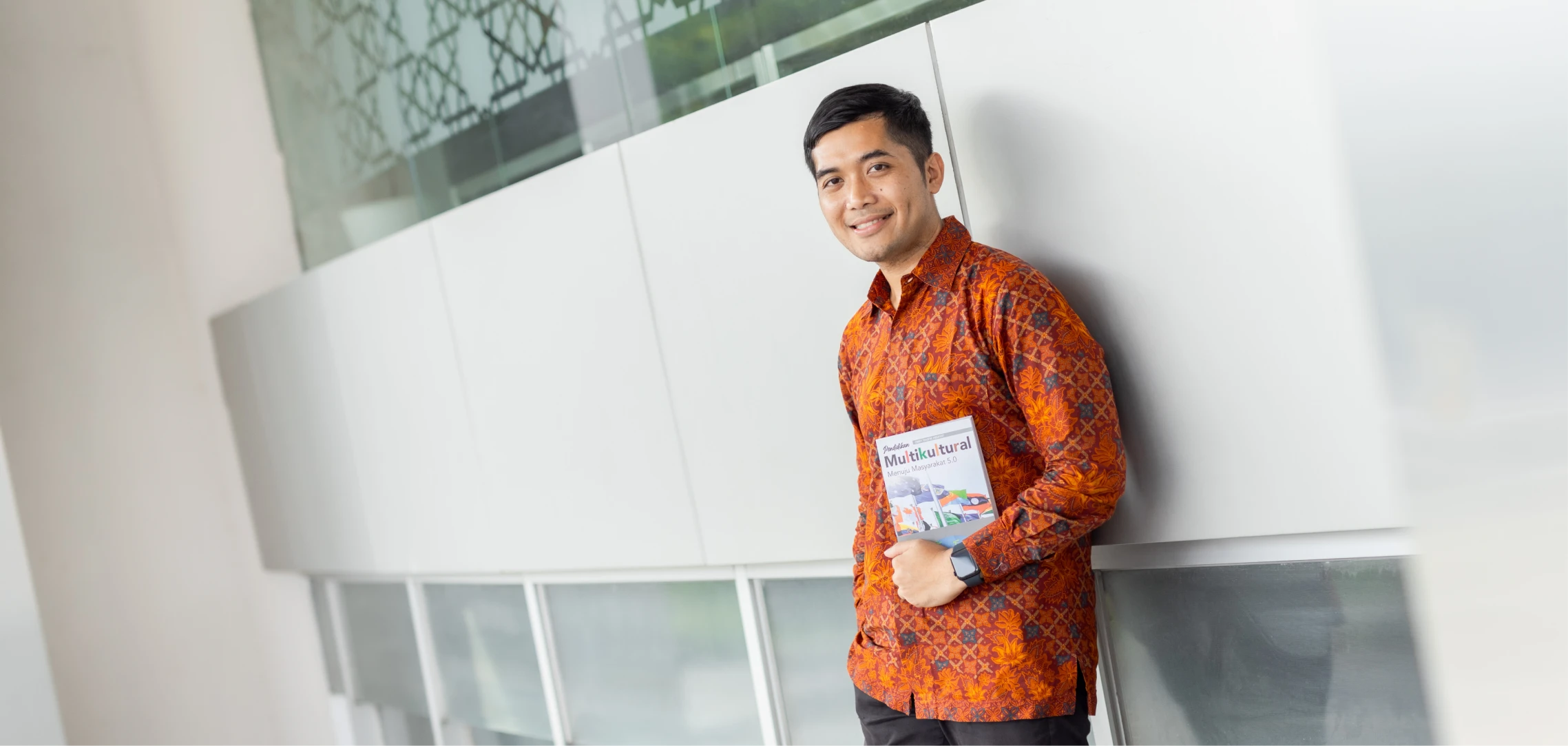
Obby Taufik Hidayat had just finished his business at the Office of Research and Innovation (LRI) of Universitas Muhammadiyah Surakarta (UMS) one afternoon in mid-December. The man, known as Obby, shared that he was about to embark on his latest research. “Yes, I just signed a contract for a research project,” Obby said on Wednesday (11/12/2024).
Indeed, since deciding to pursue a career as a lecturer at UMS five years ago, Obby has developed a keen interest in the field of research. It is no surprise that he actively seeks various funding opportunities for research grants from prestigious international research institutions.
Obby has a particular focus on developing research on service-learning. This is the topic that made him secure funding from several international research institutions. The funding he received for his proposals includes the Sasakawa Young Leader Fellowship Funds (SYLFF) from the Tokyo Fund and the Fundamental Research Grant from Malaysia's Ministry of Education.
Service learning is an experiential pedagogy. This concept empowers students to apply what they learn in class to help solve community problems.
Obby said that service learning might seem similar to volunteer programs and community service. However, service learning focuses more on enhancing students’ understanding of theoretical knowledge through community service experiences and reflecting on those experiences. “What students learn in the classroom is also applied in the community,” Obby explained.
His commitment to developing service learning began with the realization of the importance of learning that goes beyond classroom knowledge and extends to its implementation in society. This way, the knowledge students gain doesn’t go to waste
Obby observed that there are experiential pedagogies in Indonesian universities, such as KKN (community service). Some academics argue that KKN is another name for service learning in Indonesia.
However, after further investigation, he found that the KKN curriculum needed development because many student projects did not focus on enhancing their mastery of the material taught in class. “KKN tends to focus only on community service,” Obby emphasized.
As a course, KKN naturally has credit hours and specific learning outcomes for students. “Conceptually, KKN involves applying theories or concepts learned. But in practice, it doesn't work that way. Most of it is just community service,” he explained.
From his research and experience, Obby assessed that the implementation of many KKN programs did not align with the concept of service learning. For example, mechanical engineering or accounting education students often had routine projects, such as teaching English or conducting Al-Quran studies for children in their KKN location every evening. These activities, he added, were indeed valuable but did not align with the theories they studied during their coursework.
One of his studies, titled "Developing Moral Education Through Service Learning: Indonesia Higher Education Context," identified a gap between expectations and reality in the KKN program. Most students participating in KKN did not fully understand its vision, mission, objectives, activities to be undertaken, or the intended learning outcomes.
In the research, Obby emphasized the importance of empowerment and reflection on students' experiences before, during, and after KKN. This process would equip students with knowledge, skills, and moral values. Students and lecturers carefully planned to identify and analyze community problems before starting the KKN program.
He conducted an experiment with a group of UMS students who were undergoing KKN. He explained the philosophy and pillars of service learning to the group as a foundation for designing their work programs. He also shared his experiences in implementing service learning in Malaysia.
The results showed that KKN groups integrated with the philosophy and aspects of service learning demonstrated better understanding of theory, soft skills, and moral values compared to groups that conducted KKN in the usual way.
Groups following the service learning philosophy received intensive empowerment and were actively involved in identifying community problems and needs. Furthermore, they were encouraged to reflect on all their experiences in the community by relating them to the theories they learned in class.
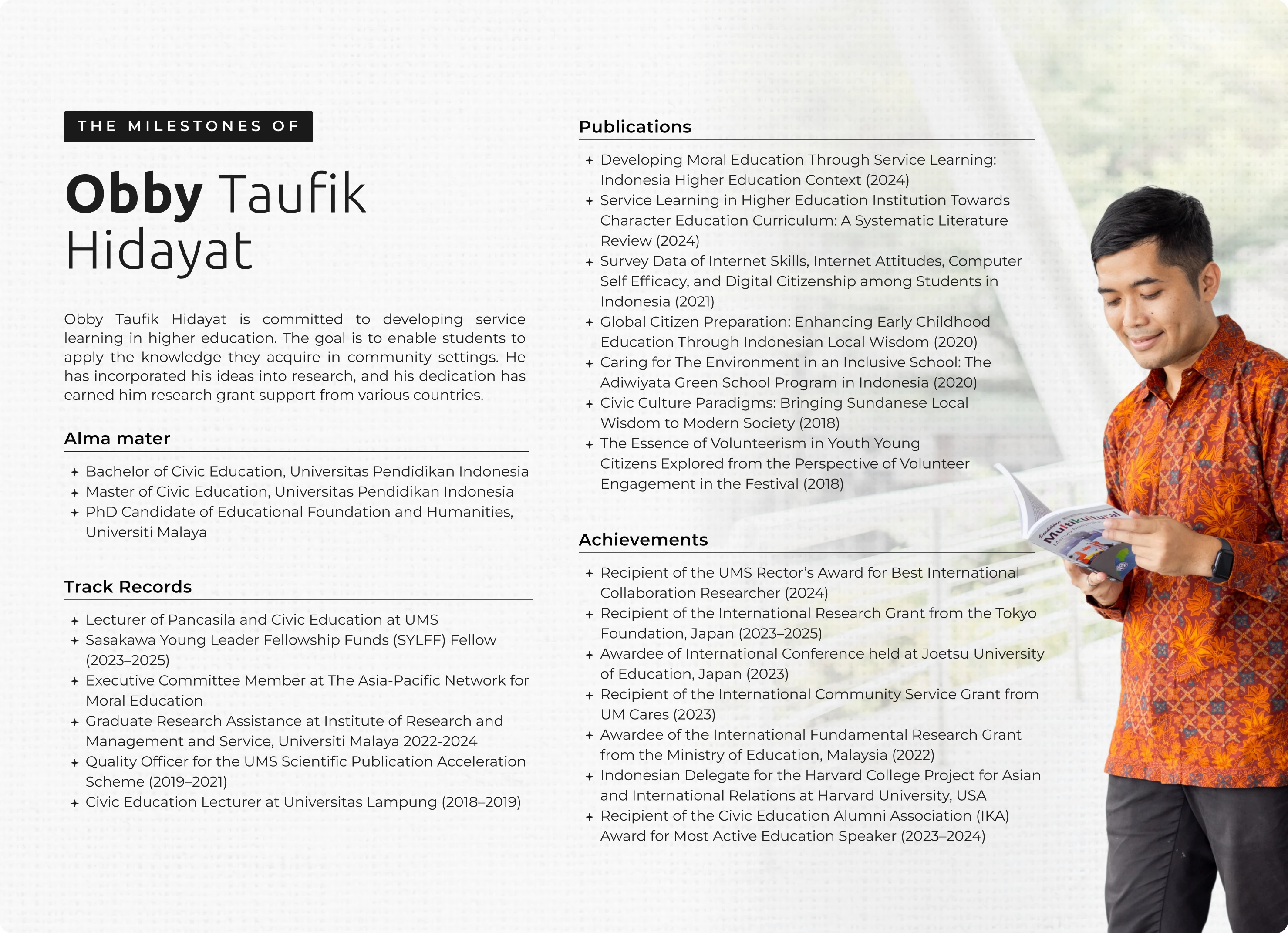
Born in Bandung 34 years ago, Obby Taufik Hidayat has been passionate about the subject of Civics Education (PKn) since his high school days. No surprise that his grades in this subject were the highest among all others.
“I started to enjoy learning about how to be a good citizen, character, morals, the roles and responsibilities of the state and its citizens, democracy, and so on,” he explained. “It’s definitely a passion of mine.”
After graduating from high school, Obby pursued his studies in Civics Education at Universitas Pendidikan Indonesia (UPI), completing his bachelor's degree in 2009 and his master's degree in 2015.
Three years after graduating, Obby began his career as a lecturer at Universitas Lampung. After teaching there for a year, he decided to move to Java in 2019.
Working as a Civic Education lecturer at Universitas Muhammadiyah Surakarta (UMS) has fueled Obby's thirst for knowledge. This drove him to pursue his doctoral studies. Two years after beginning his career as a lecturer at UMS, he continued his education at the Educational Foundation and Humanities Department, Faculty of Education, Universiti Malaya, Malaysia. This opportunity brought immense joy to Obby, as he successfully secured a scholarship from UMS to support his doctoral studies.
Universiti Malaya is ranked as the third-best university in Southeast Asia and 12th in Asia according to the QS World University Rankings 2025. Studying at Malaysia’s top university has opened various golden opportunities for Obby, including securing research grants from international research institutions.
In 2023, Obby successfully obtained the prestigious Sasakawa Young Leader Fellowship Funds (SYLFF) to support his dissertation research. This grant was provided by the Tokyo Foundation, a Japanese research institution focused on policy studies for societal development.
“Coincidentally, one of the requirements was being under 35 years old. When I applied, I was still 33,” joked the Ph.D. candidate from Universiti Malaya.
In addition to SYLFF, Obby also secured two other grants: an international community service grant from UM Cares, the SYLFF Research Grant from the Tokyo Foundation, and an international research grant under the Fundamental Research Grant scheme from the Malaysian Ministry of Education.
Beyond research funding, Obby had the opportunity to participate in several prestigious international conferences. These included the 17th Annual Conference of the Asia-Pacific Network for Moral Education at Joetsu University, Japan, and the Harvard College Project for Asian and International Relations at Harvard University, USA.
Obby’s persistence and dedication as a researcher resulted in numerous accolades. He was honored as the most active alumnus serving as an educational resource speaker during 2023-2024 by the Ikatan Alumni PKn (IKA) Awards initiated by IKA UPI. Another prestigious award was bestowed by the Rector of UMS, naming Obby the best international collaboration researcher of 2024.
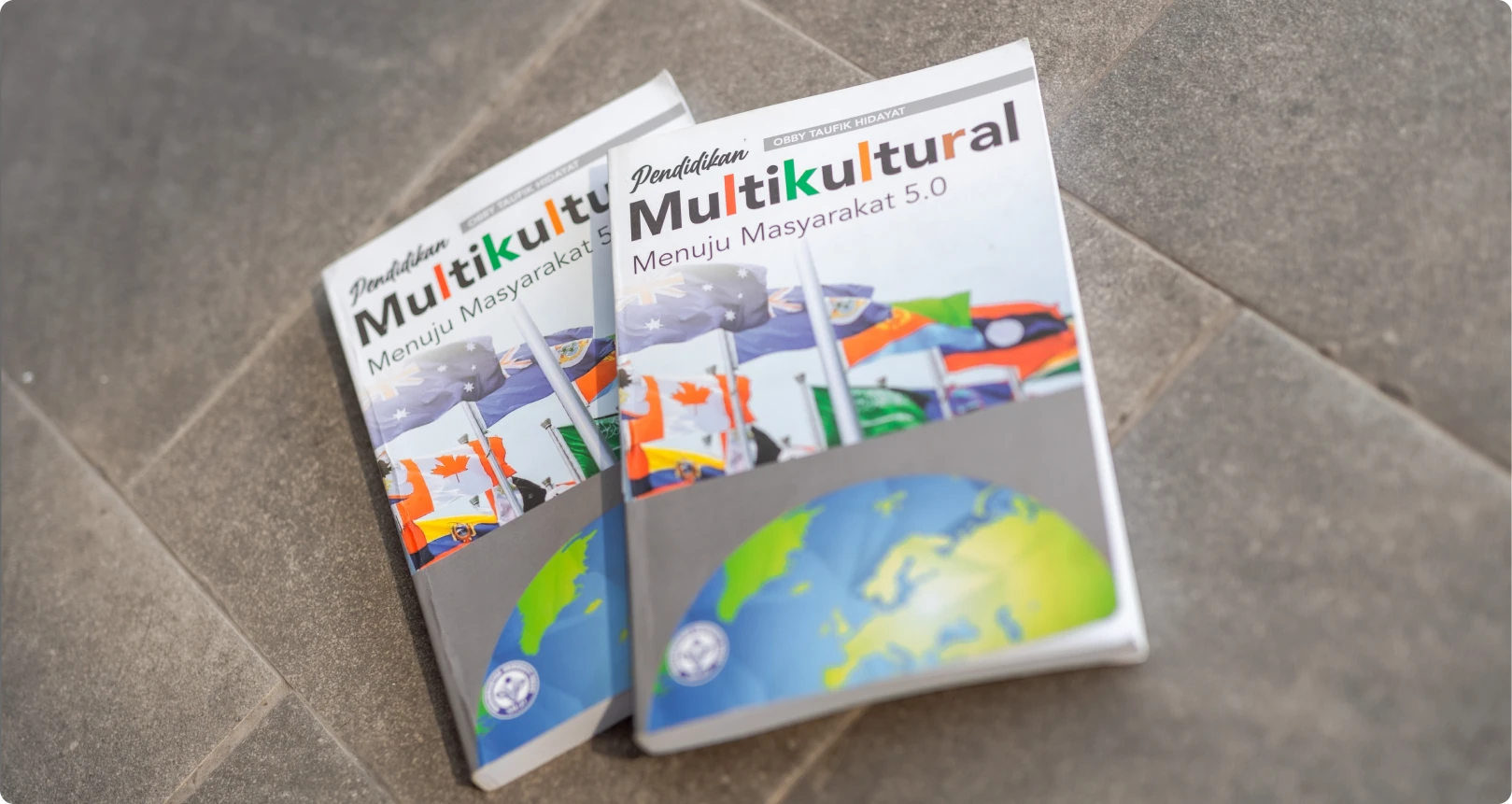
One of the books Obby that wrote. Imam Safii/UMS Public Relations
Obby acknowledged that service learning is a relatively new term in Indonesia. However, some academics or researchers in their publications consider KKN as the Indonesian context of service learning. According to Obby, though, KKN does not sufficiently meet the fundamental aspects of service learning.
There are several fundamental elements and pillars of service learning that are not adequately addressed in KKN. For instance, the practical work programs in KKN often differ from what students learn in their college courses. Furthermore, student empowerment is suboptimal before, during, and after KKN. Another crucial pillar, reflection on experiences, is also lacking in KKN practices.
In contrast, service learning is designed as an informative pedagogy to facilitate students in conducting structured service activities to meet community needs. Students reflect on their service activities and experiences to achieve predetermined learning outcomes.
“Students gain a deeper understanding of course content, a broader appreciation of their discipline, and enhanced personal values and civic responsibility,” said Obby.
Obby hoped that through his research, he can contribute to improving the KKN pedagogy both theoretically and practically to align with the philosophy of service learning, especially if KKN is to be considered as service learning in Indonesia. The biggest challenge lies in reforming the conventions that have been established since KKN's inception.
“I firmly believe that service learning brings students, educators, and communities together globally to serve, learn, and build a sustainable world for everyone to live in,” he concluded.
Writer: Gede Arga Adrian
Translator: Farizal Luqman Majid
Editor: Al Habiib Josy Asheva
Sheep dunged nutrient-rich organic fertilizer for plants, made with the help of maggots. Built on community empowerment and a zero-waste principle.
Nothing’s more special than reading curated news just for you.
Subscribe to the UMS Newsletter for free today.