
How Sheep Manure Turns into Nutrient Rich Fertilizer
16 July 2026
Sheep dunged nutrient-rich organic fertilizer for plants, made with the help of maggots. Built on community empowerment and a zero-waste principle.



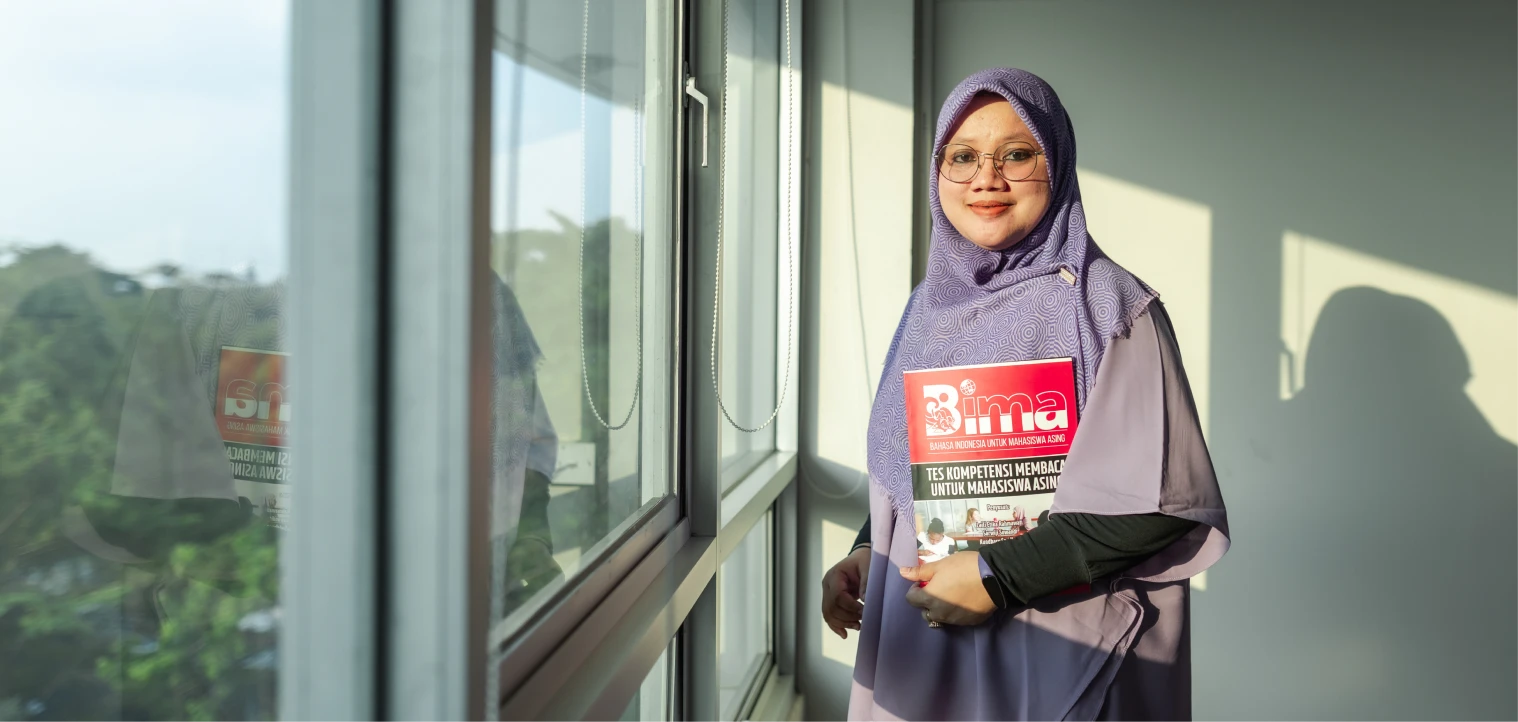
Stacks of books surround Laili Etika Rahmawati’s desk at the Learning Innovation Office (BIP) in the Siti Walidah Main Building, Universitas Muhammadiyah Surakarta (UMS). On the corner of her desk, a computer monitor is decorated with sticky notes listing important notes for her tasks. After teaching, it has become Laili’s routine to return to her desk to tackle these remaining responsibilities.
Laili is a cheerful storyteller, her bright smile evident as she greets us. She has been teaching Indonesian for Foreign Speakers (BIPA) at UMS since 2012, two years after becoming a lecturer in the Indonesian Language and Literature Education program.
Her first class consisted of four students from Romania, Slovakia, Jordan, and Thailand. Laili was assisted by two interpreters, one for Arabic and one for English. However, she recognized that interpreters hindered the primary goal of BIPA: immersing students in Indonesian language.
“If we adjust the language of instruction to their native languages, students won’t learn Indonesian language but rather about language in general,” Laili explained in her office on Wednesday, July 24, 2024.
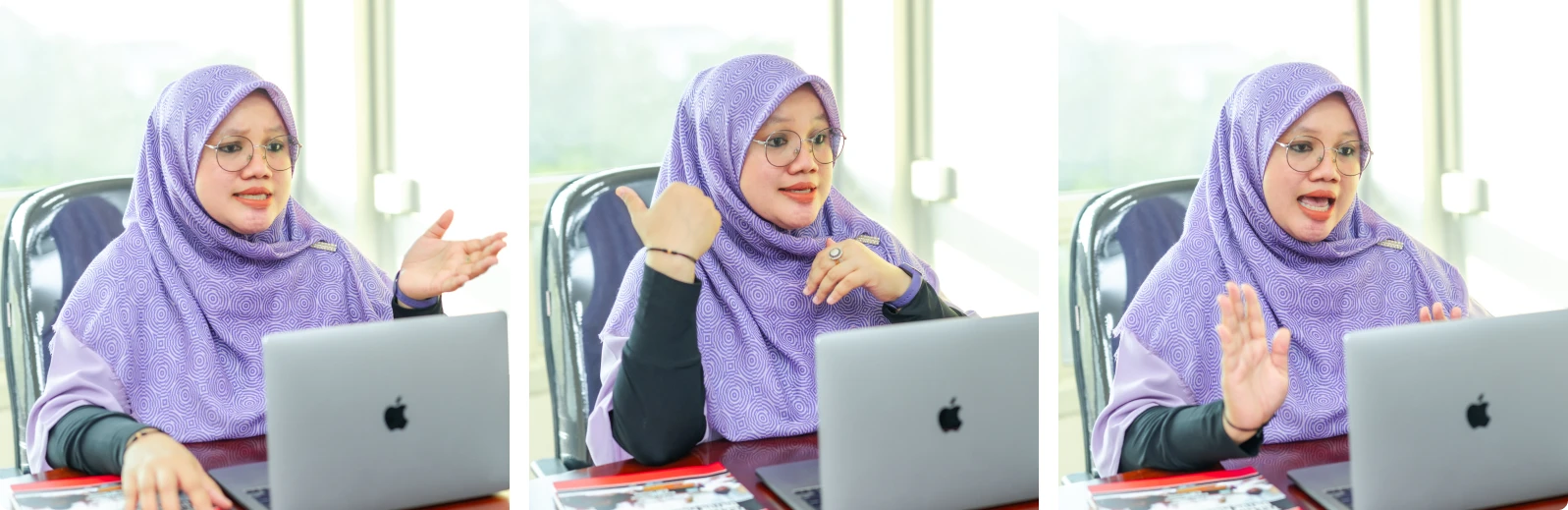
Dr. Laili Etika Rahmawati, S.Pd., M.Pd. Imam Safii/Public Relation
The following year, interpreters were removed from the BIPA class at UMS. Laili began teaching BIPA entirely in Indonesian, occasionally using sign language and English to aid understanding.
Laili often encounters international students who have never studied Indonesian language and lack English fluency. This forces her to be creative, using symbols and translator applications to bridge the language gap.
There are two main challenges she faces: First, there are numerous speech varieties in Indonesian. Laili believes international students must understand these varieties to navigate life in Indonesia during their early months.
Second is the difference in greeting culture. Indonesians use various forms of address like Bapak, Ibu, Kakak, Mas, and Mbak. In contrast, many foreign languages prefer using names no matter whom they are talking to. From the beginning, Laili emphasizes the importance of understanding and using respectful forms of address in the BIPA class to help international students adapt. “I stress the importance of politeness to foreign students,” she said.
Her passion for teaching BIPA led Laili to develop an Indonesian language testing instrument, compiled in the book BIMA (Bahasa Indonesia untuk Mahasiswa Asing): Tes Kompetensi Membaca untuk Mahasiswa Asing in 2019. The book is based on her dissertation research, which she began in 2014.
BIMA is designed to assess the writing skills of international students. Laili claimed inspiration from the International English Language Testing System (IELTS) model. Her analysis shows that reading is the fundamental skill international students must master when learning Indonesian.
“BIMA is variative. Some tests are in the form of writing, multiple choice, true or false and yes or no,” explained the Head of the Curriculum Development and Learning Innovation Division at BIP, UMS.
The five-year preparation of the BIMA instrument adheres to the BIPA graduate competency standards outlined in the Regulation of the Minister of Education and Culture of the Republic of Indonesia Number 27 of 2017.
“In BIMA, there are seven levels. I extracted the reading criteria from the seven criteria in BIPA,” she added. In 2019, Laili secured Intellectual Property Rights for her book.
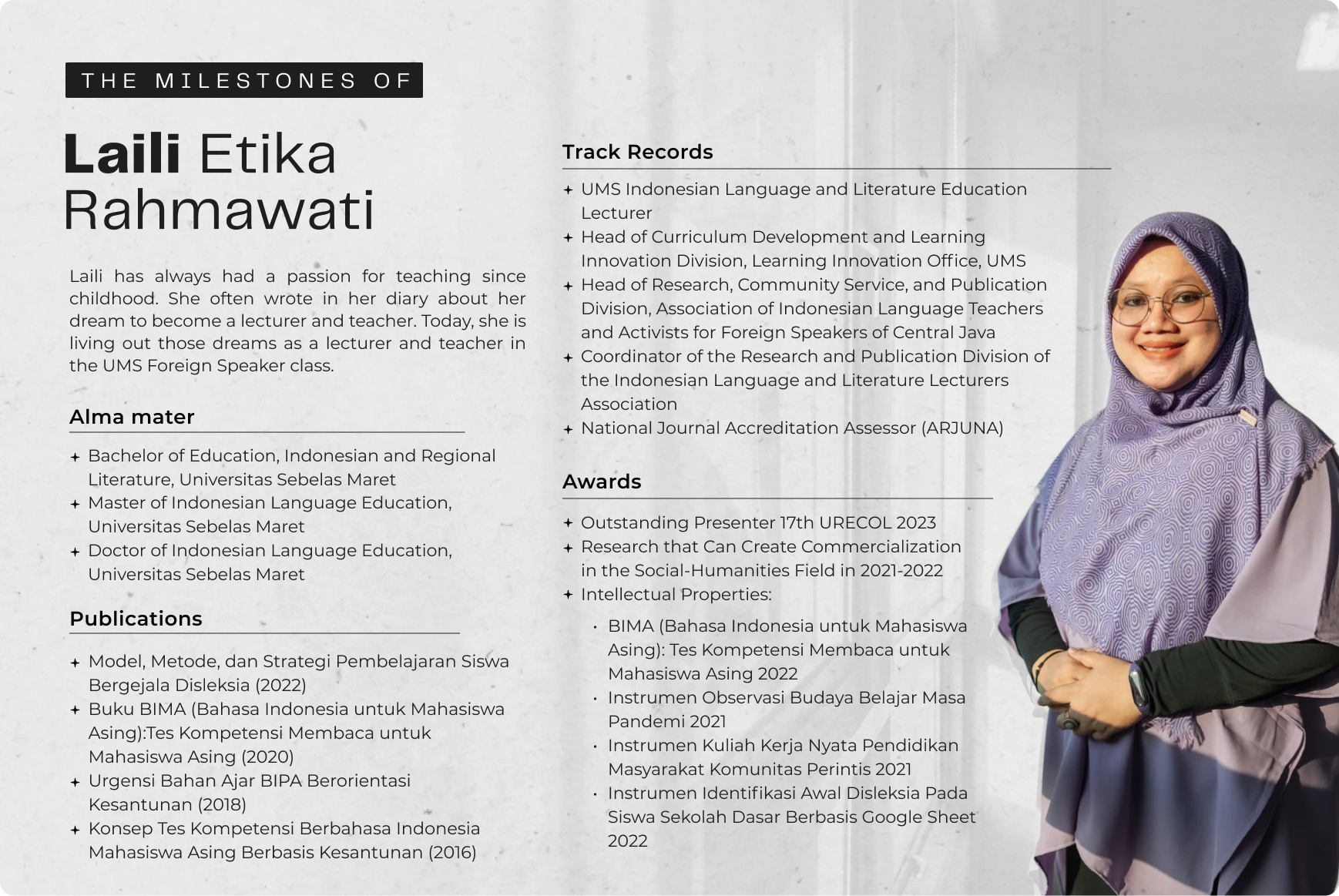
Born in Sragen, Central Java, on March 22, 1986, Laili has loved writing since childhood. She fondly recalled that in the second grade at State Elementary School 3 Gemolong, Sragen, she wrote in her diary about aspiring to be a lecturer. “My parents encouraged me to become a doctor, but I felt I couldn't do it, and I wanted to be a lecturer because I really enjoyed teaching,” she said.
Besides writing, the second of three children enjoys public speaking. In the third grade, Laili was often asked by her teacher to explain material in front of the class. She felt no fear, only motivation to share knowledge with her friends.
“When you write a lot, whatever you do, you write it down; whatever you read, you write it down; then you will become a writer,” Laili explained, repeating her teacher’s words.
A fan of Tere Liye’s novels, Laili actively participated in Indonesian language competitions, such as quiz competitions, poetry reading contests, and drama performances. It’s no surprise that she once won Best Actress in Sragen while attending State Senior High School 1 Gemolong.
These passions led Laili to pursue undergraduate studies in the Indonesian and Regional Literature Education Program (now Indonesian Language and Literature Education Program) at Sebelas Maret University (UNS) in 2004. Her motivation was simple: Indonesian Language is the subject with the most learning time at school.
“My father is an Indonesian language teacher, and he always told me that Indonesian Language Education is an easy subject with many classes. The curriculum is also something we can’t possibly get rid of,” Laili joked.
After graduating in 2008, Laili continued her Master’s in Indonesian Language Education at UNS, graduating in 2010. That same year, she became a lecturer at UMS and has been active ever since. Throughout 2014 to 2019, Laili pursued a Doctorate in Indonesian Language Education in UNS.
She is also committed to learning innovation, evident from her research, such as “Learning Innovation during the Pandemic: Teacher Creativity in Developing Learning Tools” in 2021. Given her dedication, it’s no surprise that Laili is trusted to serve as the Head of the Curriculum Development and Learning Innovation Division at BIP until 2025.
Laili isn’t just active on campus. She's also involved in various institutions and organizations, including:
Laili also holds several leadership positions including: General Treasurer of IKAPROBSI, Chairperson of the Research, Community Service, and Publication Division (2024-2029) of the ADOBSI and APPBIPA Central Java, and lastly secretary of PUSPRESMA PTMA

BIMA (Bahasa Indonesia for Foreign Students) Book: Reading Competency Test for Foreign Students. Imam Safii/Public Relations
Laili’s passion for writing extends beyond the campus. She actively produces numerous articles and books. Since 2010, she has consistently submitted manuscripts to mass media outlets, including the “Bahasa Kita” section in Solopos and the Edukasia section in Suara Merdeka.
Laili aims to share insights about language through her writings. For instance, in an article titled The Meaning of the Words Acute and Chronic, published in Solopos on Thursday, February 2, 2012, she explained the difference between the two terms in terms of duration. “Acute is sudden, while chronic is experienced over a long period of time,” she elaborated.
In addition to articles, Laili has authored several books, including Metode, dan Strategi Pembelajaran Siswa Bergejala Disleksia (2022), supported by a grant from the Indonesia Endowment Fund for Education; Keterampilan Berbahasa (2023); and most recently, Plesiran di Jawa Tengah (2024), coordinated by the Central Java Language Center.
Laili believed that mastering language is crucial because proper language not only cultivates thoughtful behavior but also serves as the conduit of knowledge. One way to achieve this is by promoting literacy in schools through Sastra Masuk Kurikulum (Literature in Curriculum), initiated by the Ministry of Education, Culture, Research, and Technology.
Quoting the Indonesian Book Information System, the Sastra Masuk Kurikulum program integrates literary works into the Merdeka Curriculum. The aim is to increase reading interest, foster empathy, and hone students’ creativity and critical thinking. Laili welcomed this initiative with one specific requirement: a thorough selection of reading materials. “Books must be able to build the reader's character,” she said.
The 38-year-old woman places special emphasis on politeness literacy for international students. She believes it’s essential for them to understand and adhere to societal norms of politeness. “Politeness is not only reflected in the way foreign students communicate but also in how they dress and conduct themselves,” Laili explained.
Laili’s ideas on politeness literacy are explored in various writings. These include the 2016 research paper Pengembangan Bahan Ajar BIPA Berorientasi Kesantunan, the same year’s paper on the Konsep Tes Kompetensi Berbahasa Indonesia Mahasiswa Asing Berbasis Kesantunant, a 2018 paper titled Urgensi Bahan Ajar BIPA Berorientasi Kesantunan, and an article called Pembelajaran BIPA Berorientasi Kesantunan published in Suara Merdeka on June 26, 2018.
Her deep-rooted motivation to contribute to education continues to drive her. Laili is deeply committed to her ideals and consistently strives to achieve them. “Indonesian language is my passion,” she said. There are anecdotes about what Laili said, “Language experts care so much they fuss over semicolons. Imagine how much more attention you’ll get,”
Writer: Gede Arga Adrian
Editor: Al Habiib Josy Asheva
Translator: Farizal Luqman Majid
Designer: Salsabila Kamila Wardah
Sheep dunged nutrient-rich organic fertilizer for plants, made with the help of maggots. Built on community empowerment and a zero-waste principle.
Nothing’s more special than reading curated news just for you.
Subscribe to the UMS Newsletter for free today.