How Sheep Manure Turns into Nutrient Rich Fertilizer
16 July 2026
Sheep dunged nutrient-rich organic fertilizer for plants, made with the help of maggots. Built on community empowerment and a zero-waste principle.



Universitas Muhammadiyah Surakarta (UMS) continually enhances the quality of healthcare education in Indonesia. One of its proudest educational facilities is the Mini Hospital of the Nursing Program, which has been operational since 2016. The Mini Hospital is designed as a simulation-based laboratory to prepare UMS Nursing students to face clinical challenges with proficient skills.
The head of the UMS Nursing Program Laboratory, Wachidah Yuniartika, S.Kep., Ns., M.Kep., Sp.Kep.K., explained that the Mini Hospital was established to address the need for practical learning facilities capable of reflecting real hospital conditions.

UMS Nursing students are practicing in the Community Room, Mini Hospital. Imam Safi'i/UMS Public Relations
“This Mini Hospital is not just a learning facility but a laboratory for nursing students to understand and master the complex clinical situations of a hospital,” Wachidah said on Tuesday afternoon (17/12/2024).
The healthcare field continues to evolve with advancements in technology and increasing complexity in patient cases. This situation demands that healthcare professionals, especially nurses, possess not only theoretical knowledge but also practical skills. “Practical skills are crucial for a nurse. Thus, the Mini Hospital was created to bridge the gap between theory and practice,” she added.
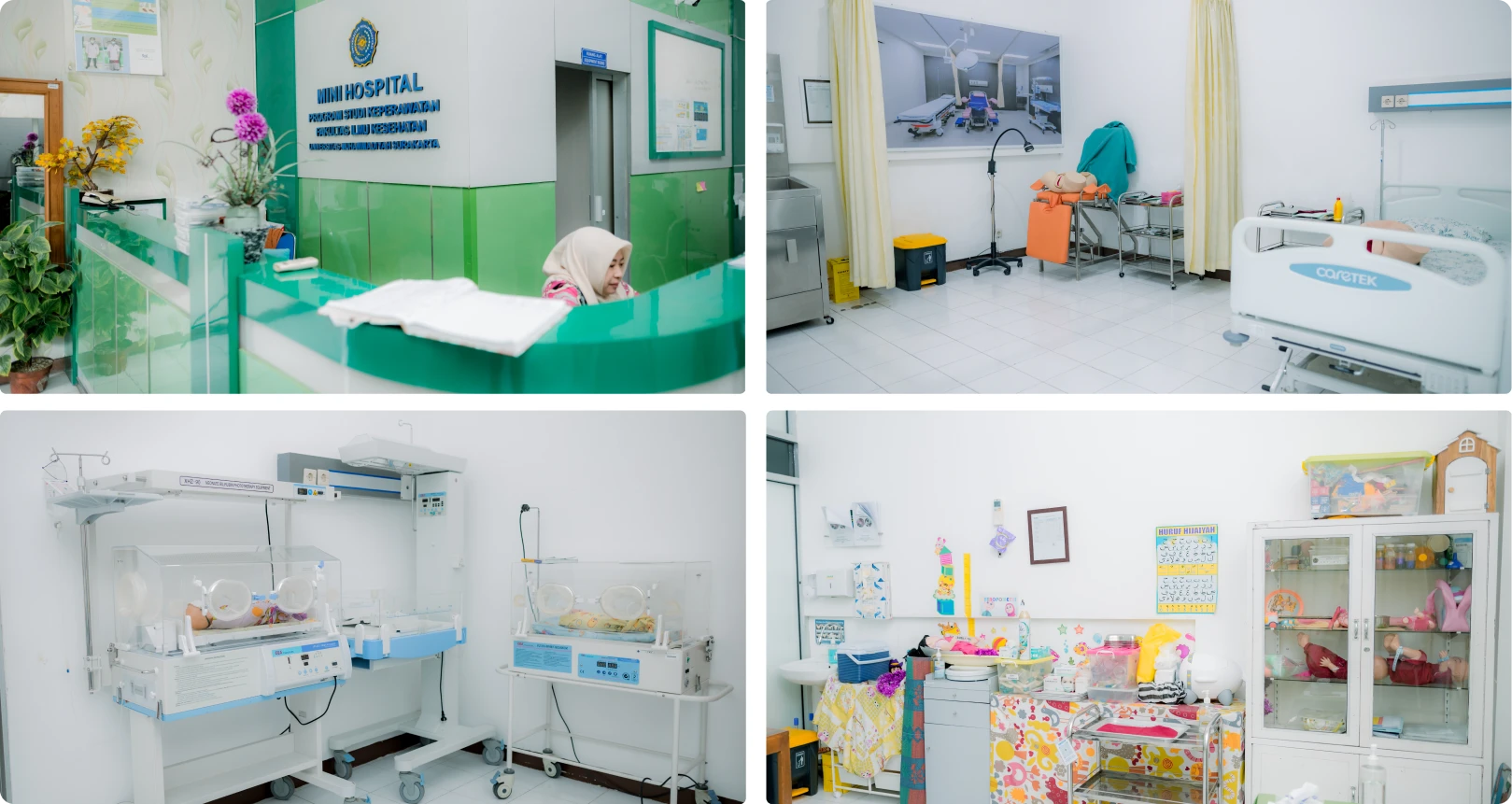
Several facilities in the Mini Hospital. Imam Safi'i/UMS Public Relations
The Mini Hospital at UMS offers various rooms specifically designed to meet diverse clinical simulation needs. Each room serves a unique purpose, including:
Nurse Station Room
A workspace for laboratory staff and an administrative center for all activities related to the laboratory, such as borrowing and returning equipment.
Medical Room
A space used for practicing medical-surgical nursing skills, including procedures such as ECG (electrocardiogram) application, catheter insertion and care, oxygen administration, and more.
Surgery Room
Students can use this room for practicing medical-surgical nursing skills, such as burn care, cast and traction care, colostomy care, and more.
Pediatric Room
A simulation area for pediatric patient care, emphasizing a holistic and child-friendly approach.
Community Room
A room designed for simulating community-based healthcare services, such as health counseling and home care. The room is equipped with counseling tables and chairs, educational posters, patient beds, walking aids for the elderly (crutches), sinks, and other tools.
Maternity Room
Students can practice maternity nursing skills, including intranatal care such as handling pregnancy cases, labor processes, and obstetric emergencies.
Mental Health Room
A room where students learn to simulate care for patients with mental health issues, including skills in therapeutic communication, restraints, group activity therapy, and more.
Critical Care Room
A room dedicated to practicing critical nursing care. Students can hone their skills in Endotracheal Tube (ETT) insertion, infusion and syringe pump setup, patient monitoring sheet completion, and more.
Triage Room
This room is used for learning triage, the process of determining patient priority based on the urgency of their condition. Students are trained to respond quickly and provide appropriate and timely care according to triage categories.
Palliative Care Room
Here, students can learn palliative care, a nursing approach aimed at improving the quality of life for patients and their families. The palliative care room is equipped with adequate facilities, including complementary therapy tools to help reduce pain in terminal patients.
Herbal Nursing Laboratory
A garden featuring various medicinal plants used for treatment purposes, such as ginger, turmeric, moringa leaves, and cat’s whiskers leaves.
With continuously evolving facilities, UMS hopes that the presence of the Mini Hospital will strengthen practice-based learning systems. “We certainly aim to ensure that our graduates become professional, competent, and integrity-driven nurses,” concluded Wachidah.
Writer: Genis Dwi Gustati
Translator: Farizal Luqman Majid
Editor: Al Habiib Josy Asheva
Sheep dunged nutrient-rich organic fertilizer for plants, made with the help of maggots. Built on community empowerment and a zero-waste principle.
Nothing’s more special than reading curated news just for you.
Subscribe to the UMS Newsletter for free today.