

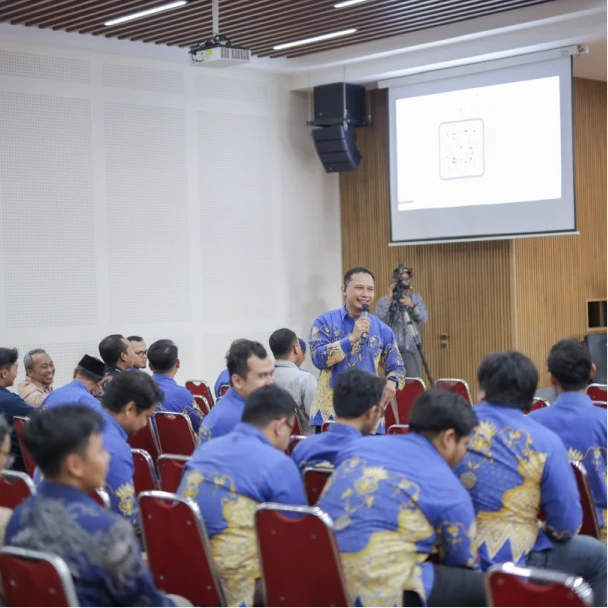
UMS Prepares to Launch Day Care Service to Support Staff Well-Being
4 August 2026
UMS Day Care and a number of other services are set to be introduced by UMS DSDMO to support staff well-being.




Celebrating iftar together (bukber) is a highly anticipated activity for Muslims in Indonesia, including students. Bukber strengthens friendships and serves as a reunion event for school friends. Fauzan Hidayat (21), a Universitas Muhammadiyah Surakarta (UMS) student, often participates in such activities.
“It happens very often. Almost every year, there is an invitation for bukber,” said Fauzan on Monday (3/25/2024). These invitations come from school friends, college friends and organization friends. Fauzan participates in these activities because bukber provides a moment to gather and share stories with his friends.
In the excitement of bukber, people often forget to perform Maghrib prayer. Although Fauzan does not miss it himself, he often notices others doing so. Fauzan prefers to pray in between bukber activities.
“Alhamdulillah, so far, I have never missed Maghrib prayer. But sometimes my salah is delayed because we get too busy chatting, and sometimes the prayer space is limited, so we have to wait in line to pray,” the student added.
The volume of people skipping Maghrib prayer due to bukber worries Dr. Mujazin, S.Pd, M.A. Contacted by phone on Friday (3/22/2024), the Head of the UMS Center for Da’wah and Education Studies suspects that there is a euphoric factor causing people to fail to fulfill their obligation to the Creator.
“I see there is a factor of euphoria. I suspect that this excitement is affecting their spirituality. What is apparent is the thrill of takjil and breaking the fast together rather than finding joy in worship,” Mujazin noted.
Mujazin emphasized that Ramadan is a month of joy. Allah blesses His people with the delight of breaking the fast and the satisfaction of worship. Bukber should serve not only as a means of worldly enjoyment during iftar but also as a means of spiritual contentment during Maghrib prayer.
Fasting and salah are deeply intertwined because of their profound relationship. However, it is unfortunate that many people fast but neglect salah. Mujazin suggests that one of the factors contributing to this phenomenon is habit.
“I see this as a factor that continues from before Ramadan. The neglect of maghrib prayer may come from not considering it important, seeing it as a burdensome routine, or not seeing its benefits,” he said.
Mujazin said that if a Muslim fasts but neglects salah, he will only experience hunger and thirst. He explained that the goodness of fasting would be diminished by the sin of neglecting salah.
“Fasting has an effect on salah, and salah has an effect on fasting. This is how it should be. You cannot give up either salah or fasting,” added the Head of the UMS Center for Da'wah and Education.
Mujazin emphasized that students should not forget Maghrib prayer. He shared some tips students can follow to ensure they can still do Maghrib prayer and enjoy the joy of celebrating iftar together.
First, calculate the time for iftar and the time for Maghrib prayer. This is critical because not all iftar venues are located near a mosque. Also, you may have to take turns because of the crowd.
Second, choose a bukber venue that provides prayer facilities, such as a musalla or a venue close to a mosque. The presence of prayer facilities at bukber location will make it easier for participants to do Maghrib prayer.
Third, prioritize salah. Mujazin urged all of us to prioritize salah during the month of Ramadan. This is because salah is the essence of being Muslims and must take precedence over bukber.
As we enter the last ten days of Ramadan, it is expected that invitations to bukber will become more frequent, especially as Eid approaches. Undoubtedly, bukber will be a gathering place to meet and share stories. As a reminder, Muslims should prioritize the Maghrib prayer despite the euphoria of bukber.
Mujazin hopes that students who wish to attend iftar together can maintain a balance between worship and friendship. Performing Maghrib prayer together after bukber is a human effort to maintain good relations with the Creator and fellow human beings.
“We must instill the idea that fasting and salah are mandated while bukber is not. Therefore, worship must be given priority to ensure its true adherence,” Mujazin concluded.
Writer: Gede Arga Adrian
Editor: Al Habiib Josy Asheva
Translator: Farizal Luqman Majid
UMS Day Care and a number of other services are set to be introduced by UMS DSDMO to support staff well-being.
Nothing’s more special than reading curated news just for you.
Subscribe to the UMS Newsletter for free today.