


How Sheep Manure Turns into Nutrient Rich Fertilizer
16 July 2026
Sheep dunged nutrient-rich organic fertilizer for plants, made with the help of maggots. Built on community empowerment and a zero-waste principle.




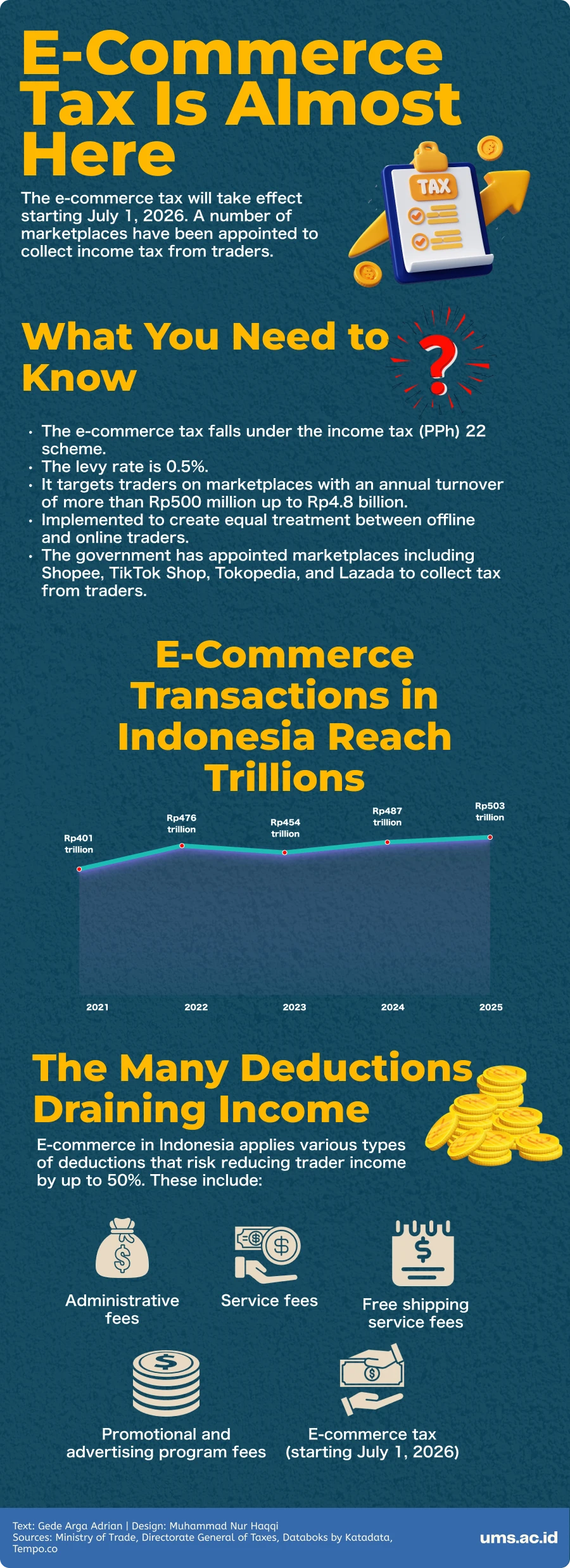
The e-commerce tax in marketplace platforms will take effect starting July 1, 2026. This e-commerce tax policy is part of the income tax (PPh) regulations that have previously been in force.
Director of Outreach, Services, and Public Relations at the Directorate General of Taxes, Rosmauli, explained that the e-commerce tax is not a new tax. What it does is shift the tax reporting system to an automatic collection mechanism carried out by the marketplace.
"This policy does not change the basic principles of income tax, but rather makes it easier for traders to fulfill their tax obligations," Rosmauli said as quoted by Antara on Friday (26/6/2026).
The e-commerce tax was initially proposed by Finance Minister Sri Mulyani Indrawati on June 11, 2025. The regulation was then enacted as Minister of Finance Regulation (PMK) Number 37 of 2025 and was originally planned to take effect in July 2025. Through the regulation, the government assigned e-commerce platforms such as Shopee and Tokopedia to collect taxes from online traders.
The e-commerce tax regulation was subsequently delayed by Minister Purbaya Yudhi Sadewa until this year. The reason was that the government needed to ensure economic conditions were stable with growth reaching six percent.
"I said we would implement it once the economy has recovered. Perhaps we are already recovering. But not fully recovered yet. Let's say the economy grows at 6 percent or more, then I will consider it," Purbaya said, as quoted by Antara on Wednesday.
The e-commerce tax will target business owners with a minimum annual turnover of Rp500 million. Business owners with turnover below that threshold are exempt from this regulation.
To date, the Ministry of Finance has not released projections for additional state revenue from e-commerce income tax. Nevertheless, the Directorate General of Taxes recorded state revenue from taxes in the digital economy business sector at Rp33.39 trillion.
That figure comprises value-added tax (VAT) from Electronic System Commerce (PMSE) of Rp26.12 trillion, cryptocurrency tax of Rp1.19 trillion, fintech (P2P lending) tax of Rp3.17 trillion, and tax collected by other parties on procurement transactions for goods and/or services through the Government Procurement Information System (SIPP) of Rp2.9 trillion.
"One of the main benefits of implementing the e-commerce tax is the provision of additional revenue for the state. With the increase in e-commerce transactions, the government can levy tax on every transaction," the Directorate General of Taxes stated as quoted from the official DJP website on Wednesday.
A taxation digitalization lecturer from the Accounting program at Universitas Muhammadiyah Surakarta (UMS), Santi Putriani, S.Ak., M.Sc., stated that the implementation of the e-commerce tax will make it easier for the government to track the income sources of business owners. This is because marketplaces hold records of the volume and value of transactions made by traders, which can serve as a basis for tax reporting.
This differs from offline traders, who often have no clear financial reporting. "Offline traders have no connection to a marketplace, so their finances are not recorded. That is why they tend to go undetected," she said when met in her office.
The implementation of the e-commerce tax also has the potential to trigger a migration of traders from marketplaces to social media. According to Santi, monitoring on social media will become increasingly difficult, as transactions there are not recorded as clearly as they are on marketplace platforms.
The e-commerce tax, Santi predicted, will also have a psychological impact on public sentiment. "People will probably start thinking that everything is being taxed," she explained.
A number of marketplace policies are already considered to have eaten into traders' earnings. Last month, bad news came in the form of increased e-commerce administrative fee policies. On top of that, traders already bear many costs, including shipping fees, service fees, premiums, and platform processing fees, with deductions amounting to nearly 50 percent of their profit.
Another challenge ahead of the policy's implementation is the state of the national economy. Amid rising basic commodity prices, a weakening rupiah, and fuel price increases, news of the e-commerce tax feels like yet another added burden on public spending.
In response, Santi argued that the government should reconsider the public's economic condition before implementing the e-commerce tax policy.
"That is why it was delayed before. And if it is implemented now, the risk is actually very significant. Especially with the recent issues around the rising dollar. That is a sign the economy is sluggish," she explained.
The Head of the UMS Tax Center also urged the government to apply equal treatment to both offline and online business owners. In addition, the government must make efforts to socialize the benefits of the taxes paid by the public, with the goal of encouraging greater tax compliance among business owners.
Writer: Gede Arga Adrian
Translator: Farizal Luqman Majid
Editor: Al Habiib Josy Asheva
Sheep dunged nutrient-rich organic fertilizer for plants, made with the help of maggots. Built on community empowerment and a zero-waste principle.
Nothing’s more special than reading curated news just for you.
Subscribe to the UMS Newsletter for free today.