How Sheep Manure Turns into Nutrient Rich Fertilizer
16 July 2026
Sheep dunged nutrient-rich organic fertilizer for plants, made with the help of maggots. Built on community empowerment and a zero-waste principle.




“After having a friend who is extremely narcissistic and possibly suffers from NPD, I feel depressed and nauseous whenever I meet or talk to him. Why? Because after boasting about his achievements, he immediately shifts to discussing the lowest points of his life. Honestly, I don’t care!”
“Life isn’t just about you, so don’t feel so special! I laugh so hard at people with NPD, it’s nauseating to watch their behavior. Get well soon! Wkwkwk.”
“They are real! They abuse, brainwash, and hijack your mind, manipulating you to live in their fantasy!”
The tweets from some of the X accounts above ring true. Those who befriend “the narcissistic” often feel fed up and experience unpleasant situations with individuals suffering from Narcissistic Personality Disorder (NPD).
The term “narcissistic” is often used to describe someone overly focused on themselves, constantly seeking attention and admiration. However, the term has a much more concerning meaning in a medical context.
“Narcissistic Personality Disorder is a serious psychological condition. The sufferer often doesn’t even realize they have NPD,” explained Fiska Puspa Arinda, M.Psi., a clinical psychology and mental health expert from Universitas Muhammadiyah Surakarta (UMS).
Narcissistic Personality Disorder (NPD) is a personality disorder characterized by an exaggerated sense of superiority, an overwhelming need for admiration, and a lack of empathy for others. Individuals with NPD often believe they are better than others and feel entitled to special treatment without any apparent justification.
“NPD sufferers can be extremely sensitive to criticism or defeat, often reacting with a dismissive and defiant attitude. They may even adopt a humble demeanor as a facade for their greatness,” the UMS Psychology Professional Education lecturer added.
Fiska also conveyed that narcissistic traits are not the same as Narcissistic Personality Disorder (NPD). A person can be diagnosed with NPD if these narcissistic traits are maladaptive (negative self-adjustment) and persistent, leading to significant psychological dysfunction.
“For example, narcissistic traits in adolescents are natural and don’t necessarily develop into narcissistic personality disorder,” she explained.
Referring to the Diagnostic and Statistical Manual of Mental Disorders (DSM-5), a guide by the American Psychiatric Association for diagnosing mental disorders, Fiska highlighted some of the characteristics of a person with Narcissistic Personality Disorder (NPD) as follows:
“The diagnosis can be made if at least five criteria are met, based on various sources or methods such as psychological tests, interviews, and observations,” said the psychologist from the UMS Office of Consultation and Psychological Examination (BKPP).
In line with the statement of the American Psychiatric Association (APA), the distinct attributes of NPD are easy to recognize. Frequently, the spontaneous behaviors exhibited by individuals with NPD make it difficult for them to maintain healthy relationships. This is because they are typically unaware of their abnormal behavior which could possibly be hurtful to others.
“They often blame others for the problems they face,” he continued.
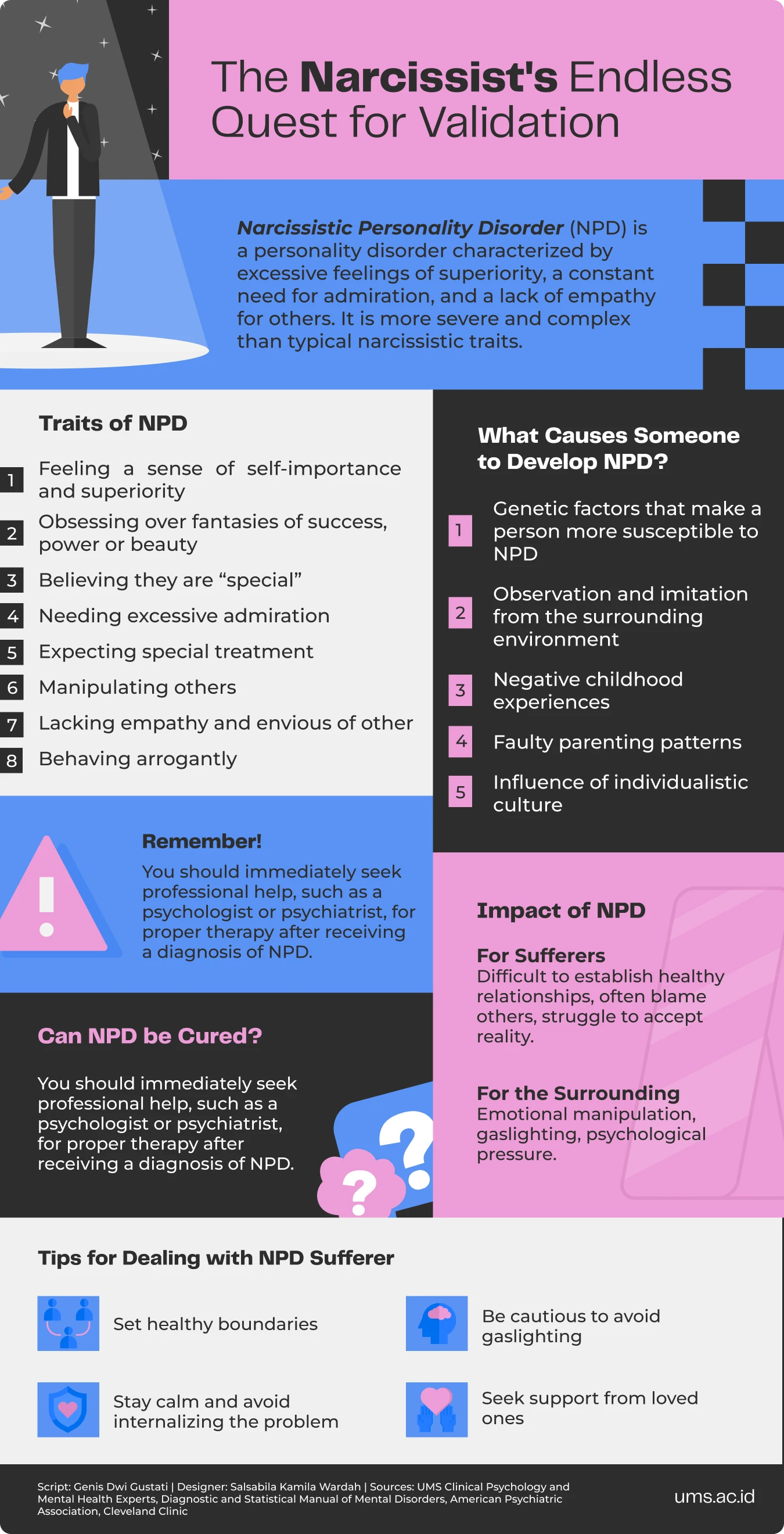
The Cleveland Clinic reported that the exact cause of NPD is still unidentified. However, several factors contribute to the development of this disorder. These include, genetic predisposition that can make a person more susceptible to NPD,
observation and imitation from their surrounding, negative childhood experience (trauma, rejection, and lack of support during childhood), overprotective or helicopter parenting, lastly growing up in a more individualistic culture.
“For example, parenting that is too indulgent or, conversely, overly strict, and the individualistic culture found in school environments, workplaces, and beyond,” said Fiska.
NPD is a chronic personality disorder that cannot be cured. However, various therapeutic methods can help individuals manage their symptoms.
“It can be through Cognitive Behavioral Therapy (CBT), Dialectical Behavioral Therapy (DBT), or family therapy, along with appropriate medical treatment. These therapies focus on helping individuals recognize negative thought patterns and behaviors, and they work on developing healthier habits in interacting with others,” she explained.
The effects of Narcissistic Personality Disorder (NPD) are extensive, impacting those around the narcissists.. Interacting with someone who has NPD requires a thoughtful and cautious approach. Establishing healthy boundaries and staying calm are essential to protecting yourself from emotional manipulation.
Although she has never faced a patient diagnosed with Narcissistic Personality Disorder (NPD), the BKPP UMS psychologist shared her experiences from interacting with individuals who exhibit tendencies toward the disorder.
“They crave validation more than anything else. Because they believe they are special, they expect others to cater to them,” she said.
People with Narcissistic Personality Disorder can often be highly manipulative and challenging to handle. However, they still need support and understanding.
“One thing is certain, don’t take it personally, so you don’t end up feeling hurt or worthless,” Fiska advises.
The next crucial step in dealing with narcissistic individuals is to prioritize your well-being. Protect yourself from falling into the trap of gaslighting, a subtle form of manipulation often used to make you doubt your beliefs and feel guilt that isn’t yours to carry.
Gaslighting is a common tactic used by those with NPD to maintain emotional dominance. This is why it’s essential to seek support from trustworthy people around you. Their support helps you maintain emotional balance and stay grounded in reality.
In other words, it’s important to decide when to walk away to avoid getting caught up in destructive dynamics. Given the complexity of Narcissistic Personality Disorder, it’s crucial not to neglect our mental health, even when trying to manage a relationship with someone who suffers NPD.
Writer: Genis Dwi Gustati
Editor: Al Habiib Josy Asheva
Translator: Farizal Luqman Majid
Sheep dunged nutrient-rich organic fertilizer for plants, made with the help of maggots. Built on community empowerment and a zero-waste principle.
Nothing’s more special than reading curated news just for you.
Subscribe to the UMS Newsletter for free today.