
How Sheep Manure Turns into Nutrient Rich Fertilizer
16 July 2026
Sheep dunged nutrient-rich organic fertilizer for plants, made with the help of maggots. Built on community empowerment and a zero-waste principle.




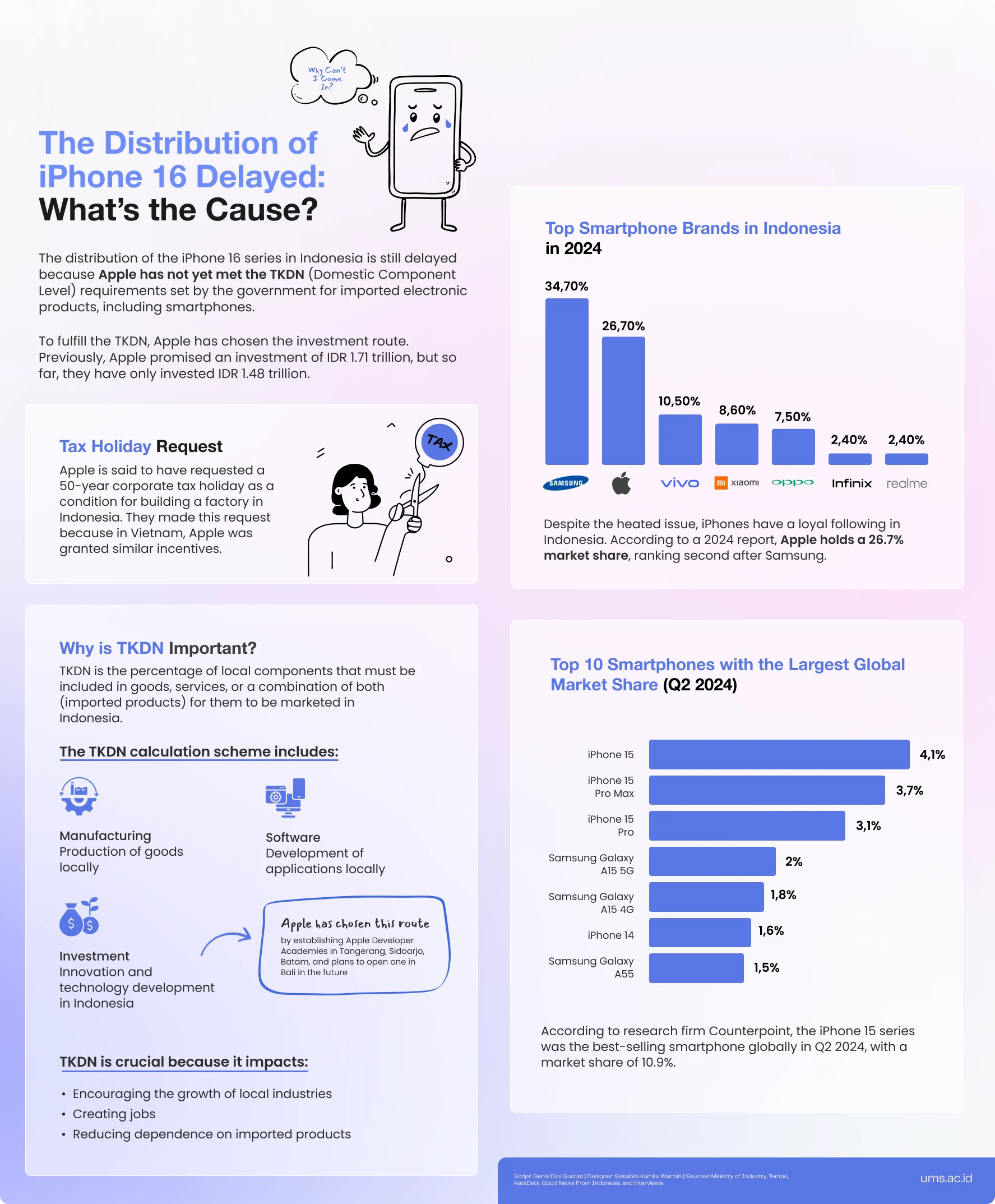
Apple officially launched the iPhone 16 series globally on September 10, 2024. Typically, the latest iPhone models enter the Indonesian market about two months after their global debut at the Apple Event. However, as of now, there are no signs of the iPhone 16's arrival in Indonesia. Fans in the country will have to wait, as the new Apple device has yet to be listed on the official TKDN (Domestic Component Level) page of the Ministry of Industry (Kemenperin).
According to Goodstats data, iPhone has a significant following in Indonesia. In its 2024 report, Apple held a market share of 26.7%, ranking second after Samsung. Although the launch is still pending, the device is eagerly awaited by most of Indonesian
The delay in the distribution of the iPhone 16 is not without reason. It relates to Apple's failure to meet the TKDN requirements, which are mandatory for foreign products to be marketed in Indonesia. The government requires that imported products, especially electronic devices, meet the TKDN requirements as part of its commitment to developing the local industry.
To better understand the implications of this policy, we spoke with Akbar Pratama Kartika, S.E., M.S.E., a lecturer in Development Economics at Universitas Muhammadiyah Surakarta (UMS), who shared his perspective on the iPhone 16 TKDN issue.
“Based on the news I’ve read, the government is not banning the iPhone 16, but delaying its distribution. It will be allowed once Apple obtains the TKDN certificate by fulfilling its commitment to invest in Indonesia,” Akbar clarified.
TKDN refers to the percentage of local components that must be included in goods, services, or a combination of both (imported products) in order to be marketed in Indonesia. Akbar explained that the main goal of TKDN is to stimulate the growth of local industries, create job opportunities, and reduce dependence on imported products.
“With the TKDN requirement, products circulating in the local market will support the domestic supply chain. This aligns with the government's policy of stimulating the development of domestic industries,” explained the international trade expert.
TKDN is calculated by comparing the value of finished goods with the value of components sourced from abroad. The value of the finished goods can be obtained through the price provided by the seller or supplier, or calculated based on production costs. Meanwhile, the value of foreign components is calculated based on information from suppliers or calculated through the percentage of imports and the prices of components in the international market.
According to Minister of Industry Regulation No. 29 of 2017 on Calculating the Domestic Component Level for Mobile Phones, Handheld Computers, and Tablet Computers, Apple must fulfill investment commitments for the iPhone 15 to be sold in Indonesia. This can be achieved through one of three programs: establishing a manufacturing facility, supporting innovation, or developing an application program.
Apple has chosen the third scheme, which involves investment through the establishment of the Apple Developer Academy, a technology education center focused on application development in Indonesia. Currently, these academies are located in Tangerang, Sidoarjo, and Batam.
“Through this investment, Apple is expected to demonstrate its commitment to technology development in Indonesia. According to the Minister of Industry's explanation, the minimum target is 40% of the total investment agreed upon,” Akbar explained.
Referring to data released by Tempo, the Minister of Industry, Agus Gumiwang Kartasasmita, stated that Apple has invested Rp 1.48 trillion out of the Rp 1.71 trillion commitment. This means that there is still a shortfall of about Rp 240 billion that must be fulfilled by the American tech giant before its latest device can receive the TKDN certificate.
“After they fulfill that commitment, we will issue a permit for them to sell the iPhone 16. This is all based on fairness for investors who have already committed to making high investments in Indonesia,” said Agus to Tempo (29/10/2024).
Previously, Apple had received the TKDN certificate, but its validity has expired. They need to renew the certificate, which must be accompanied by proof of Apple's investment in Indonesia, a condition that has not yet been met.
Akbar added that the TKDN policy is not just about restricting imported products, but also a strategic move by the government to encourage foreign investment, particularly in the manufacturing sector, which can stimulate technology transfer to Indonesia.
“With the TKDN, big companies like Apple must collaborate with local industries. Apple should not just build schools or academies, they should build factories! Building academies is relatively small investments for a giant company like Apple,” he protested.
Additionally, a recent issue that has sparked controversy is Apple's request for a 50-year tax holiday (a tax exemption to encourage long-term investment) if it is required to build a factory in Indonesia. Tax holidays are typically given to encourage new investments. However, this extreme request has raised public questions.
According to KataData, Apple has already started manufacturing iPhones by building a large factory in Vietnam, with an investment of over $270 million, taking advantage of incentives such as a 50-year tax holiday and free land. This decision has reinforced Vietnam's position as one of Apple's key production hubs in Asia, especially within the global supply chain. With such attractive incentives, Vietnam has become a more competitive option than Indonesia, which has not offered a similar scheme.
“This seems to show that Apple may not prioritize Indonesia as an important part of its production chain. To put it bluntly, sorry, it feels like modern-day colonization,” Akbar criticized.
Akbar emphasized that the 50-year tax holiday request is a strong signal for the Indonesian government to be more assertive in negotiations with foreign investors. “If one company is given the green light for such a large tax exemption, it's not impossible that other companies will demand the same,” he expressed with concern.
Drawing from the experiences of other tech companies, Akbar explained that for a company like Apple, they should not need much time to fulfill the TKDN requirements. This issue is simply about Apple's commitment to investing in Indonesia. He also mentioned that the government needs to monitor the company's commitment continuously, so that the fulfillment of TKDN is not just completed in the initial phase.
Overall, the lecturer in Development Economics at UMS believed that TKDN is a positive step by the government to encourage investment and the development of local industries, although there is still room for improvement.
In the case of the iPhone 16, he emphasized the importance of the government being firm in implementing the TKDN policy. According to him, consistency in enforcing this regulation is not just aimed at Apple but at all foreign companies that wish to market their products in Indonesia.
“The government must show firmness in enforcing this regulation,” he said. He reminded that inconsistency in applying TKDN will only cause confusion and uncertainty among investors.
The lecturer for Investment Theory and Capital Markets also suggested that the government be more cautious when accepting investment proposals from giant company like Apple. “Apple's investment proposal is still relatively small compared to their capacity as a giant company. Indonesia needs skilled negotiators who understand the value of a fair investment,” he stated.
He added that the government needs to send a skilled negotiation team to ensure the discussions benefit Indonesia.
“For now, I really appreciate Indonesia's firm stance in prohibiting the circulation of the latest iPhone. Although we know there are a lot of iPhone enthusiasts in our country,” Akbar added. As both a consumer and an Indonesian citizen, he hoped that Apple takes its investment seriously, not just enjoying the market without providing significant contributions.
Writer: Genis Dwi Gustati
Editor: Al Habiib Josy Asheva
Translator: Farizal Luqman Majid
Sheep dunged nutrient-rich organic fertilizer for plants, made with the help of maggots. Built on community empowerment and a zero-waste principle.
Nothing’s more special than reading curated news just for you.
Subscribe to the UMS Newsletter for free today.