
How Sheep Manure Turns into Nutrient Rich Fertilizer
16 July 2026
Sheep dunged nutrient-rich organic fertilizer for plants, made with the help of maggots. Built on community empowerment and a zero-waste principle.



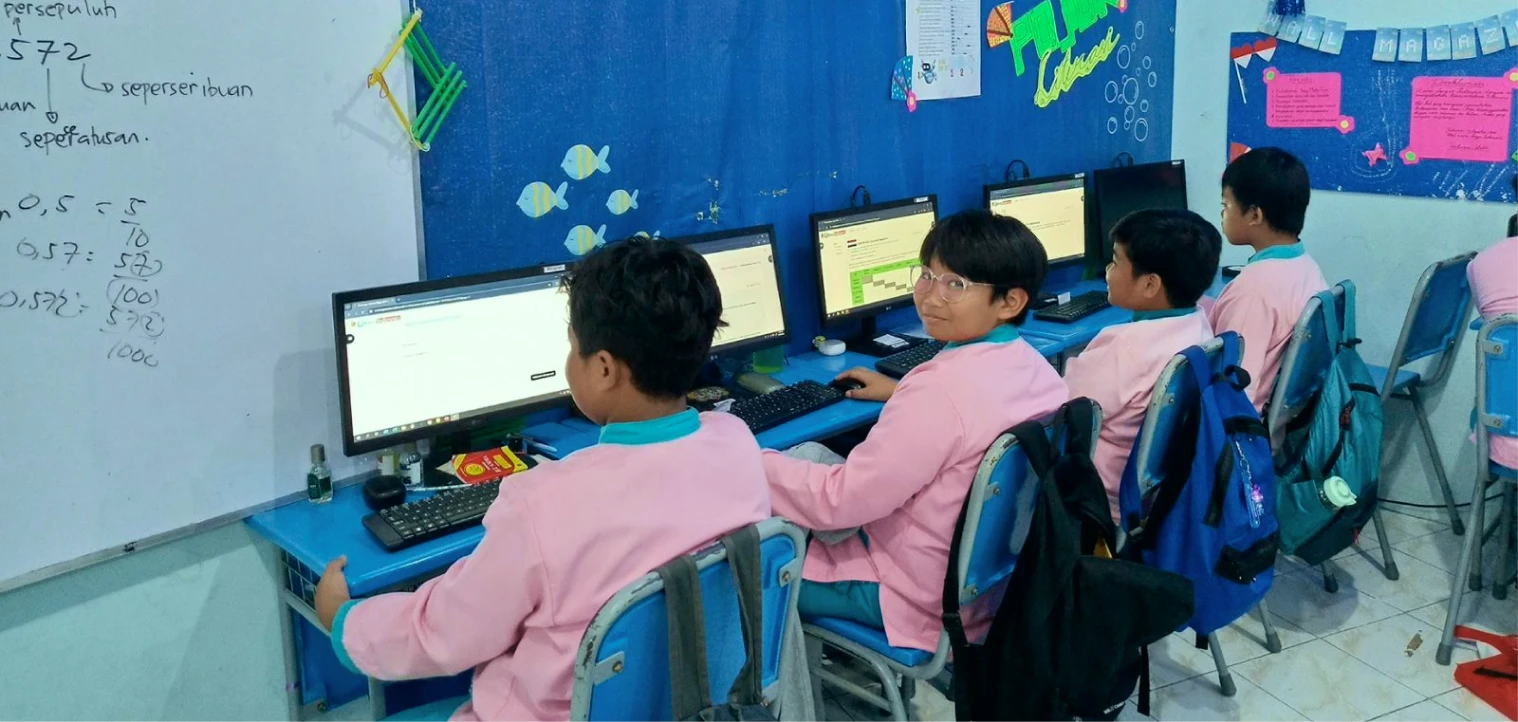
The government's plan to introduce artificial intelligence (AI) and coding as elective subjects starting from elementary school has sparked significant discussion among experts and the general public.
According to a report by Kompas.com, this idea was initially suggested by the Vice President Gibran Rakabuming Raka during the Coordination Meeting on Education Policy Evaluation in Jakarta on Monday (11/11/2024). The reason behind the proposal was to ensure Indonesian students remain competitive, particularly when compared to their Indian counterparts.
The suggestion has ignited debate on social media. For instance, on platform X, user @istbrhn, argued that elementary school students are not yet ready to study coding and AI.
“It’s clearly beyond their grasp. Computational thinking might work, perhaps some basic website or block code robotics. But AI? That’s far off. It’s better to focus on strengthening their foundational knowledge first,” tweeted @istbrhn on Tuesday (12/11/2024).
Arif Setiawan, S.Kom., M.Eng., the Head of the Informatics Education Program at Universitas Muhammadiyah Surakarta (UMS), viewed the initiative as positive given the rapid technological advancements. However, he believed teaching coding to elementary students is premature.
“It’s not a bad idea, but it needs thorough consideration. Elementary school focuses on fundamentals, while coding and AI are advanced topics. Perhaps these can be introduced at middle or high school levels,” Arif explained on Monday (18/11/2024).
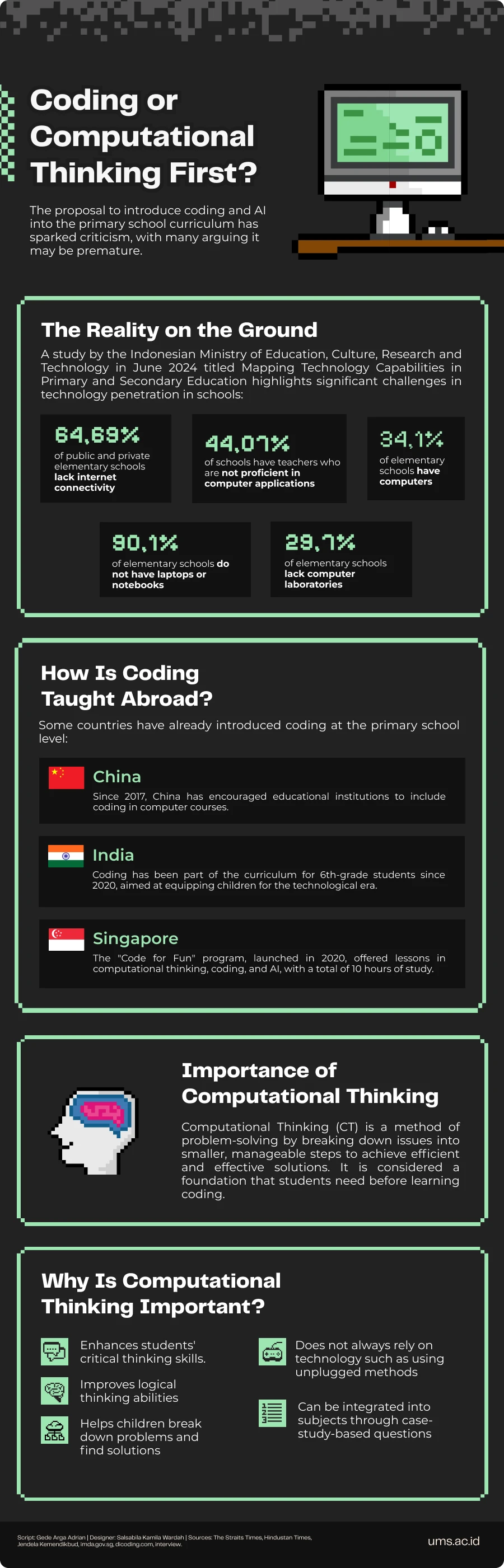
There are also practical challenges, including the lack of coding-proficient teachers and unequal technological access across Indonesia's elementary schools. According to Arif, addressing these issues is critical before coding can be introduced effectively at this level.
Irma Yuliana, S.T., M.M., M.Eng., a computational thinking expert from UMS, emphasized the importance of foundational skills such as numeracy, English proficiency, and logical reasoning. These basics, she noted, are essential for elementary students to understand coding.
Regarding the proposal to include AI as a subject in elementary education, Irma has expressed that it is premature to teach AI at this level. She emphasized the necessity of a deeper understanding of AI ethics and the need to clearly define whether students would be positioned as users or developers of AI technology.
She highlighted the risks and challenges of introducing AI to young learners, particularly the potential for dependency on AI for instant answers. Elementary students, she argued, may lack the ethical grounding required to navigate the consequences of using AI tools.
“When we ask something of AI, we are essentially training the AI system, not developing human intelligence. This poses risks, making it essential to understand the implications of AI usage,” Irma explained on Tuesday (19/11/2024).
The idea proposed by Vice President Gibran is not entirely new. Several countries have already introduced coding and AI education to elementary school students. Since 2017, China has encouraged educational institutions to incorporate coding into computer science subjects, as reported by The Straits Times
By 2018, some regions in China began mandating coding lessons in elementary schools. For instance, the Chongqing Municipal Education Commission issued a directive requiring local elementary students to complete 36 hours of coding lessons. The directive also stipulated that every school must employ at least one full-time coding teacher.
In the same year, Zhejiang Province included information technology as an elective subject in the national college entrance exams, with a strong emphasis on programming.
In Southeast Asia, Singapore has also integrated coding into its elementary school curriculum. According to imda.gov.sg, coding has been a mandatory subject for students in grades 4 to 6 since 2020.
This initiative, called “Code for Fun,” was developed by Singapore's Ministry of Education and the Infocomm Media Development Authority. Students are introduced to computational thinking, coding, and AI over a total of 10 learning hours, using robots and/or microcontrollers as learning tools.
Similarly, India adopted a new policy in 2020 that included coding as part of elementary education. As reported by Hindustan Times, coding is now taught to students starting from grade 6.
The Indian Ministry of Education believes that coding aids in the holistic development of children’s brains, fostering logical thinking, analytical skills, and creativity through the integration of art, mechanics, and problem-solving. The subject is also seen as a gateway for children to adapt to emerging technologies and create their own applications and games.
Irma Yuliana noted that introducing coding and AI into elementary school curricula requires thoughtful planning. These subjects demand reasoning skills and the development of logical thinking, which can be nurtured through computational thinking.
“It cannot be implemented immediately, as we need to ensure the availability of qualified teaching staff, appropriate materials, and supporting infrastructure,” Irma said.
Read more: On the Crossroad of Kurikulum Merdeka
Computational thinking is a method of solving problems by breaking them down into smaller, manageable parts or steps that are both effective and efficient, aiming to achieve optimal and contextual outcomes. It is a process of problem-solving and creating solutions by thinking like a computer scientist, rather than thinking like a computer.
According to dicoding.com, computational thinking is a method designed to solve problems through humans, systems or both.
“With computational thinking, individuals can model problems effectively, identify the core issue, and formulate solutions,” explained the Doctor in Educational Technology and Vocational Education from Universitas Negeri Yogyakarta.
Teaching computational thinking to elementary students is essential before introducing them to coding and AI. This process develops logical and critical thinking skills that are key to tackling complex problems.
Although not explicitly labeled in the current curriculum, some elementary schools have computational thinking concepts integrated into subjects like mathematics. For example, word problems in math encourage students to develop critical reasoning by solving real-world scenarios.
One mathematical theory that supports computational thinking is graph theory, which studies sets of points connected by lines. Graph theory is fundamental to applications like digital maps, such as Google Maps. A practical exercise might involve students determining the shortest distance from their home to school on a map, helping them apply computational methods to everyday situations.
Another way to teach computational thinking is through the unplugged method. For instance using a random number card sorting game where students are given a set of randomly shuffled number cards and tasked with sorting them from smallest to largest. This can be achieved using the bubble sort algorithm, where they compare adjacent cards, swap them if they are out of order, and repeat the process until the cards are fully sorted.
The other game is the orange game. In this activity, groups of five children each hold two fruits of different types, except for one child who holds only one type of fruit.
The fruits are distributed randomly, and the goal is for every child to end up holding fruits of the same type. This is achieved by “passing” fruits by skipping over a neighboring fruit, which simulates the concept of a bottleneck often encountered in network systems.
Computational thinking skills can also be cultivated through everyday life activities. For example, tasks such as analyzing queue systems or organizing stacked items teach children logical reasoning while also instilling social etiquette.
“Children can learn about data structures like queues or stacks, for instance, in a queue, children understand the first in, first out principle,” said Irma. “This method is part of the semantic wave approach, which simplifies abstract concepts into tangible lessons for children.”
Irma, who serves as the Coordinator of Bebras PTI UMS Bureau, emphasized the importance of initiatives like the Bebras Challenge, an annual competition designed to test and enhance computational thinking.
Based on her observations, these skills often lead to improved discipline among children. “Parents of participants in the Bebras Challenge have shared how their children became more logical,” Irma said.
Computational thinking helps children grasp the importance of managing their time effectively, such as waking up early and getting ready early to avoid being late for school. “For instance, if you leave the house at a certain time, you might get stuck in traffic at location X. Therefore, leaving earlier helps you avoid the traffic,” Irma shared feedback from a parent.
However, integrating computational thinking into education comes with significant challenges. Irma, a national speaker providing technical guidance on informatics for middle school teachers under the Directorate General of Teachers and Education Personnel (GTK) at the Ministry of Primary and Secondary Education, often finds that many technology and communication teachers lack a background in informatics.
“These teachers are allowed by GTK to teach mandatory informatics subjects at middle and high schools,” she explained. “But if there’s already a shortage of qualified teachers for those levels, what about elementary school
“The main issue lies with human resources. Not all teachers are familiar with computational thinking,” Irma noted. “They are still focused on the subject matter itself and haven’t advanced to teaching computational thinking.” This situation makes the government's proposed policy seem rushed and disconnected from realities.
Irma suggested that the government must address the welfare and quality of educators, as well as ensure adequate infrastructure and resources in schools, before introducing coding as a subject. By doing so, the curriculum for coding could potentially be implemented effectively nationwide. If successful, Indonesia could realize its aspiration to rival Indian students in technological competencies.
Writer: Gede Arga Adrian
Translator: Farizal Luqman Majid
Editor: Al Habiib Josy Asheva
Sheep dunged nutrient-rich organic fertilizer for plants, made with the help of maggots. Built on community empowerment and a zero-waste principle.
Nothing’s more special than reading curated news just for you.
Subscribe to the UMS Newsletter for free today.