
How Sheep Manure Turns into Nutrient Rich Fertilizer
16 July 2026
Sheep dunged nutrient-rich organic fertilizer for plants, made with the help of maggots. Built on community empowerment and a zero-waste principle.




Hantavirus has been the subject of widespread discussion in recent days, after an outbreak was reported aboard the MV Hondius cruise ship sailing from Argentina. Three people died from hantavirus on board.
Two suspected hantavirus cases were detected in Jakarta and Yogyakarta last week. Although the Ministry of Health confirmed that both suspected cases tested negative for hantavirus, the news had already generated considerable noise on social media.
Health Minister Budi Gunadi Sadikin said he has coordinated with the World Health Organization (WHO) to anticipate further spread of the virus.
"We have already coordinated with WHO. We asked for guidance on how to conduct screening, but the input we received indicates that the cases are still concentrated on that ship. So it has not spread anywhere else," Budi said, as quoted on Tuesday (13/5/2026).
Hantavirus is a virus that originates from rodents, such as rats and mice, which serve as its primary reservoir. Hantavirus first infected humans during an outbreak of Korean hemorrhagic fever among United Nations troops during the Korean War from 1951 to 1954.
A microbiology lecturer at the Faculty of Medicine, Universitas Muhammadiyah Surakarta, dr. Listiana Masyita Dewi, M.Sc., explained that hantavirus is divided into two major groups: old world hantaviruses and new world hantaviruses.
"Simply put, this grouping is based on clinical manifestations and distribution. These two are the two major groups," said the lecturer commonly known as Syita, Tuesday (13/5/2026)
Old world hantaviruses are predominantly found in Asia and Europe. This type can cause Hemorrhagic Fever with Renal Syndrome.
Strains in this group include Hantaan virus, Seoul virus, Puumala virus, and Dobrava-Belgrade virus. The Seoul virus strain is commonly found in Indonesia.
New world hantaviruses, on the other hand, are predominantly found in North and South America. This type can cause Hantavirus Pulmonary Syndrome. Strains in this group include Sin Nombre virus, Andes virus, Laguna Negra virus, and Black Creek Canal virus.
Hantavirus can be transmitted through several routes.
1. Inhaling airborne particles or aerosols
Transmission can occur when the urine, feces, or saliva of an infected rodent dries out. Viral particles can become airborne along with dust and infect humans who inhale them.
2. Direct Contact
Transmission can occur if a person touches the urine, feces, or nesting materials of an infected rodent and then touches their face without first washing their hands.
3. Rodent bites
Although extremely rare, a bite from an infected rodent can introduce hantavirus directly into the human bloodstream.
4. Consuming contaminated food
Food contaminated by rodents carrying hantavirus poses a health risk if consumed by humans.
Can hantavirus spread from person to person?
Person-to-person transmission of hantavirus is extremely rare. dr. Syita explained that human-to-human transmission has been reported in cases of Andes hantavirus infection, occurring in South America, particularly in Argentina and Chile.
Transmission is believed to occur through close contact with a patient's bodily fluids or droplets during the early stage of illness, for example among family members or healthcare workers providing close care to a patient.
"Most other types of hantavirus, such as Sin Nombre virus or Hantaan virus, have not been shown to spread between humans and are generally transmitted directly from rodents to humans," she explained.
Syita added that hantavirus is not limited to tropical regions and can be found across various parts of the world, including temperate and cold climates.
"Its spread is more determined by the presence of reservoir rodents than by tropical climate alone," she continued.
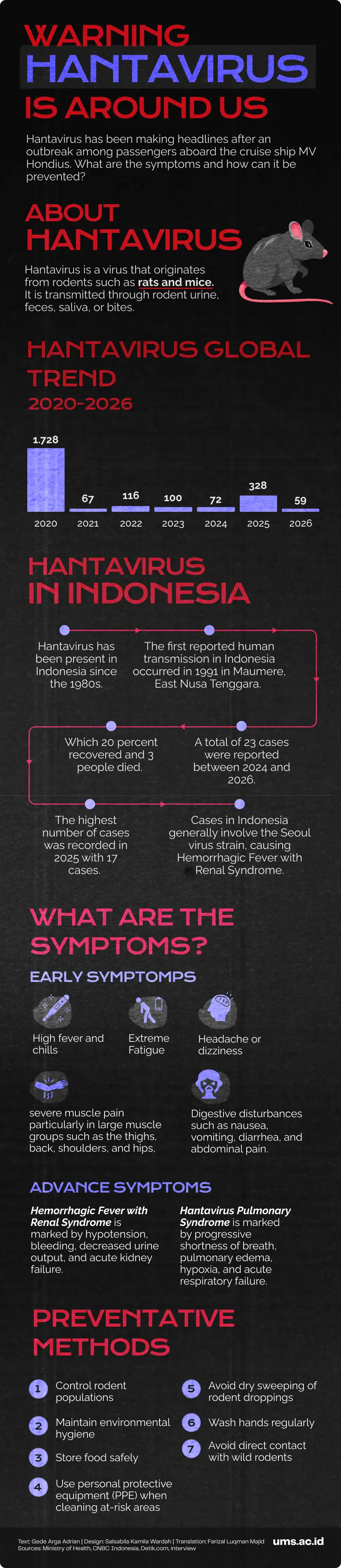
Hantavirus symptoms can appear after an incubation period inside the body. Syita noted that the incubation period typically lasts between one and eight weeks.
Early symptoms of hantavirus occur during the first one to five days, a phase referred to as flu-like syndrome. "This is because the symptoms resemble those of a general viral infection, similar to what is seen in the early stages of influenza," Syita said.
Early symptoms of hantavirus include:
Advanced hantavirus symptoms differ depending on the type of virus. In Hemorrhagic Fever with Renal Syndrome (HFRS), the advanced phase of the disease is marked by prominent kidney complications resulting from increased vascular permeability.
Patients may experience hypotension, bleeding, decreased urine output (oliguria), and acute kidney failure. In severe cases, shock and fluid and electrolyte imbalances can occur.
In Hantavirus Pulmonary Syndrome (HPS), the advanced phase is characterized by severe respiratory distress caused by capillary leakage in the lungs. Patients experience progressive shortness of breath, pulmonary edema, hypoxia, and acute respiratory failure that can develop rapidly within a short period and often requires mechanical ventilation.
Can hantavirus cause death?
Syita explained that hantavirus can be fatal. Deaths can occur when a hantavirus infection progresses to HFRS or HPS.
"In HFRS, death is generally caused by shock from vascular leakage, severe bleeding, acute kidney failure, electrolyte disturbances, or multi-organ complications," she explained.
In severe cases, hypotension and circulatory failure can progress to fatal organ failure. The mortality rate for HFRS varies depending on the type of hantavirus involved. Puumala virus infection typically carries a low mortality rate of under one percent, while Hantaan virus and Dobrava virus can reach around 5 to 15 percent in severe cases.
"For HPS, death can occur due to acute respiratory failure and shock, with a mortality rate that can reach around 30 to 40 percent," Syita added.
Hantavirus may be a cause of concern for some people, but the spread of the virus can still be controlled through a number of measures.
Ways to prevent hantavirus transmission include the following.
1. Controlling rodent populations
This can be done by sealing holes and gaps in the houses and setting traps to prevent rodents from entering living areas.
2. Maintaining environmental hygiene
This involves clearing away leftover food, waste, and damp areas that can serve as habitats for rodents.
3. Storing food safely
Food and water should be kept in sealed containers to prevent contamination from rodent urine or feces.
4. Using personal protective equipment (PPE) when cleaning at-risk areas
Wearing a mask and gloves when cleaning storage rooms, attics, or areas with high rodent activity is strongly recommended.
5. Avoiding dry sweeping of rodent droppings
Droppings should first be sprayed with disinfectant to prevent viral aerosols from being inhaled.
6. Washing hands after contact with at-risk environments
Handwashing helps reduce the likelihood of the virus entering the body through the mouth, nose, or eyes.
7. Avoiding direct contact with wild rodents
Direct contact with both live and dead rodents is best avoided, as both can serve as sources of hantavirus transmission.
Concern over the spread of hantavirus has been spreading across social media. On platform X, a number of users have expressed worry that hantavirus could become a global pandemic. Even so, Syita urged the public to remain calm.
The risk of hantavirus becoming a global pandemic is currently considered low, as most hantavirus strains do not spread easily between humans. "Transmission primarily occurs from rodents to humans," she stressed.
Unlike respiratory viruses such as SARS-CoV-2, which spread through the air, hantavirus transmission generally requires close exposure to the urine, feces, or saliva of an infected rodent.
"This case went viral because many media outlets and social media platforms compared it to the early days of the Covid-19 pandemic. The outbreak also occurred on a cruise ship and involved cross-border passenger tracing," Syita continued.
That said, Syita emphasized the importance of staying alert to certain types of hantavirus, such as Andes hantavirus, given its capacity for human-to-human transmission through close contact.
Other factors worth monitoring include climate change, urbanization, and growing rodent populations, all of which have the potential to increase the risk of localized outbreaks in the future.
Syita encouraged the public to recognize the symptoms of hantavirus, both in themselves and in those around them. Particular attention should be paid if someone develops acute fever accompanied by severe muscle pain, headache, nausea, or shortness of breath following a history of rodent exposure or contact with a rodent-contaminated environment.
"Suspicion increases further if advanced-phase symptoms appear, such as progressive shortness of breath pointing toward HPS, or a decrease in urine output and signs of bleeding pointing toward HFRS," she said firmly.
Writer: Gede Arga Adrian
Translator: Farizal Luqman Majid
Editor: Al Habiib Josy Asheva
Sheep dunged nutrient-rich organic fertilizer for plants, made with the help of maggots. Built on community empowerment and a zero-waste principle.
Nothing’s more special than reading curated news just for you.
Subscribe to the UMS Newsletter for free today.