How Sheep Manure Turns into Nutrient Rich Fertilizer
16 July 2026
Sheep dunged nutrient-rich organic fertilizer for plants, made with the help of maggots. Built on community empowerment and a zero-waste principle.


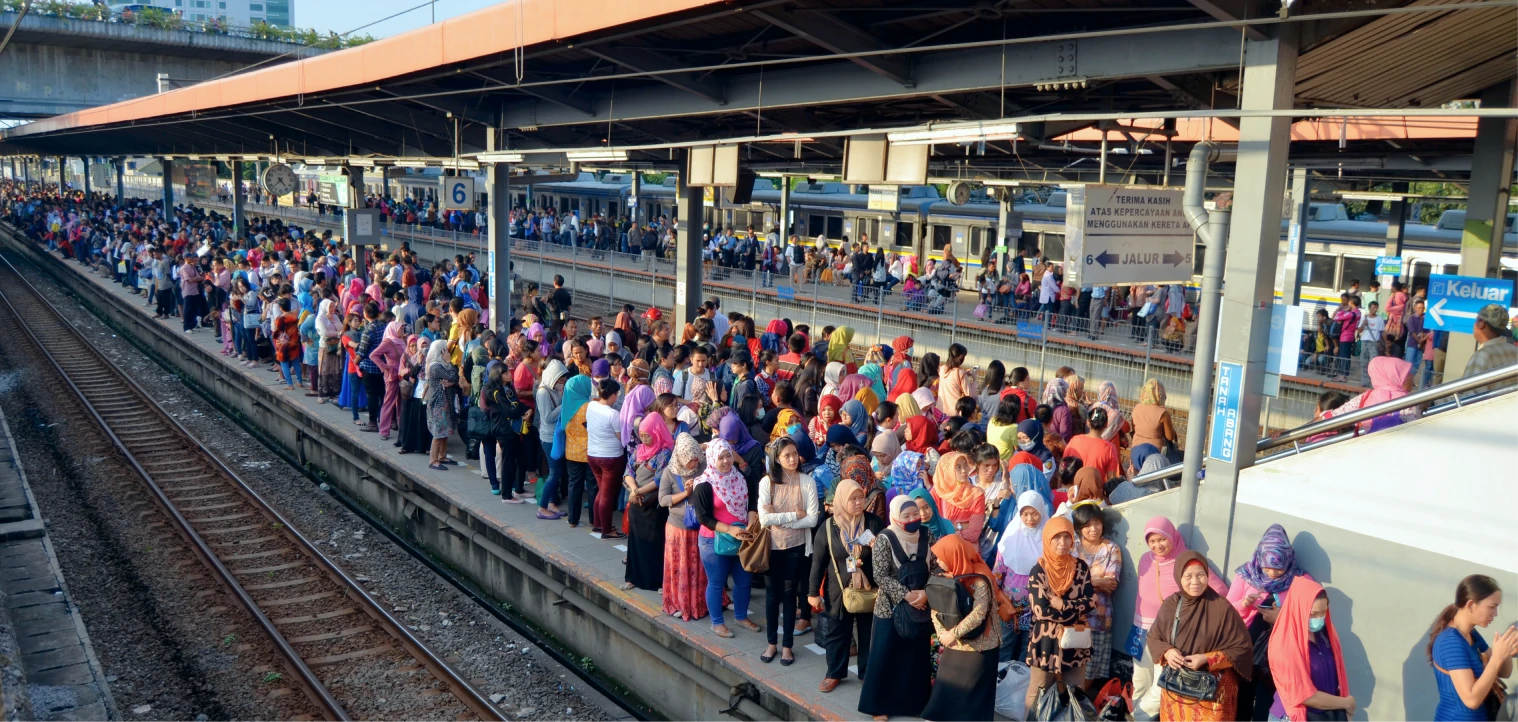
Jabodetabek KRL users may soon face increased travel expenses. According to Book II of the Financial Note and the Draft State Budget for 2025, the government is planning to introduce a fare subsidy scheme for KRL based on the national identification number (NIK).
The policy, which gained attention at the end of August, sparked an outcry among netizens. Social media platforms like Twitter (X) were flooded with harsh criticism. Many users argued that the policy would place an additional burden on the middle class, who rely on KRL as a primary mode of transportation for their daily mobility.
“Public transportation should be accessible to people of all economic levels. Those in more established economic positions need to be encouraged to use public transport. If public transportation becomes less attractive, they will easily switch to private vehicles,” tweeted Insan Ridho on his X account @insanridho, Wednesday (28/8/2024).
A similar sentiment was shared by the Anak Kereta (Anker) Community, which urged the need for a deeper evaluation of the policy. “From the perspective of regular KRL users, this policy is clearly burdensome. It requires thorough study and careful planning, considering various aspects such as legal, social, economic, and technological factors," tweeted the Anak Kereta Community on its X account @AnkerTweet, Friday (30/8/2024).
Muhammad Arif, S.E., M.Ec.Dev., a regional economic expert from Universitas Muhammadiyah Surakarta (UMS), believes that all subsidies, including KRL fare subsidy, must be distributed proportionally. He emphasized that subsidy should not be reduced without conducting a thorough study on alternative schemes. It is an open secret that KRL fare subsidy have played a key role in encouraging public transportation use, which has positively impacted labor mobility, particularly in the Jabodetabek area.
According to Muhammad Arif, subsidized mass transportation could lift up a community's economic burden and help alleviate congestion in urban areas. “Congestion is costly. When stuck in traffic, fuel consumption rises, including the consumption of subsidized fuel,” Arif explained. “The primary goal of subsidizing the KRL is to reduce Jakarta's reliance on private vehicles.”
One of the options proposed by Arif is to shift part of the fuel subsidy to KRL fare subsidy. However, we need to strike a balance between fuel and KRL fare subsidy. Fuel subsidy are crucial for ensuring the smooth distribution of goods, while KRL fare subsidy are essential for supporting service distribution and labor mobility.
It remains unclear which groups will face the subsidy cuts under the new fare policy. Muhammad Arif proposed two potential schemes the government might implement: one based on the location of the individual's KTP (ID card), and the other based on whether the individual is already a beneficiary of government assistance programs.
Both schemes present significant challenges if implemented. The first scheme, which would provide a special fare subsidy only for residents with Jabodetabek KTP, is seen as ineffective. The lecturer from Development Economics progam pointed out that the majority of Jabodetabek residents are migrants who still hold KTP from their home regions. This approach would be problematic, as it assumes that all non-Jabodetabek KTP holders are financially stable, which is not necessarily true.
This scheme is seen as flawed because it could result in discrimination and unfairness in the distribution. People who live and work in Jabodetabek but have KTP from other regions would not benefit from the subsidies. Nevertheless, those with Jabodetabek KTP who no longer live in the area would be the receiver yet they are not entitled.
The second scheme involves implementing special subsidies for targeted beneficiaries. This approach has been widely promoted by the government, as it aims to ensure that subsidies are directed specifically to those in need, particularly the poor, making the distribution more effective and targeted.
However, the second scheme has probably been confusing as well. He pointed out that the average KRL user consists of formal sector workers, mostly from the middle class. “Most low-income individuals work in the informal sector and rarely use KRL services for their businesses,” said the researcher from the Center of Economic Development.
He suspects that the effort to cut KRL subsidies might be a government's covert way to reduce overall subsidies for the public. He points to several mega projects, such as the Nusantara Capital City and the Jakarta-Bandung high-speed train, as evidence of this shift in focus.
Amid rising prices of basic commodities, which are eroding income due to inflation, Arif urged the government to conduct a thorough study and rely on accurate data before implementing the NIK-based KRL fare subsidy policy.
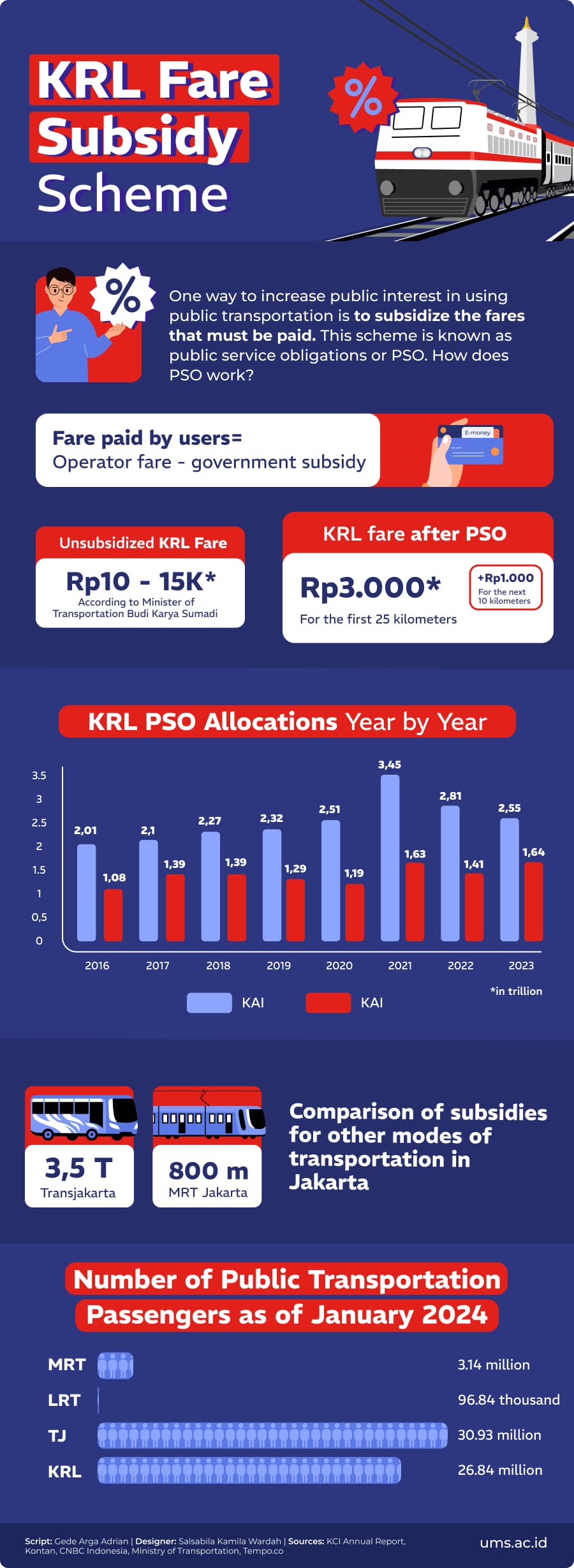
KRL fares have remained unchanged since the last increase in 2016, with passengers paying Rp3,000 for the first 25 kilometers and Rp1,000 for each additional 10 kilometers. This relatively affordable fare structure has contributed to KRL Jabodetabek achieving a record of 26.84 million passengers in January 2024.
The fare paid by KRL passengers is already subsidized by the state through the Public Service Obligation (PSO) scheme. According to Transportation Minister Budi Karya Sumadi in an interview with Kompas TV on Friday (30/12/2022), if the KRL were not subsidized, passengers would have to pay between IDR 10,000 and IDR 15,000 for a one-way trip.
Budi mentioned that the rise in operational costs hasn’t been matched by an increase in tariffs. If this situation isn’t addressed, it could lead to a significant increase in PSO (Public Service Obligation) subsidies from the government, which would put a strain on the state budget.
When asked about the fare increase, Arif stated that any increase should be accompanied by improvements in KRL services. These improvements should include better departure schedules, upgraded facilities, enhanced infrastructure, and improved travel headways. Currently, KRL services are struggling with limited train facilities and travel headways that lead to congestion at certain transit stations, such as Manggarai Station.
“If there is no improvement in quality and service, it will be impossible for the public to accept (the fare increase),” Arif explained.
The rejection was also voiced by Assoc. Prof. Dr. Ir. Zilhardi Idris, M.Eng., a transportation expert from UMS. He argued that providing a KRL fare subsidy is a way for the state to support its citizens. Affordable KRL fares, he said, are a fundamental right for all people. “Public transportation should be accessible to everyone, not just the rich or the poor,” Zilhardi emphasized on Thursday (12/9/2024).
The state should not divide public transportation subsidies based on NIK. This is because both wealthy and less affluent individuals contribute to the tax system in different ways. The poor pay value-added tax (VAT) on their daily necessities, while the wealthy are subject to higher income taxes. Thus, public transportation subsidies should be equitable for all, regardless of their economic status.
The proposed subsidy cut could lead to a higher proportion of transportation costs being shouldered by the public. According to the UMS Civil Engineering lecturer, transportation costs in Indonesia currently account for 10 to 20 percent of an individual's salary, which is relatively high. The World Bank suggests that spending on transportation should be around 10 percent of monthly income. “Ideally below 5 percent. Public transportation should be free and funded by the state,” he added.
Zilhardi acknowledges that public transportation in Jakarta still faces significant challenges. It struggles to compete with private vehicles in terms of accessibility and mobility. “Public transportation often feels like it's waiting at the bus stop, while private vehicles are always ready right outside the house,” he explained.
Ensuring easy accessibility to public transportation through equitable distribution of networks in the Jabodetabek area is an urgent priority. Not everyone in Jabodetabek has easy access to public transportation. For instance, many people need to use private vehicles or ride-hailing services to reach and return from KRL stations.
“In certain conditions, using public transportation can actually be more expensive than using private vehicles because you often need to switch between different modes of transport,” Zilhardi added.
According to the UMS Civil Engineering lecturer, train operating costs can be reduced with proper and efficient management strategies. “With better management, the fare passengers pay could be lower than IDR 10-15K for a one-way trip,” he added.
He also urged the government to distribute economic centers more evenly across different regions, rather than concentrating them in Java, particularly in the Jabodetabek area. According to him, one of the reasons for the heavy congestion in Jabodetabek is the influx of migrants from other regions, which has not been matched by improvements in public transportation to support their mobility. “All the candy and sweets are all in Java,” he remarked.
Transportation Minister Budi Karya Sumadi, as reported by Antara on Thursday (29/8/2024), stated that his team is currently conducting a study to ensure that all subsidized public transportation services are accessible to those who are eligible for the subsidies. “It’s still a discourse, still a study,” he said.
However, the debate over implementing NIK-based subsidy has generated considerable buzz and concern. The issue has heightened public anxiety, as there is a risk that expenses could increase if the new subsidy scheme is put into place.
Writer: Gede Arga Adrian
Editor: Al Habiib Josy Asheva
Translator: Farizal Luqman Majid
Sheep dunged nutrient-rich organic fertilizer for plants, made with the help of maggots. Built on community empowerment and a zero-waste principle.
Nothing’s more special than reading curated news just for you.
Subscribe to the UMS Newsletter for free today.